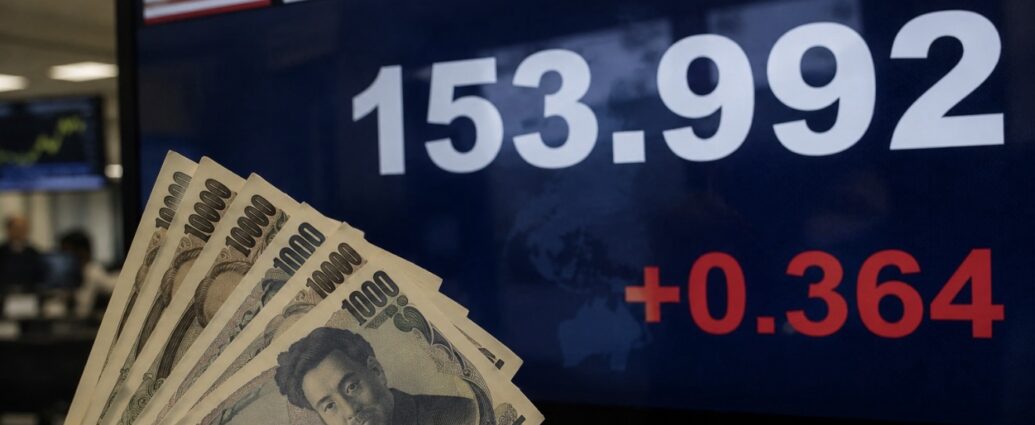
The yen was hovering around 159.36 per dollar on Thursday, back within sight of the 160 level that has historically signaled Tokyo may step into the market again. That leaves it having given up about half the gains from the rally that followed the record joint yen-buying operation Japan and the United States ran at the end of July. A senior analyst at Gaitame.com Research Institute noted the pair has now completed a 50% retracement of the intervention-driven decline, with the next technical target in the mid-160s.
The reason is not complicated, and it is the same reason the intervention was always going to be a holding action.
American interest rates sit at 3.5% to 3.75%. Japan’s policy rate is 1.0%. Money parked in dollars earns roughly three and a half times what money parked in yen earns. That gap pays a return every single day, to everyone, automatically. An intervention is a one-time purchase — governments spend reserves to buy yen, the price moves, and then the daily arithmetic resumes. Buying a currency once cannot outlast the reason people are selling it.
The scale of what was spent makes the point. Japan’s finance ministry reportedly sold as much as $59 billion to buy yen on July 30, when the currency sat at 40-year lows, and Tokyo and Washington later confirmed they had acted together — the first joint operation since 1998, with Treasury Secretary Scott Bessent and Finance Minister Satsuki Katayama both pledging to repeat it if needed. Other estimates put the Japanese side nearer $75 billion and the much smaller American operation somewhere between $5 billion and $10 billion. The yen began the year at 156 to the dollar, weakened to 163 by late July, strengthened to 157 after the intervention, and was back at 159 by Aug. 11. Tens of billions of dollars bought roughly a week.
Tokyo now appears to be reaching for the tool that actually addresses the gap. Prime Minister Sanae Takaichi’s government supports a near-term rate increase by the Bank of Japan, with September or October the likely timing, according to people familiar with the matter. The central bank is concerned that yen weakness is raising import prices and feeding inflation, and the government sees a rate move as reinforcing the intervention. The prime minister’s office said the choice of tools belongs to the BOJ’s judgment, and that the bank should work with the government toward stable 2% inflation. The BOJ’s summary of opinions from its July meeting flagged growing risks of faster inflation, with one board member suggesting the pace of hikes could quicken.
The yen firmed briefly on that report, to 159.18 from about 159.46, and then went nowhere. There has been little sign of the dollar-selling that a genuinely narrowing rate differential would produce, reflecting persistent underlying dollar demand and a widespread view that a single BOJ hike would not be enough to lift the currency. A quarter-point move against a gap of more than two and a half points does not change the trade.
What Washington got out of helping is worth spelling out, because it is unusual. Japan is the largest foreign holder of U.S. Treasuries, and one economist at Julius Baer wrote that the American motive was likely keeping Treasury yields stable by limiting pressure from Japanese selling. Analysts described the operation as an effort to stop a yen and Japanese government bond selloff from spilling over into already-rising U.S. yields. That makes the yen a borrowing-cost story for American companies, not just an exchange-rate story.
There is also a case that the framing itself is off. One analysis this month argued the yen market is not actually disorderly — volatility is not extreme, spreads are not gapping and business is getting done — and that what markets are really pricing is doubt about Japanese policy: an accommodative central bank fueling the carry trade, a bank that owns half of all Japanese government bonds, and an administration planning to expand spending on technology, defense and consumption. Japan’s dependence on imported energy makes the Iran war a further drag on the currency. Dollar-priced oil bought with a falling yen compounds both problems at once.
For businesses on this side of the Pacific, the practical read is that Japanese-made goods, components and machinery stay cheap in dollar terms, and that anyone selling into Japan keeps facing a customer whose purchasing power is shrinking. The weak yen is squeezing Japanese real incomes and has become a political problem at home.
One currency strategist at MUFG put the bind plainly: recent price action makes it hard for the BOJ to skip a September hike without disappointing the market and inviting more yen selling. The central bank has been maneuvered into raising rates to defend a currency rather than to manage its economy. Whether that is enough depends less on Tokyo than on the Federal Reserve, where market pricing has pointed to the possibility of another hike this year — which would widen the gap again and undo the whole exercise.
JBizNews Desk | Tokyo
© JBizNews.com All Rights Reserved. Reproduction or distribution without written permission is prohibited.