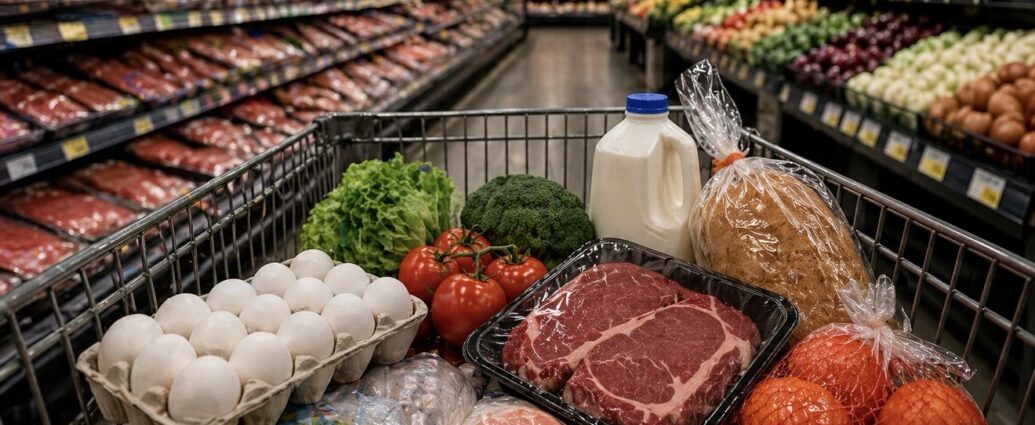
American consumers walking into supermarkets in 2026 are encountering what economists describe as a “two-speed” grocery economy — one where a handful of staple items are getting cheaper, but most of the store is moving in the opposite direction. Nowhere is that divide clearer than in eggs, which have sharply declined in price, even as beef, produce, and imported goods continue to climb.
According to the U.S. Department of Agriculture, egg prices fell 3.3% between February and March 2026 and are now down 44.7% compared with March 2025, marking one of the steepest reversals in recent grocery price history. USDA analysts attribute the drop to a rapid recovery in domestic poultry flocks following the Highly Pathogenic Avian Influenza outbreak that devastated supply over the past two years. Officials added that egg prices are projected to fall another 29.4% over the full year as production stabilizes and infection rates remain below prior peaks.
But the relief ends quickly once shoppers move beyond the dairy aisle.
The USDA reports that beef and veal prices rose 12.1% year over year in March, while fresh vegetables increased 7.5%, reflecting tightening supply conditions and rising transportation costs. Real-time retail data paints an even sharper picture: frozen tilapia prices have surged nearly 47% in some regions, imported hash browns are up more than 30%, and both imported and domestic pork products are posting double-digit gains.
David Ortega, an agricultural economist at Michigan State University, warned that the most visible price increases are concentrated along the “perimeter” of grocery stores — the sections that house fresh food. “Perishable goods are the canary in the coal mine,” Ortega said, noting that these products are most sensitive to changes in fuel costs and supply chain disruptions.
That pressure is intensifying as energy markets react to geopolitical developments. U.S. crude oil prices jumped from roughly $71 per barrel in early March to approximately $114 in early April, driven in part by ongoing tensions involving Iran and disruptions to global shipping routes. Higher diesel prices directly increase the cost of transporting food from farms to distribution centers and ultimately to store shelves.
Ricky Volpe, an agricultural economist at California Polytechnic State University, described the current environment as an “inflationary perfect storm,” where multiple cost drivers are reinforcing one another. “Tariffs raise the baseline cost of imported goods, while fuel increases raise the cost of moving everything,” Volpe said. “Those forces stack — they don’t cancel out.”
Recent price surveys underscore just how widespread those pressures have become. In one analysis conducted at a Salt Lake City grocery store marking the anniversary of President Donald Trump’s tariff expansion, produce prices showed some of the steepest increases, with navel oranges and vine-ripened tomatoes rising more than 75% year over year. Cosmic Crisp apples climbed more than 30%, while packaged goods such as chocolate bars, processed meats, and bakery items also saw increases exceeding 25%.
Government forecasts suggest the divergence will persist. The USDA projects that overall food prices will rise 2.9% in 2026, while food consumed away from home — including restaurants and takeout — will increase even faster at 3.8%, reflecting higher labor and operational costs in the service sector.
Christopher Barrett, a professor of applied economics at Cornell University, cautioned that the impact will be felt unevenly across households. “Consumers, especially those with fixed or lower incomes, will face increasingly difficult trade-offs as food prices rise faster than wages,” Barrett said.
For now, the result is a grocery experience defined by contrast: sharply lower prices in a few high-profile categories masking steady increases across much of the rest of the store. Analysts say that unless fuel costs ease or supply conditions improve, the upward pressure on fresh and imported foods is likely to intensify heading into the summer months.
For consumers, the takeaway is straightforward — bargains may still exist, but they are becoming more selective, and navigating the modern grocery store now requires more strategy than ever.
JBizNews Desk