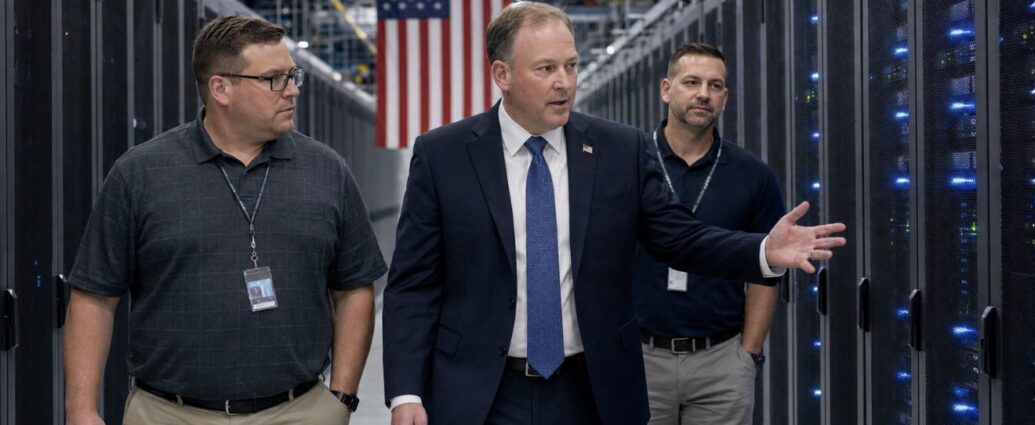
Environmental Protection Agency Administrator Lee Zeldin is warning states and communities against broadly blocking new data centers, arguing that stopping construction across the United States could allow China to take the lead in artificial intelligence.
Zeldin acknowledged that communities have legitimate concerns about electricity costs, water consumption, pollution and the strain large data centers can place on local infrastructure. But he said those problems should be addressed project by project instead of through sweeping bans.
“What we can’t do is just say, well, let’s not have any data centers built all across the entire country and let’s just let China win,” Zeldin said Sunday.
His remarks come as opposition to data centers grows across the country. Residents and elected officials have raised concerns that the enormous facilities could consume large amounts of electricity, increase utility bills, require new power plants and place additional pressure on water systems.
New York imposed a one-year moratorium on permitting new large-scale data centers while the state studies their energy and environmental effects. Hundreds of local jurisdictions nationwide have enacted or considered restrictions, moratoriums or tighter approval requirements.
Zeldin has criticized New York’s approach as an “easy way to cop out,” arguing that state and local governments should remain engaged with developers and negotiate protections for their communities.
The EPA administrator said the federal government would not establish one nationwide environmental standard for every data center because conditions differ widely among states and individual projects. Some facilities, for example, use closed-loop cooling systems that sharply reduce their need for a continuous local water supply.
The Trump administration views data centers as essential national infrastructure. They house the advanced chips and computer systems needed to train and operate artificial-intelligence models, support cloud computing and process the rapidly expanding volume of digital information used by businesses and government agencies.
China is simultaneously investing heavily in domestic computing capacity, power generation and artificial-intelligence infrastructure. U.S. officials fear that delays in constructing American data centers could limit access to computing power and weaken the country’s position in the global technology race.
The challenge is finding a balance that protects communities without stopping development entirely.
Data centers can bring billions of dollars in construction investment and new tax revenue, but they generally employ fewer permanent workers than traditional factories of comparable size. The facilities can also require as much electricity as a small city, creating concerns that residential customers could ultimately shoulder part of the cost of expanding the power grid.
Zeldin’s position is that those risks require negotiation, transparency and local safeguards—not a nationwide retreat from building the infrastructure that will power the next generation of American technology.
JBizNews Desk | Washington
© JBizNews.com All Rights Reserved. Reproduction or distribution without written permission is prohibited.