By JBizNews Desk | April 27, 2026
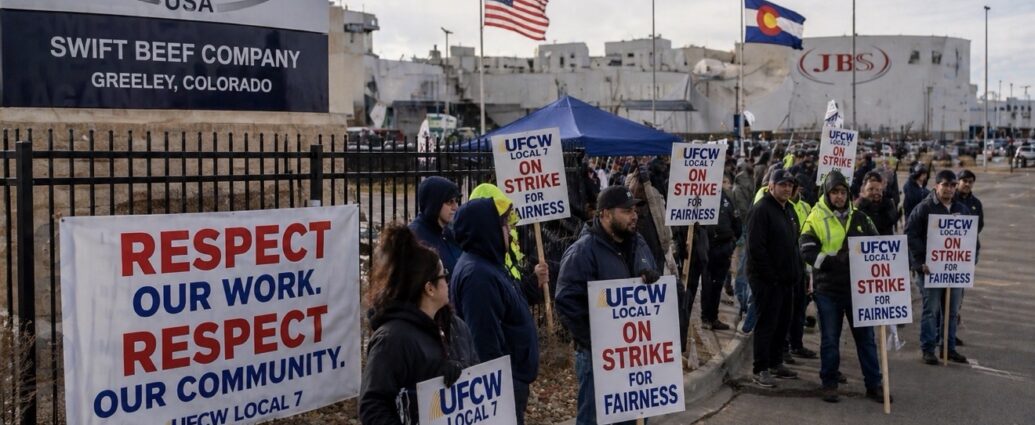
Nearly 3,800 meatpacking workers at JBS USA’s Swift Beef Company plant in Greeley, Colorado have ratified a new two-year labor agreement, ending the largest U.S. meatpacking strike in more than six decades—while underscoring mounting pressure across an already strained beef supply chain.
The agreement, approved by 93% of union members on April 11, concludes a three-week walkout that began March 16 after eight months of negotiations between JBS and United Food and Commercial Workers (UFCW) Local 7. The Greeley facility, one of the largest in the country, accounts for more than 6% of total U.S. beef processing capacity, making the strike’s impact immediate and far-reaching.
“Workers stood together on the picket line for three weeks, through extreme weather, because they knew their worth and refused to be disrespected,” said Kim Cordova, President of UFCW Local 7, describing the deal as a significant step forward for labor conditions in the industry.
The timing of the strike amplified its economic consequences. It unfolded as U.S. cattle inventories hit their lowest levels in more than 75 years, driving beef prices to record highs. According to market data cited by industry analysts, boxed beef prices were already up more than 10% year-to-date, with retail ground beef prices approaching $8 per pound in some regions.
The sudden reduction in processing capacity at Greeley—where as many as 6,000 head of cattle are processed daily—triggered immediate supply chain disruptions. Ranchers in the Mountain West faced a backlog of livestock unable to be processed, while retailers and distributors grappled with tighter supply and rising wholesale prices.
“The loss of capacity at a facility of this scale creates ripple effects across the entire supply chain,” analysts at major agricultural consultancies noted, pointing to longer transport routes, shifting delivery schedules, and increased logistical costs as cattle were rerouted to other plants across neighboring states.
JBS confirmed it operated the Greeley facility at reduced capacity during the strike and diverted production to other locations where possible. However, industry observers noted that tighter slaughter capacity has paradoxically supported higher margins for processors, even as it squeezed producers and consumers.
The newly ratified contract delivers immediate and incremental wage gains. Workers will receive a $0.70 hourly raise upon ratification, followed by $0.40 increases in July 2026 and July 2027. The agreement also includes a $750 signing bonus and a $500 payment in 2027, alongside improved benefits such as capped healthcare costs, additional vacation time, and employer-covered personal protective equipment.
Union officials said the total wage package represents nearly 33% more than JBS’s pre-strike offer. The agreement also restructures retirement benefits, eliminating the pension plan in favor of higher near-term wages while maintaining the company’s existing 401(k) program.
For JBS, the deal restores full operations at a critical facility, but at a higher labor cost base. Analysts expect at least part of those costs to be passed through the supply chain, adding further pressure to already elevated beef prices.
The broader industry backdrop remains challenging. The U.S. beef market is widely viewed as being in a prolonged “super-cycle,” driven by constrained cattle supply, strong consumer demand, and limited processing capacity. Prices have consistently outpaced general inflation for more than a year, raising concerns about affordability and demand elasticity.
The labor dispute has also renewed scrutiny of the industry’s dominant players—JBS, Tyson Foods, Cargill, and National Beef—which collectively control the majority of U.S. beef processing. Critics, including members of Congress, have accused the “Big Four” of suppressing wages while maintaining elevated consumer prices.
A hearing led by the House Monopoly Busters Caucus is scheduled for May in Greeley, where lawmakers are expected to examine market concentration, pricing dynamics, and labor conditions across the sector.
For now, the resolution of the strike restores a key piece of national processing capacity at a critical moment. But with cattle supplies tight, labor costs rising, and structural pressures across the industry unresolved, the outlook for beef prices remains firmly elevated.
JBizNews Desk