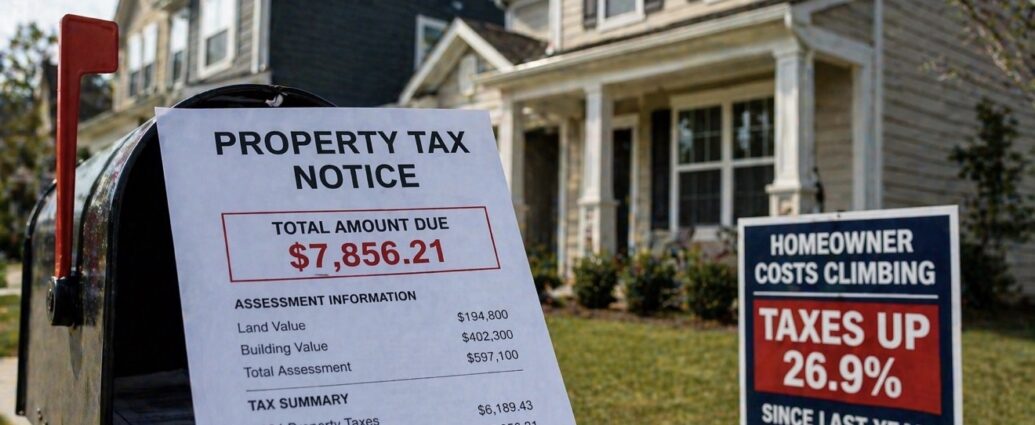
Property taxes on U.S. single-family homes climbed again this year, adding pressure to household budgets even as home values cooled in many markets. In a report released April 9, ATTOM said owners of more than 89.6 million single-family homes paid a combined $396.8 billion in property taxes in 2025, and ATTOM Chief Executive Rob Barber said the increase reflected “a continued rise in the average tax burden on homeowners,” according to the company’s latest property tax analysis.
The data point to a national average tax bill of $4,427 per single-family home, up 3% from 2024, while the total levy rose 3.7%, ATTOM said in its release. The property data firm said its findings drew on tax records from local assessment offices and estimated market values, and Rob Barber said the trend showed “property taxes continue to increase across much of the country even as home price growth has moderated,” a dynamic that matters for affordability as borrowing costs remain elevated.
That increase ran ahead of the latest inflation backdrop. The annual consumer price index rose 2.4% in March, according to the U.S. Bureau of Labor Statistics, and the agency said shelter costs remained “the largest factor in the monthly all items increase,” underscoring how housing-related expenses continue to dominate household spending. With property taxes rising faster than headline inflation, local tax bills increasingly shape the real cost of homeownership beyond mortgage rates and insurance.
The tax increase also arrived alongside softer valuations in ATTOM’s estimates. The firm said the average estimated value of a single-family home slipped 1.7% from a year earlier to $494,231 in 2025 after a sharp jump in 2024, and ATTOM said the higher average tax bill stemmed primarily from an increase in the effective tax rate rather than appreciation alone. That distinction matters for owners and buyers because it suggests local governments and assessment practices, not just market prices, increasingly drive annual tax costs.
Regional differences remained stark. ATTOM said states in the Northeast and parts of the Midwest continued to post some of the highest effective tax rates, while many Southern and Western states remained lower-tax jurisdictions by comparison. In prior housing affordability research, economists at the National Association of Realtors have said “housing affordability remains a challenge,” and chief economist Lawrence Yun has repeatedly pointed to taxes, insurance and financing costs as key barriers for buyers, according to the group’s recent market commentary.
The latest property-tax figures land at a time when local governments face competing budget pressures. Municipal finance analysts at Moody’s Ratings said in recent public commentary that property taxes remain a core and generally stable revenue source for local governments, even as office-market weakness and uneven commercial real estate values create uncertainty in some jurisdictions. Moody’s has said local governments generally retain “strong revenue-raising flexibility,” but that taxpayers can still feel the impact when assessments or rates move higher to support school, public safety and infrastructure spending.
For homeowners, the increase adds to a broader stack of housing costs that already includes elevated insurance premiums and still-high financing costs. Freddie Mac said in its latest weekly survey that 30-year mortgage rates remain well above the ultra-low levels of the pandemic era, and chief economist Sam Khater said recently that “affordability headwinds persist,” according to the mortgage finance company. Even owners with fixed-rate mortgages often cannot escape rising carrying costs when tax assessments and local levies move up.
The tax burden also carries implications for home sales and migration patterns. Analysts at Redfin and Zillow have said in recent market updates that buyers continue to weigh total monthly cost, not just listing price, when choosing where to move. Redfin economists said affordability pressures keep pushing some households toward lower-tax metros and states, while Zillow has noted that recurring ownership costs increasingly influence demand in a slower housing market.
What comes next depends on how local assessors, school districts and municipal governments respond to shifting property values and budget needs through the rest of 2026. ATTOM said the latest figures show tax burdens still moving higher despite softer estimated home values, and that combination could keep pressure on household finances, relocation decisions and housing demand if inflation stays contained but local levies do not. For executives, lenders and real estate investors, the next round of county assessments and local budget decisions could offer one of the clearest signals yet on where housing affordability tightens further and where demand holds up.
JBizNews Desk