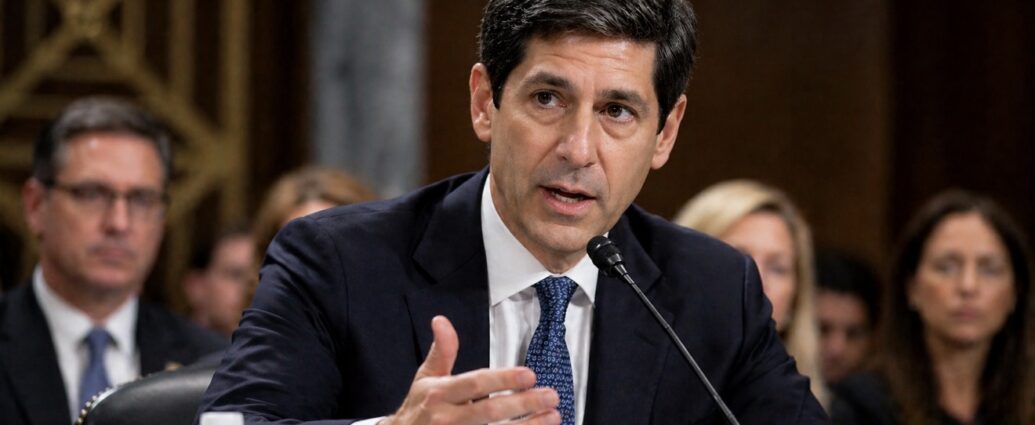
Washington is navigating a once-in-a-generation transition at the Federal Reserve, with two defining events colliding in a single day: a partisan committee vote that moved Kevin Warsh one step closer to the chairmanship, and what is almost certainly Jerome Powell’s final policy decision at the helm of the central bank.
Warsh, President Donald Trump’s nominee to lead the Federal Reserve, won the backing of the Senate Banking Committee on Wednesday in a 13–11 party-line vote, putting him on track to be confirmed by the full Senate before Powell‘s term ends May 15.  It was the first fully partisan vote on a Fed chair nominee in the committee’s history, Sen. Elizabeth Warren confirmed in a press release. 
The vote had been in jeopardy until days ago. Sen. Thom Tillis of North Carolina was the linchpin — he had blocked the nomination until the Department of Justice dropped its criminal investigation into Powell over cost overruns in a renovation of the Fed’s Washington headquarters. U.S. Attorney Jeanine Pirro announced her office would refer the matter to the Fed’s inspector general, and Tillis declared himself satisfied. 
Democrats were unmoved. Sen. Warren called the vote a step toward “completing his illegal attempt to seize control of the Fed and artificially juice the economy,” citing Trump’s effort to fire Fed Governor Lisa Cook and his sustained pressure campaign against Powell.  Sen. Tim Scott of South Carolina, who chairs the committee, countered that Warsh is “battle tested” and called his leadership “absolutely essential” at the central bank. 
Hours after the committee vote, Powell presided over what multiple outlets confirmed was his final policy meeting as chair. The Federal Open Market Committee voted to hold its benchmark funds rate in a range of 3.5%–3.75% — the third consecutive meeting where the committee chose to stand pat, following three consecutive cuts last year.  The decision was far from routine. The meeting saw an unusually dramatic split, with the FOMC dividing 8–4 — the last time four members dissented was October 1992. 
Fed Governor Stephen Miran, a Trump appointee, dissented in favor of an immediate 25 basis point rate cut. Three others — Cleveland Fed President Beth Hammack, Minneapolis Fed President Neel Kashkari, and Dallas Fed President Lorie Logan — dissented in the opposite direction, opposing the statement’s easing bias and signaling they are not keen on cutting rates anytime soon.  The four-way split sent a pointed message to Washington about the internal tensions Warsh will inherit if confirmed.
At his final press conference as chair, Powell offered measured congratulations to his successor-in-waiting. “I want to congratulate Kevin Warsh on his advancement out of the Senate Banking Committee this morning,” he told reporters. “This is, and will be, a very normal, standard kind of a transition process.” 
Powell also announced he will not be leaving the Fed quietly. He signaled he would remain on the Board of Governors for an indefinite period, saying he is waiting until an investigation into the Federal Reserve’s renovations “is well and truly over with transparency and finality.”  Staying on as a governor — his term runs through January 2028 — would be highly unusual and would deny the Trump administration an open seat on the board.
Trump responded Thursday, saying he doesn’t care that Powell is staying on as a governor. “I’m just happy that Kevin Warsh is set to take over,” he told reporters. 
Markets are already recalibrating. SoFi Technologies CEO Anthony Noto said he expects a Warsh-led Fed to deliver more rate cuts in 2026. “The credit markets and the home loan market are definitely suffering from the high cost of debt, and that’s going to impact the economy at some point in 2027 if there isn’t action taken in 2026,” Noto told Yahoo Finance.  The bond market, however, is currently pricing in no rate cuts this year.
The full Senate is likely to vote on Warsh’s confirmation the week of May 11 — meaning he could be seated before Powell’s term as chair expires on May 15.  Every prior full-Senate confirmation of a Fed chair has included bipartisan support. Warsh has called for “regime change” at the Fed, proposing to alter its economic models, scale back forward guidance, scrap the so-called dot plot, and reassess the size of its bond holdings.  Whether those ambitions survive contact with an already-divided FOMC remains the central question facing financial markets as the leadership clock runs down.
JBizNews Desk
© JBizNews.com. All rights reserved. This article is original reporting by JBizNews Desk. Unauthorized reproduction or redistribution is strictly prohibited.