By JBizNews Desk | Monday, May 4, 2026
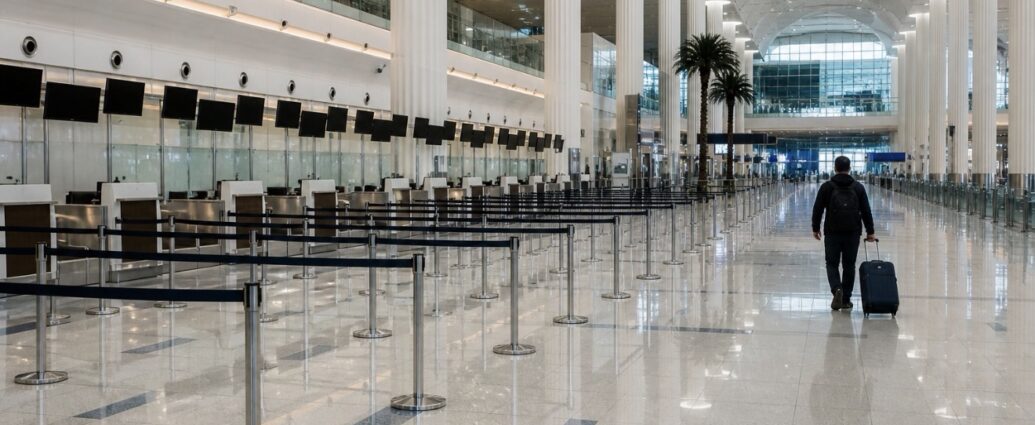
Dubai International Airport — the world’s busiest airport for international passengers — suffered one of the steepest traffic collapses in its history in March, as the Iran war shut down Gulf airspace, forced repeated evacuations and slashed passenger volumes to levels not seen since the depths of the COVID-19 pandemic. The airport is now ramping back up, but the damage to one of the region’s most critical economic engines has already been done.
Dubai Airports released its first-quarter traffic figures on May 4, showing the airport handled 18.6 million passengers in the first three months of 2026 — a 20.6% decline year over year. The damage was heavily concentrated in March: passenger traffic that month fell 65.7% to just 2.5 million, an extraordinarily steep drop for a hub that had been on course to handle nearly 100 million passengers for the full year.
Cargo volumes also fell sharply, dropping 22.7% to 399,600 tonnes in the first quarter, while aircraft movements declined 20.8% to 88,000.
What Happened
The collapse unfolded quickly after the U.S. and Israel launched strikes against Iran on February 28. Dubai International Airport was impacted by retaliatory Iranian strikes that forced the airport to be evacuated. A travel advisory from Dubai Airports warned passengers not to travel to the airport unless they had received a confirmed departure time directly from their airline. Nearly 4,000 flights in and out of DXB were cancelled in the days immediately following the outbreak of conflict, according to FlightAware.
The airport suspended operations again on March 7 following additional Iranian drone strikes. As of the end of March it remained in limited operation due to ongoing security concerns.
Paul Griffiths, CEO of Dubai Airports, described the period as “unprecedented” for a global hub like DXB. “International transfer traffic through the Middle East accounts for a major share of global air travel, with 22.4 million annual passenger journeys flowing through DXB,” he said. “Maintaining smooth operations here is critical to keep global journeys moving.”
Despite the disruption, Dubai Airports said it supported the movement of six million passengers, over 32,000 aircraft movements and 213,000 tonnes of essential cargo from the start of the conflict on February 28 through April 30 — a logistical effort Griffiths said sharpened the airport’s ability to adapt at pace.
The Broader Aviation Toll
DXB was far from alone in absorbing the blow. Regional aviation hubs in Abu Dhabi, Dubai, Doha and Bahrain typically process around 526,000 passengers per day combined, but that number plummeted as airspace closures grounded flights across the region. Emirates, Etihad Airways and Qatar Airways saw their daily flight operations fall to a fraction of normal levels by mid-March, according to Flightradar24 data.
The World Travel & Tourism Council estimated the conflict was costing the Middle East travel and tourism industry approximately €515 million per day. Analysts at Tourism Economics warned that inbound arrivals to the Middle East could decline between 11% and 27% year over year in 2026 — a swing of 23 to 38 million fewer international visitors compared to pre-war forecasts, representing a loss of $34 billion to $56 billion in visitor spending.
Signs of Recovery
The most significant development in aviation came Sunday — the same day Dubai Airports released its first-quarter data. The United Arab Emirates lifted all flight restrictions put in place since the start of the Iran war, with the country’s General Civil Aviation Authority announcing that all air operations had returned to “normal status” in UAE airspace. The authority said the decision followed a comprehensive assessment of operational and security conditions in coordination with relevant authorities.
The ramp-up is being supported by coordination across the oneDXB network, including Emirates and flydubai, as well as service partners and air traffic control. India remained DXB’s largest market in the first quarter with 2.5 million passengers, followed by Saudi Arabia at 1.3 million, the UK at 1.2 million and Pakistan at 918,000. London was the busiest city destination.
Just months ago, Dubai International was targeting 99.5 million passengers for the full year of 2026 — a figure that would have made it the first airport in history to approach 100 million passengers annually. That milestone is now firmly out of reach. Whether the airport can salvage its position as the world’s dominant international hub will depend on how quickly the Iran war ends and how fast nervous travelers return to the Gulf.
— JBizNews Desk
© JBizNews.com. All rights reserved. This article is original reporting by JBizNews Desk. Unauthorized reproduction or redistribution is strictly prohibited.