Most Israelis believe that ending the war with Iran in the current terms is not aligned with Israel’s security interests, while 62% of Israelis think there is a high likelihood of the war resuming, a survey by IDI’s Viterbi Center for Public Opinion and Policy Research revealed on Tuesday.
According to the survey, 64% of Jewish Israelis see the current security situation regarding Iran as incompatible with Israel’s interests, while 48,5% of Arab Israelis think it’s compatible.
In terms of Israeli opinion on the conflict resuming, a majority of both Israeli Jews (62%) and Arabs (52%) believe the fighting will restart soon.
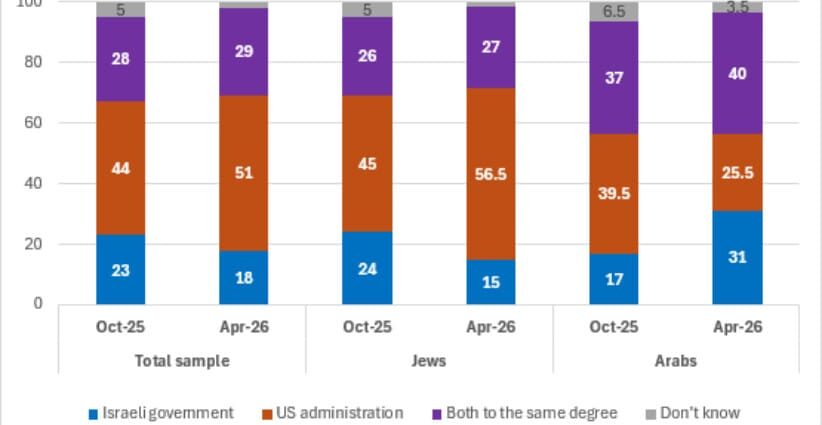
Additionally, 51% of Israelis believe that the Trump administration has more influence over Israel’s defense decisions than the government, with Israeli Jews having a similar view (56%), while Arab Israelis think both the government and the US administration have equal decision-making power.
The survey also reported a sharp decrease in Israeli optimism about national security, from 47% in March to 39% in April. At the same time, optimism about social cohesion also dropped from 30% to 22.5% over the last month, while optimism for the future of democratic rule and the economy remained stable at 44% and 33.5%, respectively.
West Bank, Lebanon security situations
The survey also revealed that 45% of Israelis (46% Jews / 42% Arabs) think that settlers who attacked Palestinians were being treated too leniently by security and enforcement agencies.
It also reported a spike in the Arab Israelis thinking violent settlers were treated very harshly by law enforcement, going from 10% in November 2025 to 35% today.
Finally, the survey revealed that most Israelis (73%) think there are low chances of reaching a diplomatic agreement with Lebanon that would solve the war with Hezbollah.
The April 2026 Israeli Voice Index was prepared by the Viterbi Family Center for Public Opinion and Policy Research at the Israel Democracy Institute. The survey was conducted via the internet and by telephone (to include groups that are under-represented on the internet) between April 26–30, 2026, with 601 men and women interviewed in Hebrew and 150 in Arabic, constituting a nationally representative sample of the adult population in Israel aged 18 and over. The maximum sampling error was ±3.58% at a 95% confidence level.