JBizNews Desk | May 10, 2026
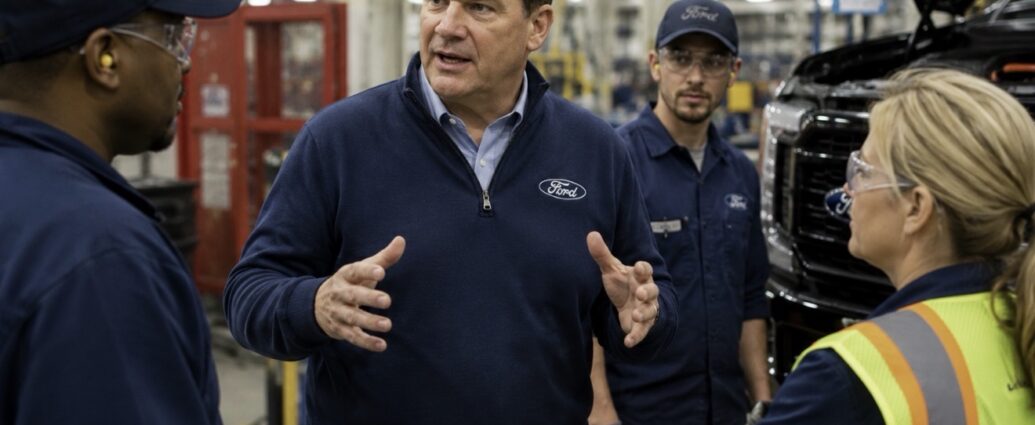
Jim Farley, CEO of Ford Motor Company, has spent years sounding the alarm about a workforce crisis he believes most of corporate America and Washington are still not taking seriously enough.
This week, in an exclusive interview with Fortune, he made it personal — revealing that his own Gen Z son has chosen to spend the summer working as a fabricator in North Carolina rather than taking summer courses, and arguing that the story of one young man’s career choice is a microcosm of a much larger economic problem.
“He feels like that’s more fulfilling than doing summer school at some fancy college,” Farley told Fortune.
The skilled-trade shortage — the gap between the jobs America desperately needs filled and the workers available to fill them — remains, in Farley’s words, “full-blown.”
He placed the country in “the second or third inning” of grappling with it seriously, noting that awareness has improved but solutions remain fragmented.
The “second or third inning” framing is significant.
In baseball terms, the game is barely underway.
Farley is not describing a problem that is close to being solved.
He is describing one that has barely been confronted.
Ford’s Problem — and America’s
The numbers behind Farley’s urgency are concrete.
As of January 2026, Ford had 5,000 open mechanic positions paying roughly $120,000 annually — positions Farley says he simply cannot find workers to fill.
Those are not entry-level jobs.
They are skilled, well-compensated careers — paying nearly double the American worker’s median salary — going begging because the pipeline of trained tradespeople has been systematically neglected for decades.
The country is already short:
- 600,000 factory workers
- 500,000 construction workers
Farley wrote in a LinkedIn post last June that America will need 400,000 auto technicians over the next three years alone.
In total, Farley has put the national blue-collar job opening at more than 1 million unfilled positions across emergency services, trucking, factory work, plumbing, electrical work, and skilled trades.
“So many of the real problems are in small companies and small businesses that don’t have the funding,” Farley said.
“Trade school is often offered as an option, but it’s extremely expensive. Not everyone can afford it.”
That last point cuts directly to the equity dimension of the shortage.
The conventional solution — more vocational training — runs directly into the same affordability barrier that has made four-year college increasingly inaccessible for working-class families.
Farley has argued that fixing the blue-collar shortage requires not just cultural change but systemic policy investment:
- more funding for vocational education
- expanded apprenticeship pipelines
- regulatory reform that makes it easier for small businesses to train and retain skilled workers
The AI Paradox
The deeper irony at the heart of Farley’s argument is one that has gained significant traction in 2026:
The same artificial intelligence boom that is eliminating white-collar entry-level jobs is simultaneously creating enormous new demand for the blue-collar workers America has spent decades undervaluing.
What Farley calls the “essential economy” — the blue-collar sectors that get things “moved, built, or fixed” — represents $12 trillion in U.S. GDP, according to the Aspen Institute.
But it is chronically understaffed and undervalued.
AI could eliminate half of all white-collar jobs in the U.S. within a decade, Farley has warned — gutting entry-level tech roles like junior programming and clerical work, the rungs many young Americans have been told to climb.
Meanwhile, the skilled tradespeople needed to build the data centers that will run those AI systems simply do not exist in sufficient numbers.
According to a March 2026 labor market report, the data center industry alone faces a projected shortfall of up to 499,000 workers, with construction labor costs rising 8% to 12% year over year.
“I think our story is just very similar to what’s going to be happening across the country with linemen, electricians, plumbers,” Farley told Fortune.
“It won’t be just for data centers, it’ll be for transmission lines, off-grid energy sources.”
Ford is experiencing this tension internally.
As the company converts its BlueOval SK battery plant in Glendale, Kentucky — originally built to produce EV batteries — into a dedicated energy storage facility, workers are now learning lithium iron phosphate chemistry, skills most never anticipated needing when they took the job.
“We are ourselves finding skilled trade shortages as we convert our automotive battery plants to energy storage battery plants in Kentucky and Michigan,” Farley said.
The Cultural Shift That’s Underway
Farley is not alone in making this case anymore — and that may be the most meaningful development of 2026.
For Farley, the macro argument and the personal one have become inseparable.
Figures ranging from BlackRock CEO Larry Fink to JPMorgan CEO Jamie Dimon are now publicly sounding the alarm about skilled-labor shortages threatening America’s growth ambitions.
The Ad Council is mobilizing a paid advertising campaign around the issue.
Carhartt CEO Linda Hubbard, who appeared alongside Farley in this week’s Fortune interview, said:
“It does seem that business is picking up the mantle and saying, ‘Yeah, we need to move this forward.’”
The cultural data supports the momentum.
A November 2025 NBC News poll found that 63% of Americans now say a four-year degree is “not worth the cost” — up from 47% in 2017.
Between 2011 and 2023, roughly 2 million fewer students enrolled in four-year universities.
In the first quarter of 2024, Gen Z made up nearly 25% of all new hires in skilled trades.
A February 2026 survey found 60% of Gen Zers plan to pursue skilled-trade work this year.
For American businesses trying to hire, expand, and compete — in manufacturing, construction, energy, automotive, or any sector that depends on physical labor and technical skill — Farley’s “second or third inning” assessment carries a direct message:
Plan for the shortage to get worse before it gets better, because the workforce pipeline that would solve it is still being built from scratch.
© JBizNews.com. All rights reserved. This article is original reporting by JBizNews Desk. Unauthorized reproduction or redistribution is strictly prohibited.