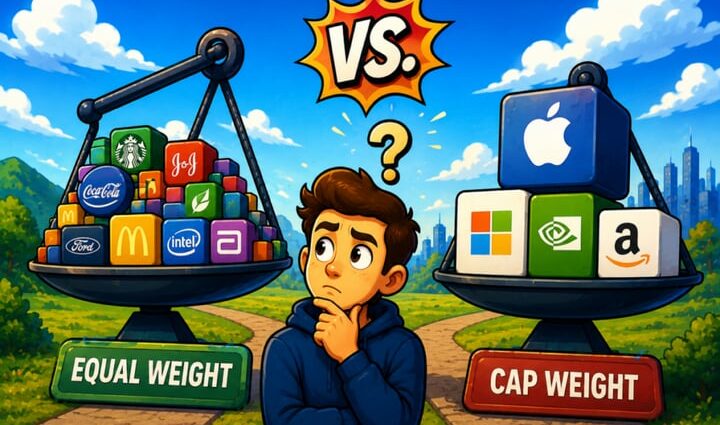
Think buying an S&P 500 index fund means you own a piece of all 500 companies equally? Think again. The index you probably hold in your 401(k) or brokerage account has quietly become something very different from what most investors imagine, and that gap between perception and reality is widening by the year.
The S&P 500 as most people know it is cap-weighted, meaning each stock’s slice of the pie is proportional to its total market value. Apple Inc. (NASDAQ:AAPL), Microsoft Corp. (NASDAQ:MSFT), and Nvidia Corp. (NASDAQ:NVDA) are far from equal participants in that portfolio. By the end of 2025, the 10 largest companies in the index collectively accounted for nearly 41% of its total weight; more than double their share from just a decade ago, according to RBC Wealth Management. Owning a standard S&P 500 fund today is, in practical terms, placing a concentrated bet on a handful of AI-adjacent megacap tech names, whether you realize it or not.
The alternative, the S&P 500 Equal Weight Index, assigns every one of those 500 companies an identical ~0.2% allocation. Apple and a mid-sized industrial company sit on the same footing. That seemingly small structural difference can lead to dramatically different outcomes for your portfolio, depending on what the market is doing.
A 20-Year Winner Dethroned
For much of modern investing history, the equal-weight approach quietly won. From 2003 through 2022, the S&P 500 Equal Weight Index outperformed its cap-weighted counterpart by roughly 1.5% per year, largely because of size effects and periodic mean reversion among large-cap leaders, according to RBC Wealth Management data. Invesco similarly notes that the equal-weight version outperformed by an average of about 1.05% annually up until 2023.
Then the artificial intelligence wave hit, and the Magnificent Seven — Apple, Microsoft, Nvidia, Amazon, Alphabet, Meta, and Tesla — began a concentration run that has few parallels in market history. Since the start of 2023, the cap-weighted S&P 500 has outperformed the equal-weight index by roughly 32%, one of the largest three-year relative outperformances ever recorded and slightly exceeding the peak outperformance seen during the dot-com bubble in the late 1990s.
For individual investors, this stretching of the gap has a hidden personal cost: if you’ve been watching a broader equal-weight fund underperform the nightly-news benchmark for three years, the temptation is to chase the cap-weighted winner. That’s often how investors end up buying concentration risk at precisely the wrong moment.
The Math Problem Nobody Is Talking About
Here’s a framing that reshapes how you should think about future cap-weighted returns: at current valuations, the biggest companies simply face an arithmetic ceiling.
Apple is near a $4 trillion market capitalization. For that stock alone to double from here, it would need to add more …





This post was originally published here