By JBizNews Desk | May 10, 2026
A new analysis by The Wall Street Journal highlights one of the sharpest contradictions inside America’s trade strategy toward China: while Washington has effectively blocked Chinese-built cars from entering the U.S. market through massive tariffs and regulatory restrictions, the components powering and maintaining American vehicles continue flowing from China at enormous scale.
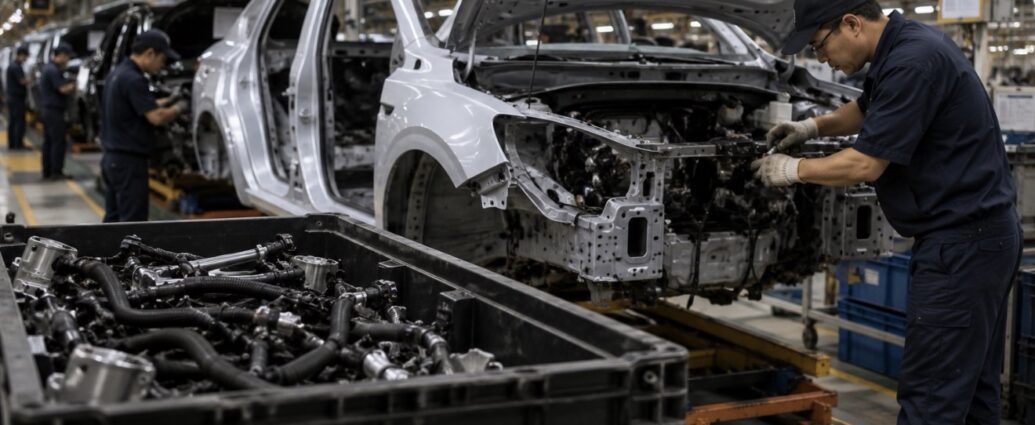
From brake hoses and engine mounts to semiconductors, battery materials and electronic systems, Chinese-made auto parts remain deeply embedded inside the vehicles Americans buy, drive and repair every day.
Industry estimates cited by analysts place annual U.S. imports of Chinese transportation and automotive components at roughly $15 billion to $20 billion per year, exposing how difficult it has become for the United States to separate itself from supply chains that took decades to build.
The disconnect between political messaging and industrial reality has only widened as Washington escalates pressure on Chinese automotive manufacturers.
Chinese-built electric vehicles now face tariffs reaching 100%, effectively locking them out of the American consumer market. The federal government has also moved to restrict Chinese software and connected-vehicle technology beginning with the 2027 model year, citing national-security concerns tied to data collection and digital infrastructure.
Yet even as policymakers push aggressive “decoupling” rhetoric, the supply chains supporting the American auto industry continue running directly through China.
According to data from the U.S. International Trade Commission cited by Goldman Sachs analyst Mark Delaney, the United States imports approximately $9 billion to $10 billion annually in Chinese auto parts and accessories alone, part of a broader transportation-goods relationship worth substantially more.
Those parts ultimately appear inside vehicles produced by Ford, General Motors, Toyota, BMW and virtually every major automaker operating in the U.S. market.
The dependency extends beyond manufacturers.
Auto-parts retailers including AutoZone, O’Reilly Auto Parts and NAPA continue relying heavily on Chinese suppliers because of their ability to manufacture huge volumes of components quickly and cheaply across thousands of product categories.
Industry executives say replacing that capacity would require years of investment and significantly higher production costs elsewhere.
The electric-vehicle sector reveals the dependency even more clearly.
According to data from the U.S. Transportation Department, many EVs sold in the United States still contain between 30% and 51% Chinese content, despite tariffs and political pressure to localize production.
China’s dominance over EV battery manufacturing remains especially difficult for the West to unwind.
Battery giant Contemporary Amperex Technology Co. (CATL) and five other leading Chinese battery manufacturers now control roughly two-thirds of the global EV battery market, giving Beijing enormous influence over one of the fastest-growing segments of the global economy.
Even major American automakers continue depending on Chinese battery technology.
Ford Motor Co. has incorporated CATL technology into portions of its supply chain through licensing agreements, while General Motors acknowledged it would temporarily source lithium iron phosphate battery packs from Chinese-linked suppliers to support production of lower-cost EV models.
GM has said it intends to shift more of that production into the United States by 2027, but analysts note the transition will take time, infrastructure investment and massive capital spending.
Chinese suppliers have also increasingly used Mexico as a manufacturing bridge into the American market.
Companies including Huayu Automotive Systems and Joyson Electronics have expanded operations in Mexico, allowing parts containing Chinese content to enter North America under the framework of the United States-Mexico-Canada Agreement (USMCA) while avoiding some of the steepest direct tariffs on Chinese imports.
Consulting firm Beijing-based Insight and Info Consulting estimates Chinese automotive suppliers now support nearly half of global automotive component demand, a market position built through decades of industrial investment, scale advantages and integrated manufacturing infrastructure.
That dominance has proven far more difficult to dismantle than political leaders initially anticipated.
The current tariff structure imposes roughly 25% duties on many Chinese auto parts, on top of earlier trade penalties dating back to President Donald Trump’s first administration.
But even with those tariffs in place, automakers continue sourcing from China because many alternative suppliers either lack sufficient manufacturing scale or charge substantially higher prices.
“For Ford, GM, Toyota, BMW — every car that’s sold in the United States, you’re going to want parts for that,” said Jack Perkowski, founder and managing partner of Beijing-based merchant bank JFP Holdings. “The tariffs raise costs — but they do not eliminate the dependency.”
That dependency increasingly affects consumers directly.
Tariffs, supply disruptions and production bottlenecks have contributed to rising vehicle prices across the U.S. market, with Cox Automotive estimating average new vehicle prices now hover around $50,000.
Some analysts estimate tariffs and supply-chain disruptions could increase the cost of certain vehicles by as much as $12,200 if manufacturers fully pass those costs through to buyers.
The result has been a complicated balancing act for automakers attempting simultaneously to comply with U.S. industrial policy, maintain competitive pricing and secure access to the world’s most deeply integrated manufacturing ecosystem.
Wall Street analysts say the situation increasingly highlights the gap between political timelines and industrial realities.
Decoupling from Chinese manufacturing — particularly in sectors tied to batteries, graphite, semiconductors and electronics — would likely require years of infrastructure expansion, new mining projects, supplier diversification and enormous government subsidies.
China currently accounts for approximately 77% of global graphite supply, a material critical for lithium-ion batteries and EV manufacturing.
The Commerce Department’s Bureau of Industry and Security has already begun restricting Chinese connected-vehicle technology tied to software and data systems starting with the 2027 model year.
But the broader automotive supply chain remains deeply intertwined with Chinese manufacturing in ways regulators have not yet been able to fully unwind.
What the numbers ultimately reveal is an American auto industry publicly committed to reducing reliance on China while privately depending on Chinese manufacturing to keep production lines operating and repair networks functioning.
Tariffs have increased costs. Supply chains have become more fragile. Political tensions continue rising.
But the underlying reality has not changed.
Chinese-built cars may be effectively barred from American roads.
Chinese-made parts, however, are already inside nearly every vehicle driving on them.
JBizNews Desk