By JBizNews Desk
May 11, 2026
American equity markets extended their six-week winning streak to a seventh, closing at fresh all-time highs Monday even as President Donald Trump rejected Iran’s peace counterproposal as “TOTALLY UNACCEPTABLE,” declared the month-old ceasefire “on life support,” Brent crude surged above $104 a barrel, gas at the pump averaged $4.50 nationwide, and markets braced for a pivotal week that includes Tuesday’s Consumer Price Index report, Trump’s Wednesday departure for Beijing — the first visit to China by an American president in nearly nine years — and whatever signals emerge from his summit with President Xi Jinping on trade, rare earths, Boeing aircraft orders, and Taiwan.
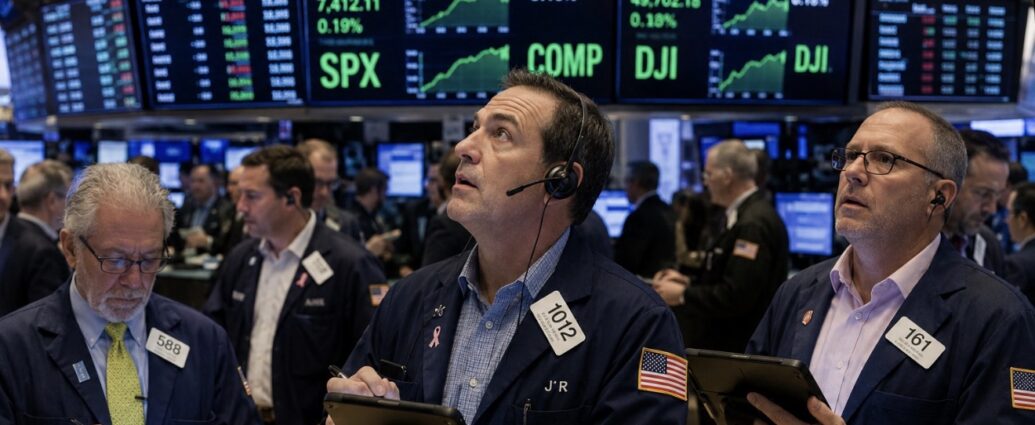
The S&P 500 gained 0.19% to close at a record 7,412.84. The Nasdaq Composite added 0.10% to finish at a record 26,274.13. The Dow Jones Industrial Average rose 95.31 points, or 0.19%, to 49,704.47. The Russell 2000 small-cap index outperformed all three major benchmarks, rising 0.26% to a record close of 2,868.58.
The 10-year Treasury yield climbed 4.6 basis points to 4.41% as oil prices pressed higher and inflation anxiety crept back into bond markets ahead of Tuesday’s CPI print. The CBOE Volatility Index rose more than 7% on the day to 17.19 — a notable uptick even as the indexes themselves kept climbing, a sign that investors are quietly adding downside hedges even while riding the rally.
Breadth told a cautionary story: only 37.8% of U.S. issues advanced on the session, with gains concentrated almost entirely in semiconductors, computer hardware, and energy, while more than 55% of U.S. issues declined.
Intel was Monday’s standout, gaining 5.7% as investor enthusiasm continued to build around the preliminary chip-manufacturing agreement with Apple reported by the Wall Street Journal last week — a deal that would make Apple a customer of Intel’s foundry division, joining Microsoft, Amazon, and Tesla. Intel CEO Lip-Bu Tan confirmed ongoing product collaborations with Nvidia, including custom Xeon CPUs for data centers and integration of Nvidia’s RTX IP into future Intel silicon.
Nvidia itself hit a fresh 52-week high of $222.29 during the session. Advanced Micro Devices gained 2.4% and Micron Technology surged more than 6%, with the broader semiconductor sector providing virtually all of the index-level lift on a day when the rest of the market was largely flat to lower.
Monday.com was Monday’s single biggest gainer among large-caps, surging 26% after the software company reported a first-quarter earnings and revenue beat, with its AI platform helping revenue grow 24% year over year to $351.3 million.
Moderna spiked 7.5% — as high as 9% during the session — after a U.S. citizen tested positive for hantavirus following an outbreak aboard the cruise ship Hondius, with Moderna disclosing it had already been developing a hantavirus vaccine ahead of the public health emergency.
Lumentum rose 7.7% after Nasdaq confirmed the optical and photonic products company will join the Nasdaq-100 on May 18, replacing CoStar Group.
Circle Internet Group gained 3.2% after disclosing a $222 million institutional fundraise for its new Arc blockchain, backed by BlackRock, Apollo, and Andreessen Horowitz, alongside first-quarter revenue that rose 20% year over year.
On the downside, The Trade Desk fell 9% after missing Wall Street earnings expectations and issuing weaker-than-expected second-quarter guidance — the stock’s second significant post-earnings decline of the year, compounding concerns that AI-driven disruption to the programmatic advertising market is weighing on the company’s growth trajectory.
Dollar General slipped 5.8% after offering soft fiscal 2026 guidance and disclosing a leadership transition, adding to a difficult stretch for the discount retailer as it navigates a consumer who is spending selectively.
W.W. Grainger slid 18% as traders locked in gains after the industrial supply company hit record highs the prior week.
Nintendo fell 5.5% after reporting it would raise the Switch 2 price to $499.99 in the U.S. effective September 1, cut its full-year sales forecast, and project a 27% decline in net profit — all driven by the AI-fueled memory chip cost surge that is cascading through consumer hardware pricing globally.
Copper climbed more than 2% to a record close of $6.4605 per pound — up more than 13% year to date — reflecting global demand for the metals that power AI data centers, the electric grid buildout, and clean energy infrastructure.
Citigroup strategist Scott Chronert called the Nasdaq-100 Wall Street’s preferred vehicle for AI exposure, noting that while valuations remain elevated by historical standards, they are not excessively stretched when weighed against expected earnings growth.
Yardeni Research president Ed Yardeni raised his year-end S&P 500 target to 8,250 from 7,700 — the most aggressive forecast on Wall Street, above Oppenheimer at 8,100, Deutsche Bank at 8,000, and Goldman Sachs and JPMorgan at 7,600 — citing 25.6% year-over-year earnings growth this season and what he called an “earnings-led meltup” unlike anything he has seen in decades of market analysis.
The week’s principal risks are stacked into the next 72 hours.
Tuesday’s CPI report — with the Briefing.com consensus at 0.6% for headline and 0.4% for core — will determine whether the Federal Reserve has any room to consider cutting rates before fall, or whether elevated oil prices are leaking into broader consumer prices in ways that extend the current rate pause.
Trump’s Beijing summit, beginning Wednesday, could move markets on any signals around tariff extension, rare earth access, or new bilateral trade mechanisms.
With oil above $100, the ceasefire fraying, and a China visit of enormous geopolitical and commercial significance about to begin, Tuesday’s close may look very different from Monday’s.
JBizNews Desk
© JBizNews.com. All rights reserved. This article is original reporting by JBizNews Desk. Unauthorized reproduction or redistribution is strictly prohibited.