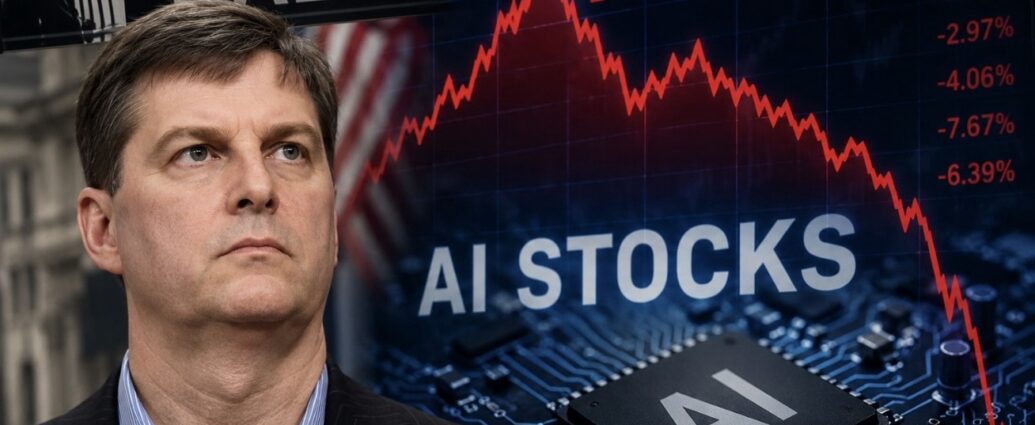
Investor Michael Burry, the hedge fund manager who famously predicted the 2008 housing collapse years before Wall Street recognized the danger, is now warning that the artificial intelligence-fueled technology rally driving U.S. markets to record highs bears an alarming resemblance to the euphoric final phase of the dot-com bubble before it burst in 2000.
In a sharply worded post published on Substack, Burry argued that investors are no longer buying stocks based on economic fundamentals, earnings quality, or consumer demand — but simply because prices continue rising.
“Stocks are not up or down because of jobs or consumer sentiment,” Burry wrote. “They are going straight up because they have been going straight up. On a two letter thesis that everyone thinks they understand.”
“Absolutely non-stop AI,” he added. “No one is discussing anything else throughout the day.”
Burry posted the warning on May 8, the same day the S&P 500 hit another all-time high, underscoring what he sees as a dangerous disconnect between market enthusiasm and underlying economic realities.
The comparison to the late 1990s was deliberate.
“Feeling like the last months of the 1999-2000 bubble,” Burry wrote, directly invoking the speculative mania that sent internet and technology stocks soaring before the Nasdaq ultimately collapsed nearly 78% over the following two years.
At the center of Burry’s concern is the explosive rally in semiconductor stocks — the foundational infrastructure behind the current AI boom.
The Philadelphia Semiconductor Index (SOX) has surged approximately 65% in 2026 alone, including gains of more than 10% in a single week ending May 8. The index includes many of the market’s biggest AI beneficiaries, including Nvidia, Broadcom, Intel, Micron Technology, and Taiwan Semiconductor Manufacturing Co. (TSMC).
The popular semiconductor ETF SOXX now trades roughly 60% above its 200-day moving average, a level of technical extension historically associated either with prolonged corrections or sharp selloffs.
Burry’s concerns extend beyond price momentum into what he views as increasingly distorted earnings quality.
He argues that the Nasdaq 100 is effectively trading at around 43 times earnings, substantially higher than many investors realize because of how stock-based compensation is accounted for in corporate financial reporting.
According to Burry, major technology companies are overstating profitability by failing to fully reflect the dilutive impact of stock compensation expenses.
“Wall Street may be overstating by more than 50% the earnings at our fastest growing, most highly valued companies,” he wrote.
Burry estimates that shareholders effectively receive only about 83 cents of every GAAP-reported dollar of earnings, once stock-based compensation is properly considered.
That accounting adjustment, he argues, pushes real valuation multiples far above what headline earnings ratios imply.
The broader valuation backdrop supports some of his concerns.
The Shiller cyclically adjusted price-to-earnings ratio (CAPE) — one of Wall Street’s most closely watched long-term valuation indicators — stood near 40.1 as of May 8, according to market data.
Historically, CAPE readings above 35 have occurred only during a handful of periods in modern market history, most notably the late-stage dot-com bubble and the years preceding major market corrections.
Burry is not merely talking.
According to disclosures and reporting tied to his investment activity, he has reportedly purchased large January 2027 put options against the iShares Semiconductor ETF, effectively betting on a major decline in semiconductor shares over the next eighteen months.
The positions reportedly imply expectations for a potential decline approaching 30%.
He also disclosed maintaining a “significant leveraged short position” against a broader portfolio of companies he believes remain substantially overvalued.
Despite his bearish stance, Burry cautioned investors against aggressively shorting the market directly.
He warned that speculative rallies can persist far longer than many investors expect, particularly in momentum-driven environments dominated by excitement over transformational technologies.
“Even if it seems there is more time to run up,” Burry wrote, “anyone lucky enough to be riding these parabolic moves, by not selling, is betting on one’s own ability to jump off at or near the top.”
Importantly, Burry is not alone in drawing parallels to the late 1990s.
Billionaire hedge fund manager Paul Tudor Jones, founder of Tudor Investment Corp., recently told CNBC’s Squawk Box that today’s AI boom reminds him strongly of the early commercial expansion of the internet during the mid-1990s.
Jones compared the AI revolution to the launch period surrounding Windows 95, arguing that the market may still have another “year or two to run” before reaching its eventual peak.
But while both investors see echoes of the dot-com era, they interpret the implications differently.
Where Burry sees a collapse approaching, Jones believes the rally may continue substantially higher before a correction ultimately arrives.
Jones warned, however, that if equities rise another 40%, the ratio of total stock market capitalization to U.S. GDP could reach between 300% and 350%, levels he described as potentially setting up “breathtaking corrections.”
The divergence between market optimism and broader economic conditions has become increasingly striking.
On the same day Burry issued his warning, the University of Michigan Consumer Sentiment Index fell to a record low of 48.2, the weakest reading since the survey began in 1952, driven largely by inflation, elevated gasoline prices tied to the Iran conflict, and persistent tariff-related cost pressures.
Yet markets largely ignored the data.
“The recent stock market doesn’t react to employment indicators or consumer sentiment,” Burry wrote. “It simply continues to rise just because it has been rising.”
Burry’s warnings carry unusual credibility because of his history.
His prediction of the U.S. housing collapse before the 2008 financial crisis became one of the most famous successful macro calls in modern investing, later chronicled in Michael Lewis’s bestselling book The Big Short and the Academy Award-winning film adaptation.
At the same time, some of Burry’s later bearish predictions arrived far earlier than markets ultimately corrected, leading critics to describe him as directionally insightful but difficult to time.
That tension may define the current moment as well.
For millions of Americans whose retirement accounts, pension funds, and investment portfolios are increasingly concentrated in AI and technology stocks, the warnings from Burry — combined with historically elevated valuations and rapidly accelerating speculative enthusiasm — are a reminder that markets reaching record highs can also become markets carrying extraordinary risk.
And history has repeatedly shown that the most dangerous bubbles often feel unstoppable right before they break.
JBizNews Desk
© JBizNews.com. All rights reserved. This article is original reporting by JBizNews Desk. Unauthorized reproduction or redistribution is strictly prohibited.