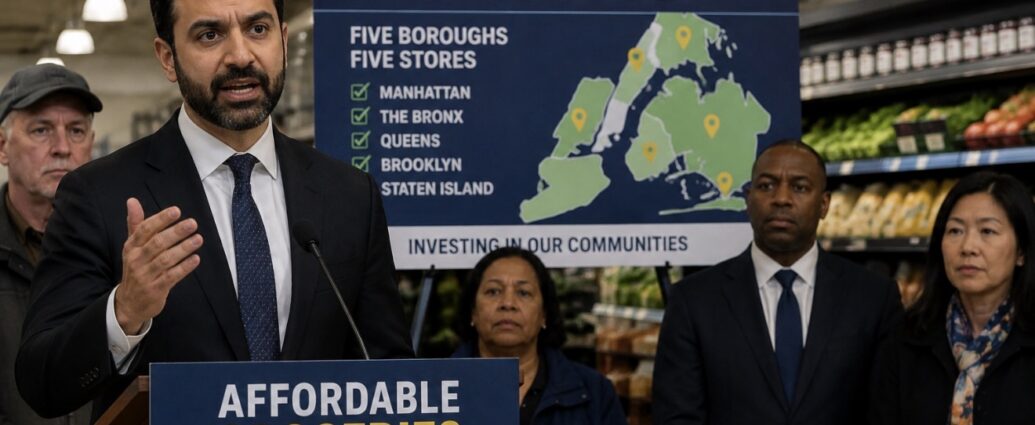
Mayor Zohran Mamdani’s proposal to open five city-owned supermarkets across New York City is rapidly escalating into one of the most closely watched economic and political fights in the city — drawing growing scrutiny from business leaders, national media, and immigrant-owned neighborhood retailers who say the plan could fundamentally reshape Main Street commerce across the five boroughs.
The effort gained immediate attention across New York’s political and media landscape because of the coalition’s unusually high-level business and civic network, with the New York Post, today’s New York Times, and Fox Business Network quickly spotlighting what many inside City Hall now view as one of the most influential emerging multicultural business coalitions and leadership teams to enter New York’s economic debate in years.
During a segment this week on Fox Business Network’s The Bottom Line with Dagen McDowell, McDowell closed the discussion by noting that her own parents made their livelihood operating a bodega and expressed concern that government-backed supermarkets could hurt immigrant-owned neighborhood stores that remain the “bread-and-butter livelihood for everyday people” across New York City.
Now, a newly formed alliance of more than 50 immigrant-led chambers of commerce says it is preparing to formally challenge the proposal before the New York City Council.
The newly launched Multicultural Business Coalition — representing Hispanic, African, Caribbean, Asian, Middle Eastern, and Jewish business organizations — has already assembled a seven-figure political and advocacy operation aimed at slowing or reshaping Mamdani’s supermarket initiative before its first major City Hall test on May 29, when the New York City Council Economic Development Committee is expected to hold its first formal hearing on the administration’s proposed $70 million municipal supermarket plan.
According to coalition chairman Frank Garcia, the organization secured a $1 million donor commitment shortly after launch and raised another approximately $100,000 from small and midsize business owners within days.
Coalition leaders say the issue is not political ideology but economic survival.
“This is not just about supermarkets,” said Duvi Honig, founder of the Orthodox Jewish Chamber of Commerce and secretary of the coalition. “This is the first time such a broad coalition of immigrant-led business organizations from across New York City has united around a single economic issue. It’s about whether government should directly compete against the same immigrant-owned neighborhood businesses that spent decades building these communities, creating jobs, paying taxes, and keeping New York’s commercial corridors alive through some of the toughest economic conditions the city has faced.
“At the same time, this is not about fighting the mayor — we are absolutely prepared to sit down together and have a serious economic discussion about how to lower costs for families while also protecting the bodegas, neighborhood grocers, and small businesses that are the economic backbone and everyday livelihood of New York City.”
That message appears to be resonating well beyond City Hall.
Unlike many previous anti-Mamdani efforts backed primarily by Wall Street donors, developers, or corporate political groups, the resistance emerging here is rooted largely inside neighborhood business corridors and immigrant-owned commercial strips throughout the city.
The coalition argues that government-owned supermarkets would receive structural advantages unavailable to independent operators, including relief from rent burdens, property taxes, financing costs, and other overhead pressures currently squeezing neighborhood grocers already operating on razor-thin margins.
Mayor Mamdani has framed the proposal differently.
The administration argues city-owned supermarkets could reduce grocery costs in underserved neighborhoods by purchasing inventory wholesale, centralizing warehousing and distribution, and operating without a traditional profit motive. The flagship location is planned for the city-owned La Marqueta site in East Harlem, with additional stores proposed across the Bronx, Brooklyn, Queens, and Staten Island.
Supporters of the initiative point to rising food insecurity across the city, with Mamdani repeatedly citing figures showing roughly one in four New York City children experiences some level of food hardship.
But critics argue the economics become more difficult once the realities of the grocery industry enter the equation.
Supermarket analyst Phil Lempert notes that grocery stores typically operate on margins between 1.5% and 2%, among the lowest in American business. Critics argue municipal stores would effectively compete against private neighborhood operators while benefiting from public support structures unavailable to existing businesses.
“A government-owned supermarket is a mission-driven business,” said Stephen Zagor of Columbia Business School. “At best, maybe they break even. More likely, they require ongoing subsidy.”
Several publicly supported grocery projects elsewhere in the country have struggled financially, including efforts in Kansas City, Atlanta, and Baltimore.
Critics also dispute whether some of the proposed New York locations qualify as true “food deserts,” noting that the planned East Harlem flagship already sits within walking distance of multiple supermarkets and dozens of grocery options.
Supermarket owner John Catsimatidis has sharply criticized the initiative, warning that government-backed stores could place additional pressure on neighborhood operators already dealing with inflation, labor costs, theft, insurance increases, and slowing consumer spending.
Meanwhile, the politics around the issue continue intensifying.
Garcia told the New York Post he rejected outreach tied to fundraising efforts connected to Mamdani allies, underscoring how quickly the supermarket debate is evolving into a wider fight over the future direction of New York’s economy.
City Council Speaker Julie Menin has already signaled caution, saying the Council intends to closely examine both the consumer benefits and the potential impact on existing neighborhood retailers before approving funding.
Without Council approval, the proposed $70 million capital package cannot move forward.
Over the coming weeks, what began as a debate over five grocery stores may evolve into something much larger — a test of whether New York City should directly enter industries traditionally built by immigrant-owned small businesses, and whether those same business communities are now becoming a coordinated political force capable of reshaping economic debates at City Hall.
JBizNews Desk
© JBizNews.com. All rights reserved. This article is original reporting by JBizNews Desk. Unauthorized reproduction or redistribution is strictly prohibited.