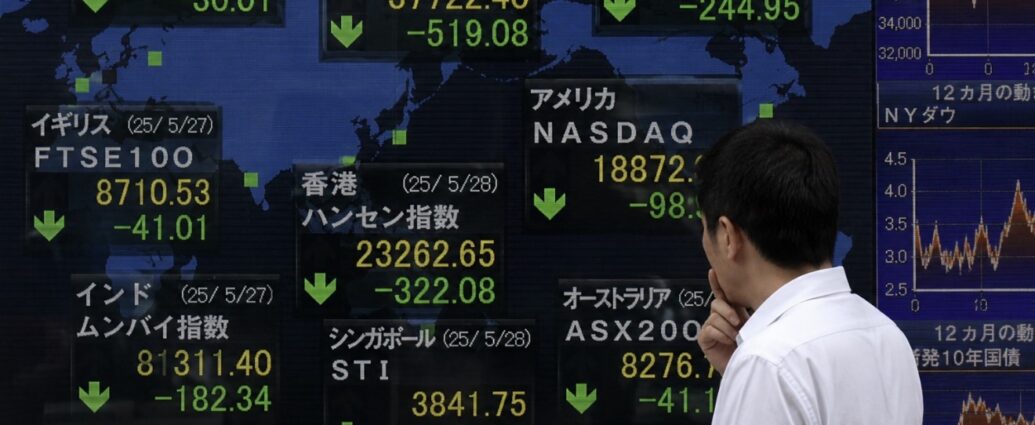
Asian stock markets fell sharply Wednesday as rising global bond yields rattled investors and increased fears that borrowing costs could stay high much longer than markets had hoped.
For everyday investors, the message from global markets is becoming increasingly clear:
higher interest rates are starting to pressure stocks around the world.
Japan led regional losses, with the Nikkei 225 dropping nearly 1% after government bond yields surged to their highest levels since the late 1990s. Markets in South Korea, Australia, Hong Kong and other major Asian economies also moved lower as investors reacted to the ongoing global bond selloff.
The pressure is coming primarily from government bond markets, where yields have climbed rapidly over the past several days.
In the United States:
- The 30-year Treasury yield briefly topped 5.19%
- The 10-year Treasury yield climbed near 4.7%
Those are some of the highest levels seen in nearly two decades.
In simple terms, rising bond yields mean borrowing money becomes more expensive throughout the economy.
That affects:
- Mortgage rates
- Business loans
- Credit cards
- Corporate borrowing
- Government financing costs
Higher yields also tend to hurt stocks because safer investments like bonds begin offering more attractive returns relative to equities.
The latest surge has been fueled largely by concerns that inflation may remain stubbornly high because of the ongoing Iran war and elevated oil prices.
Crude oil has stayed near $110 per barrel, increasing fears that energy costs could continue pushing inflation higher globally.
As a result, investors are rapidly abandoning expectations that central banks will cut interest rates anytime soon.
Some analysts are now even discussing the possibility that the Federal Reserve may eventually need to raise rates again if inflation pressures worsen.
That shift in expectations has triggered heavy selling across global bond markets.
Japan’s move is especially important because Japanese investors are among the largest holders of U.S. government debt.
As Japanese bond yields rise at home, investors may increasingly move money out of U.S. assets and back into Japan, potentially adding even more pressure to global financial markets.
Technology and AI-related stocks have also come under pressure, particularly in South Korea and Hong Kong.
South Korea’s market has been especially volatile in recent sessions as investors reassess valuations in semiconductor and AI companies after enormous rallies earlier this year.
Markets are now closely watching Nvidia earnings later Wednesday, which could heavily influence sentiment across global technology stocks.
China’s slowing economy is adding another layer of concern.
Recent Chinese economic data has disappointed investors, with weaker-than-expected retail sales and industrial output raising fears about slowing demand across Asia.
At the same time, geopolitical uncertainty remains elevated.
Russian President Vladimir Putin arrived in Beijing this week for meetings with Chinese President Xi Jinping, while markets continue monitoring developments tied to the Iran conflict and broader global tensions.
Despite the selloff, some sectors have held up better than others.
Australia’s market, for example, has been somewhat supported by mining and commodity companies benefiting from higher raw material prices.
Still, analysts say the direction of global markets now depends heavily on one central issue:
whether bond yields continue rising.
If yields stabilize, stock markets could recover relatively quickly.
But if inflation stays elevated and central banks become even more aggressive, investors may face continued pressure across both stocks and bonds — an unusually difficult environment for traditional portfolios.
For now, markets around the world are adjusting to a reality investors had hoped to avoid:
higher interest rates may not be going away anytime soon.
— JBizNews Desk
© JBizNews.com. All rights reserved. This article is original reporting by JBizNews Desk. Unauthorized reproduction or redistribution is strictly prohibited.