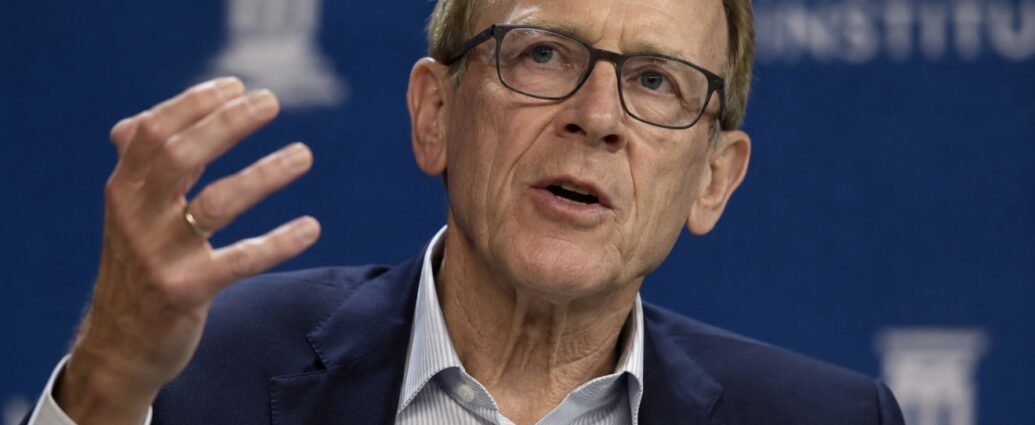
John Doerr, the Kleiner Perkins chairman who wrote the 1999 check that turned Google into a $3.89 trillion company, said in a Wall Street Journal interview published Saturday, May 23, 2026, that artificial intelligence is the “biggest thing ever, since everything” and that the technology, far from being overhyped, “has been underhyped.”
The comments cut directly against a growing chorus of skeptics on Wall Street.
Doerr, 74, has tracked what he calls innovation “tsunamis” through five decades in venture capital. His timeline runs from the 1980 personal computer and microchip revolution, to the 1990s internet and browser wave, to the iPhone and cloud era of the late 2000s. By his reckoning, the tsunamis arrive roughly every 13 years. The current AI wave, he told the Journal, is bigger than all of them.
“We don’t know how AI is going to shape the new world of education, employment, healthcare — life as we know it,” Doerr said. “There is an insatiable hunger and appetite for electrons, and as in previous tsunamis, there will be winners and there will be losers.”
The interview lands at a tense moment in markets. Microsoft has guided to roughly $80 billion in AI-related capital spending in fiscal 2025, Alphabet to about $75 billion, Meta Platforms to as much as $65 billion, and Amazon to more than $100 billion. Nvidia, the chipmaker powering most of that buildout, has added trillions of dollars in market capitalization since OpenAI launched ChatGPT in late 2022. MIT economist Daron Acemoglu and Goldman Sachs head of global equity research Jim Covello have argued AI’s productivity payoff is being overestimated and that current spending resembles a classic late-cycle bubble. Doerr’s “underhyped” call comes from the investor who made the same contrarian bet on the internet in the late 1990s and was vindicated despite the dot-com crash.
Doerr backed his AI thesis with a striking adoption number. Three years after ChatGPT’s launch, 50% of Americans now say they use generative AI — a curve that has compressed into roughly half the time the consumer internet took to reach comparable scale. “The value creation is off the charts,” he told the Journal.
His current investing focus, he said, is funding entrepreneurs using AI in two areas: the climate transition and healthcare. He has invested in both sectors for nearly two decades, first through Kleiner Perkins, where he became chairman in 2016, and now also through his family office. His most recent disclosed AI investment, Hippocratic AI, a medical large language model company, closed a Series C round in November 2025. He remains on the board of Alphabet.
The interview produced Doerr’s sharpest line yet on what venture capital actually is. “At its heart, the venture-capital business is a human-capital business,” he said. That framing, he explained, is why he stayed out of cryptocurrency. He did not see human capital “playing a powerful role in the kind of innovation and market development.” He added that “there is still plenty of time for me to be wrong in that judgment.”
Doerr was also frank about his misses. After backing both the Segway and the failed electric-car maker Fisker, he said his partners reminded him of a venture saying: “never invest in anything with wheels.” He missed Tesla, now the world’s most valuable automaker under chief executive Elon Musk. But he reframed the lesson in the asymmetric math of venture investing. “You can only lose one time your money. You can make many times it if you get it right.”
The Google story remains the defining moment of his career. Doerr met Larry Page and Sergey Brin in 1999 at Google’s birthplace, a garage in Menlo Park. He wrote a $12 million check for 12% ownership at a $100 million valuation — at the time, the largest check at the highest price his firm had ever written. The investment is now worth nearly $470 billion on paper at Alphabet’s current market capitalization. “What made me fall off my chair was how big Larry and Sergey thought improving search could be,” Doerr told the Journal. “They saw something the rest of us hadn’t yet.”
That ability to back founders who see further is, in Doerr’s view, the entire job. The most amazing entrepreneurs, he said, “see the world differently than everyone else. They are fluent in using technology to change that world.” They are good recruiters and even better sellers — selling their vision to teammates, to customers, and to investors. His first filter when meeting a founder: “Would I mind getting into trouble with them?” Because no matter how successful a venture looks from the outside, “you take the lid off the can and inside it’s a can of worms.”
Doerr also made the broader economic case for venture capital. Over the last half-century, he noted, venture-backed companies accounted for 81% of patents issued to U.S. public companies by the U.S. Patent and Trademark Office. There were 5.3 million jobs at VC-backed companies in 2022 alone. “That isn’t an accident,” he said. “That’s a structural phenomenon that America enjoys.”
For investors, the immediate signal from the WSJ interview is not a trading call. Doerr’s comments will not move single names the way an analyst upgrade does. But the message will land in capital-allocation rooms. Major endowments, sovereign wealth funds, and pension plans take cues from venture capital legends in setting long-horizon technology weights. PitchBook data show U.S. venture deployment to AI startups held at record levels through the first quarter of 2026, with OpenAI, Anthropic, xAI, Mistral AI, and Perplexity all attracting multibillion-dollar rounds.
The political dimension is also live. Doerr has been an active voice in Washington, urging more federal AI research funding and faster deployment across U.S. industry. White House AI czar David Sacks has echoed parts of that framing, warning the U.S. risks losing the global AI race through what he calls “pessimism.” International Monetary Fund managing director Kristalina Georgieva in January separately warned of an AI “tsunami” coming for young workers and entry-level jobs. The same word now spans both bullish and cautionary takes on the technology.
Doerr bet against consensus on the internet in the 1990s, and the consensus was wrong. He has now placed the same bet on AI. Wall Street will spend the rest of this decade finding out whether the man who saw Google first has seen this one too.
— JBizNews Desk
© 2026 JBizNews. All Rights Reserved. Reproduction or distribution without written permission is prohibited.