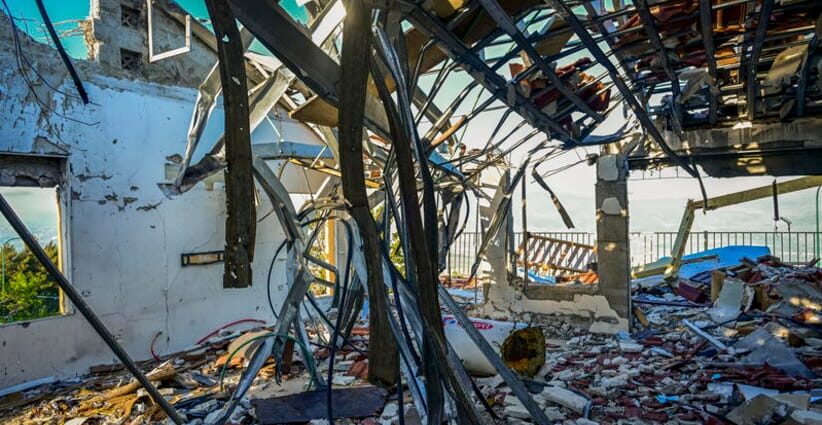
In response to ongoing Hezbollah drone attacks, which have harmed an increasing number of IDF soldiers, Israel confirmed on Tuesday that the military has invaded deeper into Lebanon beyond the April 17 ceasefire yellow line.
It was unclear how much deeper the IDF would penetrate, though for the moment, it appears the penetrations are temporary, with no intent to hold onto additional territory.
Yet, when the IDF initially entered southern Lebanon, its initial goals were only to take over a few kilometers.
It only pushed deeper toward the Litani River when its initial invasion failed to stop Hezbollah from striking Israel’s northern border towns.
In that sense, how far the IDF may go could depend on whether the new moves actually block Hezbollah from striking those northern villages.
IDF to expand beyond security zone in southern Lebanon
Moreover, Prime Minister Benjamin Netanyahu on Tuesday night suggested that the IDF may hold onto some of the new areas its ground forces have moved into to establish a larger security zone in southern Lebanon.
אנחנו מעמיקים את הפעולה שלנו בלבנון. תודה למפקדים ולחיילים הגיבורים שלנו בעומק השטח! pic.twitter.com/XBN8wJZ9in
— Benjamin Netanyahu – בנימין נתניהו (@netanyahu) May 26, 2026
Further, in prior interviews, multiple IDF officials cited specific locations beyond the yellow line, near their existing positions, from which they believed they could reduce the drone threat if they occupied those positions.
In fact, on April 29, IDF Brigade 7 Commander Col. Shaul Yisraeli expressed frustration to the Jerusalem Post that the April 17 ceasefire with Hezbollah has generally restrained him from initiating attacks further into central or northern Lebanon to reduce the terror group’s long-range attacks on his troops.
He said Hezbollah was using strategic points nearby, but slightly further north, to continue to regularly launch aerial attacks on his forces, and that at the same time, the ceasefire was not allowing him to secure those areas so that his forces would be less threatened.
After all of this, if Hezbollah simply moves its drones and launching teams back further, it could potentially continue to launch drones on IDF forces.
At press time, multiple IDF officials had failed to explain how pushing Hezbollah from around 10 kilometers from Israel’s border to around 12 kilometers back would stop the Lebanese terror group from launching drones at Israel with a 30-kilometer range.
Whether the latest IDF penetration is truly designed to gradually increase Israeli control of Lebanese territory as a pressure point to get Hezbollah to reduce drone attacks or even agree to partial disarmament, or whether it is more symbolic to try to convince the Israeli public that the IDF and government are responding harshly to the drone attacks, also remains unclear.
Throughout the day on Tuesday, Hezbollah continued to launch drones against IDF soldiers in southern Lebanon and in northern Israel.
Meanwhile, earlier on Tuesday, the IDF announced that overnight, the air force had struck over 100 Hezbollah terror infrastructure sites and terrorists not only in southern Lebanon, but also in the Bekaa Valley, around 100 kilometers deep into the country.
Specifically in southern Lebanon, the IDF attacked more than 90 of Hezbollah’s weapons storage facilities, command centers, and lookout posts.
All of this occurs as the world expects the Trump administration to soon reach a ceasefire with Iran, which will likely impose a fuller ceasefire on the IDF versus Hezbollah.
When the April 17 ceasefire went into effect, the IDF respected it beyond the yellow line, but insisted it had the right to continue destroying Hezbollah assets and killing the terror group’s fighters in parts of southern Lebanon that it took control of pre-ceasefire.
Hezbollah rejected this position and said that continued IDF actions in southern Lebanon gave it the right to continue drone and rocket strikes on IDF soldiers.
Yet, the IDF has mostly avoided striking Hezbollah in Beirut, even after IDF Chief of Staff Lt.-Gen. Eyal Zamir demanded that the Israeli security cabinet allow him to return to such attacks following rising casualties to Israeli soldiers and harm to Israeli northern towns from Hezbollah drone strikes.