By JBizNews Desk
LONDON — The head of Britain’s electronic intelligence agency will warn Wednesday that China is rapidly closing the technological gap with the West and that the United Kingdom and its allies are running out of time to maintain their advantage in artificial intelligence and cyber capabilities, a message landing as cybersecurity and AI stocks continue driving global equity markets to record highs.
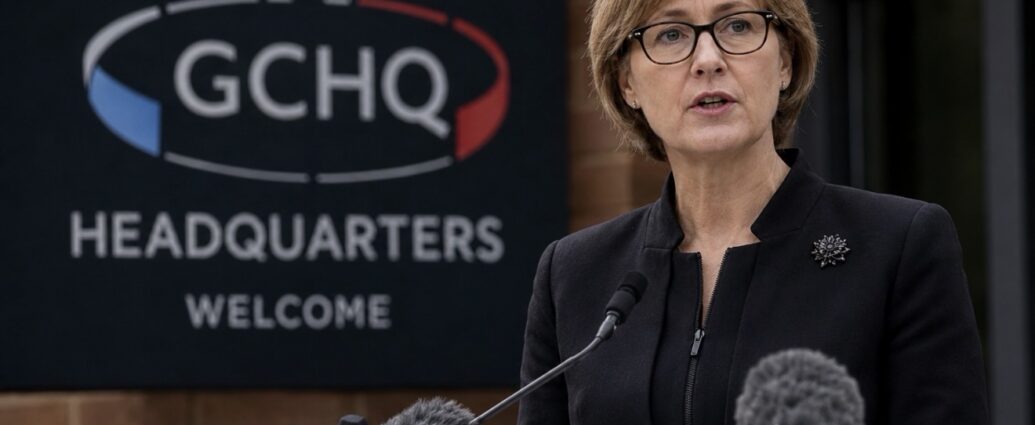
Anne Keast-Butler, director of GCHQ — Britain’s signals intelligence and cybersecurity agency, roughly equivalent to America’s National Security Agency (NSA) — is delivering the warning during the organization’s first-ever annual lecture at Bletchley Park, the historic World War II codebreaking center associated with mathematician Alan Turing.
According to excerpts released ahead of the speech, Keast-Butler plans to describe the current environment as “a new era of radical uncertainty, contested geopolitics and rapidly changing technology,” warning that “the risk of miscalculation is as high as I’ve ever seen it.”
Her central message is direct: China has become “a science and tech superpower” with sophisticated cyber, intelligence and military capabilities, while the rise of artificial intelligence is accelerating the pace of strategic competition.
In practical terms, Western intelligence officials are increasingly warning that the technological gap separating Chinese and Western cyber capabilities is narrowing much faster than governments anticipated only a few years ago.
That matters because GCHQ rarely speaks publicly in this way.
Historically, the agency operates with minimal public visibility. When senior British intelligence officials deliver unusually direct warnings to business leaders, it is often interpreted inside government and financial circles as a sign the threat assessment inside the broader Five Eyes intelligence alliance — the United States, United Kingdom, Canada, Australia and New Zealand — has materially shifted.
The speech also underscores how closely national security, artificial intelligence and financial markets have now become intertwined.
Over the past year, investors have poured money into cybersecurity firms including Palo Alto Networks, CrowdStrike Holdings, Zscaler, Fortinet and SentinelOne, while semiconductor companies tied to AI infrastructure — including Nvidia and Advanced Micro Devices — have surged on expectations of massive government and private-sector spending tied to AI competition and cyber defense.
Much of that demand stems directly from the environment Keast-Butler is describing.
She is also expected to warn that Russia is “scaling up its daily hybrid activity” against Britain and Europe by targeting “critical infrastructure, democratic processes, supply chains and public trust.”
GCHQ officials say they are increasingly focused not only on traditional espionage but also on cyberattacks aimed at transportation systems, utilities, communications infrastructure and corporate networks.
Earlier this year, Dr. Richard Horne, head of Britain’s National Cyber Security Centre, the defensive cybersecurity arm of GCHQ, said hostile-state cyber activity against the UK now averages roughly four nationally significant incidents per week, with China, Russia and Iran identified as the primary sources.
The warnings are not theoretical.
Over the past 18 months, major British companies including Marks & Spencer, the Co-op Group and Jaguar Land Rover have suffered significant cyberattacks disrupting operations, exposing customer data and generating substantial financial losses.
British officials increasingly frame those incidents not simply as IT problems but as national economic-security threats.
“Cyber security is now a matter of business survival,” British officials have repeatedly warned in recent months.
For American investors, the implications are increasingly visible across multiple industries.
Cybersecurity spending is accelerating because corporations and governments alike now assume they face persistent attacks from sophisticated state-backed actors using increasingly advanced AI tools for phishing, intrusion and supply-chain compromise operations.
The same geopolitical pressures are also driving enormous investment in AI computing infrastructure.
Companies such as Nvidia, AMD and other semiconductor suppliers are not simply selling hardware to commercial data centers. They are increasingly selling into government, intelligence and defense ecosystems across the United States and allied countries racing to expand AI computing capacity ahead of China.
That demand helps explain why semiconductor stocks have become one of the market’s dominant themes.
The timing of the speech is also notable.
Only weeks ago, Beijing confirmed an order for 200 Boeing aircraft, publicly describing aviation as “a key area for U.S. cooperation” — part of broader efforts by both Washington and Beijing to stabilize portions of the economic relationship.
Yet on the intelligence and technology side, rhetoric from Western capitals is moving sharply in the opposite direction.
The tone coming from intelligence chiefs has grown increasingly blunt. Governments are engaging more directly with private-sector executives. And Western corporations are facing growing pressure to treat cyber defense as a strategic operating priority rather than merely a regulatory or compliance function.
The venue itself carries symbolic weight.
Bletchley Park was where British and American codebreakers worked together during World War II, laying the foundation for the intelligence-sharing alliance that eventually became Five Eyes. The speech also coincides with the 80th anniversary of the UKUSA Agreement, the original intelligence treaty linking the two countries.
At the same location in 2023, Western governments and Chinese officials signed the Bletchley Declaration on AI Safety, highlighting the increasingly complicated balance between technological cooperation and strategic rivalry.
The message from Wednesday’s speech ultimately points toward the same conclusion increasingly reflected in financial markets:
The global battles over artificial intelligence, semiconductors, cyber defense and critical infrastructure are no longer separate stories. Governments, intelligence agencies and investors are increasingly treating them as part of the same strategic competition.
And according to Britain’s top cyber official, that competition is accelerating faster than many Western governments expected.
Europe — JBizNews Desk
© JBizNews.com All Rights Reserved. Reproduction or distribution without written permission is prohibited.