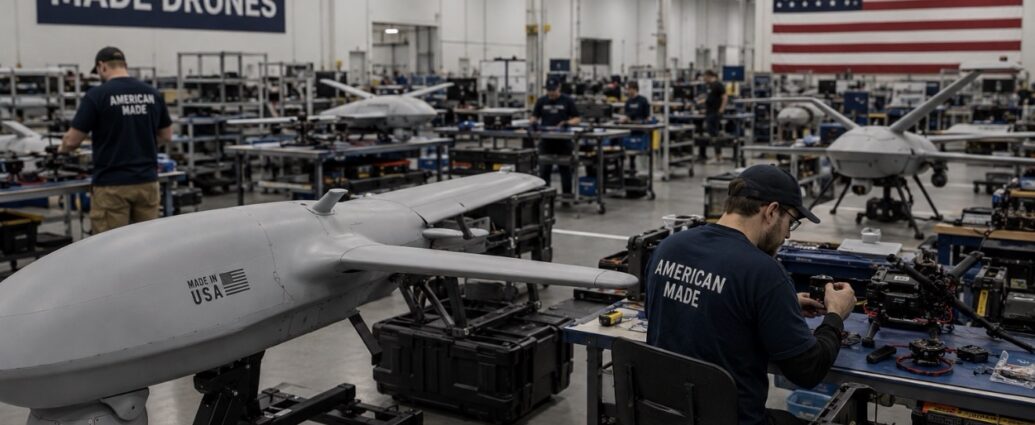
The federal government is preparing to write the biggest checks American drone manufacturers have ever seen — and, in a sharp break from how Washington has historically done business with defense contractors, it intends to take ownership in return.
The Pentagon and the Commerce Department are in active discussions with U.S. drone companies about a mix of grants, loans and direct equity investments tied to building out a domestic supply chain for military unmanned systems, according to filings, public statements and reporting from multiple outlets. The talks follow President Donald Trump’s December 2025 ban on imported Chinese drones and components on national-security grounds — a decision that effectively erased the lowest-cost option from the U.S. market overnight and turned the Pentagon into the buyer of last resort for an industry that did not yet have the capacity to fill the gap.
The scale of what is coming has snapped into focus over the past several weeks. The Pentagon has already earmarked $1.1 billion to stand up a domestic manufacturing base for armed drones. Needham analyst Austin Bohlig estimates that $63 billion of the administration’s fiscal 2027 defense request is directed at unmanned or drone-related technology — more than six times current spending — with roughly $55 billion of that flowing into a new program the Pentagon is calling the Defense Autonomous Weapons Group, aimed at producing low-cost expendable drones at speed.
Defense Secretary Pete Hegseth has issued directives requiring every U.S. Army squad to be equipped with small one-way attack drones — first-person-view, or FPV, drones costing under $2,000 each — by the end of fiscal 2026. The initial Army purchase is small at roughly 10,000 units, but procurement officials have signaled it is the front end of a far larger order book.
The companies in line to build them are no longer guessing about demand. AeroVironment, maker of the Switchblade loitering munition, posted record fiscal 2025 revenue of $820.6 million, up 14.45% on the year, and has announced plans to invest $1.5 billion to expand production. Kratos Defense, whose XQ-58A Valkyrie jet-powered drone has entered Marine Corps production status, reported 2025 revenue of $1.347 billion and guided to between $1.595 billion and $1.675 billion for 2026. Chief Executive Eric DeMarco has set a revenue target of $2.5 billion to $3 billion by 2028.
Palantir, whose software is increasingly used to coordinate drone fleets, reported first-quarter 2026 revenue of $1.63 billion. Smaller names — Red Cat Holdings, Ondas Holdings, Draganfly and Unusual Machines — have all reported new federal contracts in the past year.
What is genuinely new is how the government is paying.
In December, the Defense Department announced a $1.4 billion financing package for Vulcan Elements, a roughly 30-person rare-earth magnet startup whose magnets feed drone motors, radar systems and other military electronics. The deal includes a $620 million Pentagon loan, $50 million in equity for the Commerce Department, warrants giving the Defense Department the option to acquire a future stake, and $550 million from private investors. ReElement Technologies received a parallel award. The Vulcan structure mirrors the equity model the administration has now used repeatedly: a 10% stake in Intel, becoming the largest shareholder in rare-earth miner MP Materials, a 10% stake plus warrants in Trilogy Metals, a 5% stake in Lithium Americas, and a “golden share” governance role in the Nippon Steel–U.S. Steel combination.
Commerce Secretary Howard Lutnick has publicly said the administration is studying similar arrangements with traditional prime contractors.
“Lockheed Martin makes 97% of their revenue from the U.S. government. They are basically an arm of the U.S. government,” Lutnick told CNBC, when asked whether stakes in Lockheed, Boeing or Palantir were under consideration. “There’s a monstrous discussion about defense.”
For drone makers, the implications are concrete. A Pentagon willing to take equity is a Pentagon willing to write much larger checks — and to underwrite manufacturing capacity that no commercial customer would finance on its own. It also locks the federal balance sheet directly into the upside, or downside, of the companies it picks.
That last point has drawn scrutiny. President Trump’s sons Eric Trump and Donald Trump Jr. have taken equity stakes in multiple drone and defense-adjacent ventures, including Powerus, Unusual Machines, Anduril Industries and the Israeli drone maker Xtend — companies operating in sectors where their father’s administration is now also a potential equity partner. Eric Trump told the Associated Press he is “incredibly proud to invest in companies I believe in,” adding that “drones are clearly the wave of the future.”
For an industry that has spent two decades watching China dominate the consumer and component sides of the drone business, the new posture from Washington — buy American, fund American, and own a piece of American — is the most direct industrial-policy intervention the U.S. defense base has seen in a generation. Whether it produces the drones the Pentagon actually needs, at the prices it has set, is the next question.
Washington — JBizNews Desk
© JBizNews.com All Rights Reserved. Reproduction or distribution without written permission is prohibited.