Lawmakers told the president to stop fighting Iran. The vote won’t end the war by itself — but it shows how much the war’s cost, from pricier gas to a falling stock market, is starting to bite.
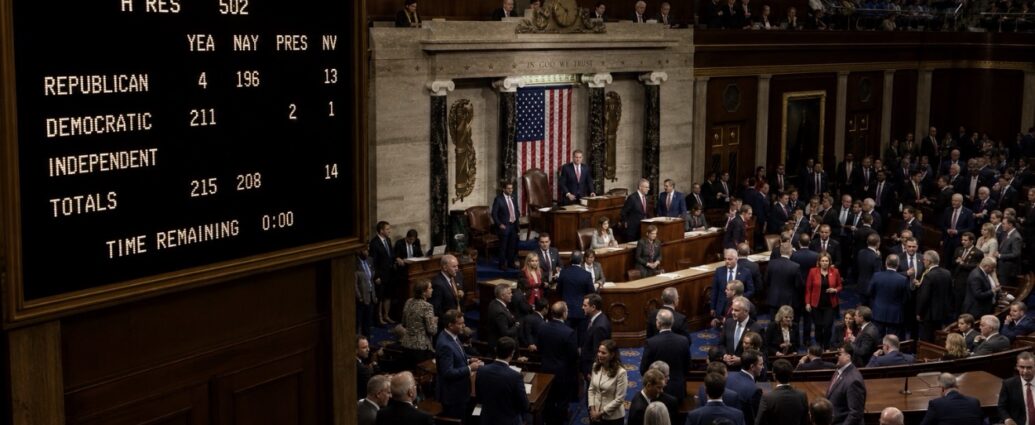
WASHINGTON, D.C.—For the first time since the Iran conflict began more than three months ago, Congress has formally voted to limit President Trump’s war powers. The House voted 215-208 on Wednesday to direct the administration to end U.S. military involvement in Iran unless Congress authorizes continued military action. The vote comes as the economic consequences of the conflict are increasingly being felt across the country, with oil prices approaching $100 a barrel, stock markets retreating from record highs, and inflation concerns resurfacing.
The House voted 215 to 208 to tell the president to stop the war with Iran. Four Republicans crossed over to join Democrats in passing the measure.
This kind of vote is called a War Powers Resolution. In plain terms, it is Congress reminding the president that, under the Constitution, only Congress is supposed to take the country to war. The resolution orders the president to pull U.S. troops out of Iran unless Congress votes to authorize continued military action.
So does this end the war?
Not by itself.
Here is why. The president can reject it — that is called a veto — and Trump is expected to do exactly that. To force him to comply anyway, Congress would need a two-thirds majority in both chambers, a much higher threshold known as a veto-proof majority. Lawmakers do not currently have those numbers, and the Senate has not yet passed its own version of the measure.
Then why does it matter?
Because it is rare.
This is the first time since the conflict began more than three months ago that either chamber of Congress has approved such a measure on a final vote. It also happened in a House controlled by Trump’s own party. When members of a president’s party break with him on a war vote, it is often viewed as a sign that concern about the conflict is spreading.
Much of that concern centers on the economy.
War in the Middle East has historically pushed oil prices higher, and Wednesday provided another example. Iran fired missiles at Kuwait and Bahrain, U.S. forces responded, and oil rose for a third consecutive day. Brent crude, one of the world’s key oil benchmarks, climbed toward $98 a barrel.
Why should that matter to the average family?
Because oil touches nearly everything.
When oil becomes more expensive, gasoline becomes more expensive. The trucks, ships, and airplanes that move food and consumer goods also become more expensive to operate. Businesses often pass those higher costs along to consumers. As a result, groceries, deliveries, travel, and countless everyday products can become more expensive.
Economists call that process inflation.
The connection may seem distant, but history shows energy prices have a way of reaching nearly every household. Every major jump in oil prices eventually works its way through transportation, manufacturing, shipping, and utility costs. Even Americans who never follow foreign policy can end up feeling the effects of events unfolding thousands of miles away.
That ripple reached Wall Street on Wednesday.
The three major U.S. stock market indexes all fell. The Dow Jones Industrial Average dropped 1.21%, the S&P 500 lost 0.73%, and the Nasdaq Composite slid 0.89%, just one day after all three reached record highs.
The war is also influencing expectations for interest rates.
The Federal Reserve, the nation’s central bank, raises or lowers interest rates to help control inflation and support economic growth. When inflation accelerates, the Fed often raises rates. Higher rates typically make mortgages, auto loans, business loans, and credit cards more expensive.
Only weeks ago, investors expected the Fed, under new Chairman Kevin Warsh, to cut rates later this year. Now, as oil prices climb and inflation concerns return, many traders believe the next move could be a rate increase instead.
Much of that concern centers on one narrow stretch of water known as the Strait of Hormuz.
Roughly 20% of the world’s oil supply passes through the waterway each day. If shipping is disrupted—or even threatened—global oil prices can rise quickly. President Donald Trump has said a deal to keep the strait open could be reached within a week, though Iranian media outlets have expressed skepticism about the prospects for a near-term agreement.
Not everyone supported the House vote.
Most Republicans backed the president.
House Foreign Affairs Committee Chairman Brian Mast of Florida dismissed the measure as “a stupid political vote.”
Rep. Abe Hamadeh of Arizona argued that the conflict had effectively ended months ago.
“The war for all intents and purposes ended back in April,” Hamadeh said, adding that Trump should be allowed to continue negotiating a peace arrangement.
Supporters saw the issue differently. They argued that the conflict has dragged on, cost lives, increased economic uncertainty, and that Congress deserves a formal role in determining whether U.S. military involvement should continue.
Rep. Brian Fitzpatrick of Pennsylvania was among the four Republicans who joined Democrats in voting for the measure.
What happens now?
The battle shifts to the Senate, where a similar proposal led by Sen. Tim Kaine of Virginia has yet to receive a final vote. Even if both chambers ultimately approve the measure, Trump would still retain the power to veto it.
The bottom line for businesses and families is far simpler than the politics unfolding in Washington.
As long as fighting continues and oil remains elevated, gasoline prices, grocery costs, inflation expectations, and financial markets are likely to remain sensitive to every headline coming out of the Gulf.
Wednesday’s vote will not bring a single soldier home, nor is it likely to end the conflict on its own. But it delivered a clear message: as oil prices rise, markets react, and inflation fears return, the economic consequences of the war are becoming harder for lawmakers to ignore.
Whether Congress ultimately changes U.S. policy or not, the costs of the conflict are already being felt far beyond the battlefield—in gas stations, grocery stores, retirement accounts, and household budgets across America.
Washington, D.C. — JBizNews Desk
© JBizNews.com All Rights Reserved. Reproduction or distribution without written permission is prohibited.