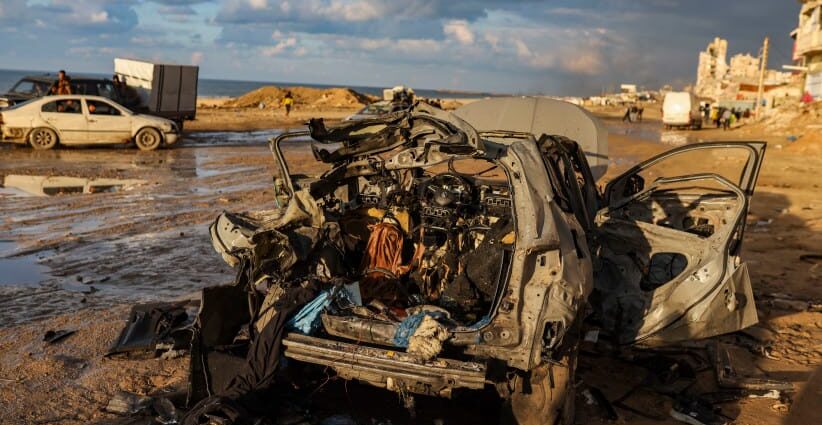
After nearly two decades of Hamas rule in the Gaza Strip, it is time to ask a question that can no longer be ignored: What has this political model ultimately delivered for the people of Gaza?
For millions of Palestinians who have lived through these years, this is no longer an ideological debate or a partisan struggle between Hamas and its rivals. It is a question of measurable outcomes. Gaza, which was once expected to become a model of Palestinian self-governance, has instead become one of the most fragile, impoverished, and aid-dependent territories in the world.
Wars have repeatedly devastated the Gaza Strip. Infrastructure has deteriorated. Economic opportunities have collapsed. A generation of young people has grown up with little hope for a better future. While political leaders continued to speak in the language of resistance, victory, and historical missions, ordinary civilians were left to confront unemployment, poverty, insecurity, and uncertainty about the future of their children.
Today, after years of destruction and suffering, many Gazans are beginning to ask different questions. They are no longer asking who will win the next battle. They are asking what will remain of Gaza after the war ends. They are asking what kind of political system can protect civilians, provide stability, and prevent future generations from experiencing the same cycle of violence.
The difficult truth is that Gaza is not suffering only from war. It is suffering from a prolonged crisis of leadership.
The Palestinian political system, both inside and outside Gaza, has repeatedly failed to produce a governing model capable of delivering security, prosperity, accountability, and long-term stability. The result has been a population trapped between competing power centers while its basic needs remain unmet.
From failure to a civil alternative
This is where the Civil Opposition to Hamas begins.
We do not present ourselves as an extension of Fatah. We do not present ourselves as an alternative faction seeking to replace Hamas while preserving the same political culture. Nor do we seek to become another party competing for power within a broken system.
Instead, we seek to advance a new political and civic vision based on a simple principle: Human beings must matter more than political movements. The interests of ordinary people must matter more than the interests of organizations. The future of children must matter more than the ambitions of political elites.
The Palestinian experience over recent decades has demonstrated that elections alone are not sufficient to create a healthy political system. Societies emerging from conflict require functioning institutions, civic culture, rule of law, accountability, and public trust. Without these foundations, democratic mechanisms can become vulnerable to polarization, manipulation, and institutional collapse.
Years of political division, ideological indoctrination, and factional rivalry have weakened civic life and narrowed the space for independent political thought. For this reason, genuine reform in Gaza cannot simply be about changing faces or replacing one faction with another. It must involve rebuilding institutions and restoring the relationship between citizens and government.
The Civil Opposition believes that Gaza’s future requires a strong transitional civil administration supported by professional institutions capable of enforcing the rule of law, protecting civilians, and preventing the return of armed domination over public life. Stability cannot be built on slogans alone. It requires functioning institutions that serve the public interest and protect individual rights.
True peace is not merely the absence of war.
True peace means that a father can send his children to school without fear. It means that a mother can access healthcare when she needs it. It means that young people can find employment and build careers. It means that citizens trust that the law protects them regardless of their political affiliations.
From this perspective, the Civil Opposition proposes several principles for Gaza’s future:
First, the creation of a modern educational system focused on science, technology, critical thinking, languages, and openness to the wider world, including Hebrew language education as a practical tool for understanding the region in which Gazans live.
Second, the establishment of civilian safe zones free from armed factional activity, where civilian life and economic development can flourish without military interference.
Third, the strengthening of the rule of law and accountability mechanisms to ensure that no individual or organization stands above legal responsibility.
Fourth, the launch of large-scale economic reconstruction programs capable of creating jobs, attracting investment, and restoring hope for younger generations.
Fifth, the rebuilding of infrastructure, schools, universities, hospitals, and public services necessary for a functioning and prosperous society.
Sixth, the facilitation of civilian mobility and travel through reliable and sustainable arrangements that allow Gazans to connect with the outside world.
Seventh, the development of practical economic and civil cooperation with all regional actors willing to contribute to stability, security, and prosperity.
Many Gazans today are not searching for another military victory. They are searching for a normal life. They want homes instead of ruins, schools instead of shelters, jobs instead of dependency, and opportunities instead of despair.
Likewise, residents of the Israeli communities bordering Gaza do not wish to return to a future defined by rockets, sirens, and recurring wars. There is a shared human interest on both sides of the border: security, stability, and the ability to raise children in peace.
For this reason, Gaza’s future should not be built on revenge, perpetual conflict, or the political formulas that have repeatedly failed the people. It must be built on a new vision that places human dignity, security, and opportunity at the center of political life.
This vision may appear ambitious under current circumstances. Yet every major political transformation in history began as an idea that many considered impossible.
What seems unrealistic today may become achievable tomorrow if supported by responsible leadership, institutional reform, and a population determined to build a different future.
Those of us who advocate a civil alternative understand that trust cannot be won through rhetoric alone. It must be earned through action, transparency, and results. We recognize that the road ahead will be long and difficult.
Nevertheless, we believe that Gaza deserves more than the repetition of past failures. Its people deserve the opportunity to live in security, dignity, and freedom. They deserve institutions that serve them rather than control them. They deserve leaders who view public service as a responsibility rather than a source of power.
Ultimately, Gaza’s future should not be determined by weapons, factions, or ideology. It should be determined by the fundamental right of every human being to live a safe, productive, and dignified life.
Only when that principle becomes the foundation of governance can a genuine new beginning emerge for Gaza and for the broader region.
The writer is a Gazan political activist living in Belgium and the co-founder of the We Want to Live movement.