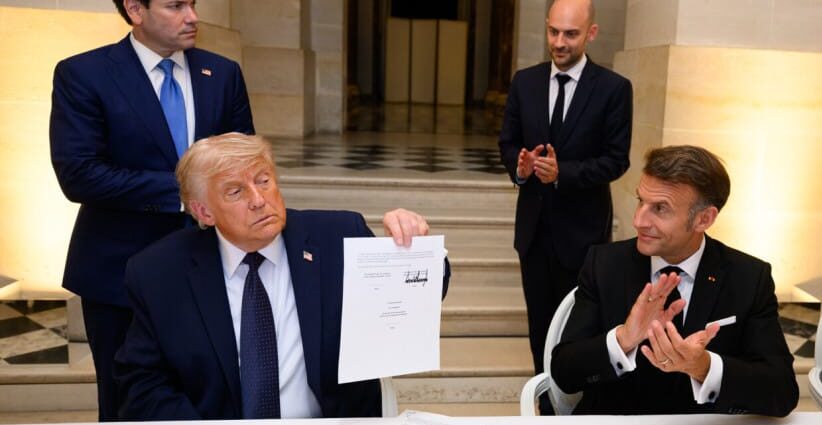
A growing number of Jewish groups are pushing back against the new memorandum of understanding brokered between US President Donald Trump and Iran.
At least for now, however, their responses are more muted than when the same groups publicly opposed former president Barack Obama’s own Iran deal in 2015. And at least one major Jewish group that opposed Obama’s deal is backing Trump’s framework.
“Trust President Trump,” the Republican Jewish Coalition told its followers Thursday, becoming the most notable Jewish group to support Trump’s memorandum of understanding.
“President Trump has earned the trust of the Jewish community as he and his team work towards a final agreement,” RJC CEO Matt Brooks and chair Norm Coleman said in a statement. They praised the MoU, saying it “envisions a horizon of economic stability for the United States, the region, and the world,” and that it “provides an opportunity for potential new pathways to greater peace.”
The RJC cautioned that “a final deal must avoid the flaws that doomed Obama’s,” specifying that there should be “no sunset clauses” on Iran’s nuclear program and other proposals. In the days before its own statement, the group had been reposting praise of the MoU from other Trump allies, including Sen. Lindsey Graham.
Meanwhile, the American Jewish Committee and the pro-Israel lobbying giant AIPAC took a different tack. They became the largest Jewish organizations to voice concern with the new Iran deal on Thursday, issuing public objections following requests for comment from the Jewish Telegraphic Agency.
The MoU “raises significant questions,” AIPAC said in a lengthy statement that urged Congress to intervene ahead of “a final nuclear agreement,” claiming that the terms of the MoU don’t match “President Trump’s stated objectives for the war.”
The AJC outlined what it said were seven “concerns” it had with the MoU. Like most of the other Jewish groups that responded to JTA for this story, the AJC also expressed hope that the terms of the deal could be changed to be stricter on Iran and more favorable to Israel before it is finalized. (In 2015, in response to Obama’s Joint Comprehensive Plan of Action, the AJC said it “overwhelmingly” would “oppose this deal.”)
Trump’s MoU is not a final agreement, unlike Obama’s JCPOA. Rather, it marks the start of a 60-day negotiating period that aims to end the Iran war about to enter its fourth month. It does not yet outline any clear commitments regarding Iran’s nuclear program, which had been at the heart of the JCPOA and which is of particular concern to Jewish groups, who are roundly opposed to Iran obtaining a nuclear weapon in large part because of the risk to Israel. Many had objected to Obama’s deal in part because of its “sunset clauses” that would have phased out nuclear restrictions starting at the 10-year mark.
Regardless, many analysts across the political spectrum are concluding that Trump’s framework is a worse deal than Obama’s, in part because it provides a pathway for Iran to stage an economic recovery.
The Israeli government, which sent Prime Minister Benjamin Netanyahu to personally lobby Congress in 2015 to oppose Obama’s deal, is also strongly opposed to Trump’s – in part because it would require Israel to withdraw from fighting Hezbollah in southern Lebanon. A new poll by Israel’s Channel 12 found that 71% of Israelis don’t trust Trump to look out for their country’s interests in negotiations with Iran.
Trump’s deal weaker than Obama’s, Jewish think tank says
Hawkish pro-Israel think tanks, including the Foundation for Defense of Democracies and the Jewish Institute for National Security of America, issued papers knocking Trump’s deal.
“In some ways, the MoU is even weaker than President Barack Obama’s,” JINSA said. “This new deal authorizes the transfer of far more money and lifts many more sanctions on Iran than the JCPOA ever did.”
Trump and his top surrogates, including Vice President JD Vance, are increasingly signaling a lack of patience with Israel and a willingness to prioritize ending the war over stopping Iran’s nuclear program.
Some groups are waiting before weighing in. Nathan Diament, head of the Orthodox Union, declared Obama’s deal “not kosher” in 2015. On Thursday, he told JTA that the question of how to respond to Trump’s deal “will be a central topic of discussion” at the group’s leadership advocacy mission in Washington, DC, taking place early next week. OU representatives are scheduled to meet with members of the Trump administration, as well as members of Congress.
JTA reached out Thursday to a wide range of Jewish groups that publicly opposed Obama’s Iran deal in 2015 to ask them their views on Trump’s. Many others, including the Anti-Defamation League and the Conservative movement’s Rabbinical Assembly, did not respond by press time.
Of those who did, only Morton Klein, head of the right-wing Zionist Organization of America, castigated the MoU outright. Klein told JTA he was “extremely upset with this deal” – and with Trump.
“I find this deal just astonishing,” Klein said. “Helping out a country that Trump himself said, if they’d gotten nukes, they’d have used them on Israel and killed millions of Jews? So that mentality, now you’re helping them rebuild?”
He added, “Trump has done many wonderful things for Israel, so we’ve praised Trump for that. But now he’s doing something very bad for Israel and America.”
Jewish groups holding back on opposition to deal when compared to Obama’s
Such level of forceful public opposition to the deal, though, is rare in Jewish circles at present – especially in contrast with the extent of Jewish mobilization against Obama’s deal in 2015.
Back then, in addition to the usual Jewish advocacy groups, dozens of local Jewish federations across the country pushed their communities and representatives to fight it, in a sweeping and sustained show of opposition.
“This Iran deal threatens the mission of our Federation as we exist to assure the continuity of the Jewish people, support a secure State of Israel, care for Jews in need here and abroad and mobilize on issues of concern,” one typical statement, from the Jewish Federation of Greater Los Angeles, read at the time.
Three years later, during Trump’s first term, he tore up the JCPOA, calling it “a horrible one-sided deal that should have never, ever been made.”
The lack of similar opposition today for Trump’s deal, Klein said, was glaring: “Nobody is taking issue with this agreement in the Jewish world.”
Among local Jewish groups, the initial reaction to Trump’s MoU has struck a measured tone. The Jewish Community Relations Council of Greater Washington, one of dozens of local Jewish communal groups that publicly opposed the 2015 JCPOA, told JTA it was “concerned” that Trump’s deal “has granted Iran a new leverage point to use in the future to inflict pain on the world’s economy.”
Ron Halber, the JCRC’s head, blasted the MoU for being crafted without Israel’s input, and for requiring Israel to withdraw from its offensive against Hezbollah in Lebanon. Similar to AIPAC, Halber said his organization would continue to push for “a final US-Iran agreement” that is more favorable to Israel and takes harsher measures against Iran.
In its statement, the Jewish Federation of Greater Philadelphia, which also opposed the JCPOA, did not directly weigh in on the new MoU. Instead, the federation said, “Any agreement involving the Iranian regime should be judged by its ability to prevent a nuclear-armed Iran,” among other factors.
JTA reached out to six other major Jewish federations that opposed the 2015 JCPOA, including Combined Jewish Philanthropies of Greater Boston, which was the first federation to oppose that deal and whose leader wrote, in 2021, “We were right.”
CJP of Boston did not respond to a request for comment. The Jewish United Fund of Chicago declined to comment, while several other federations that opposed the JCPOA – including Los Angeles, Miami, Phoenix and Detroit – did not respond by press time.
In its own statement opposing the MoU, AIPAC did not outline an advocacy plan to combat it, in contrast to its full-court press against the JCPOA. An AIPAC spokesperson did not return a JTA request for comment on whether, or how, it planned to advocate against Trump’s MoU.