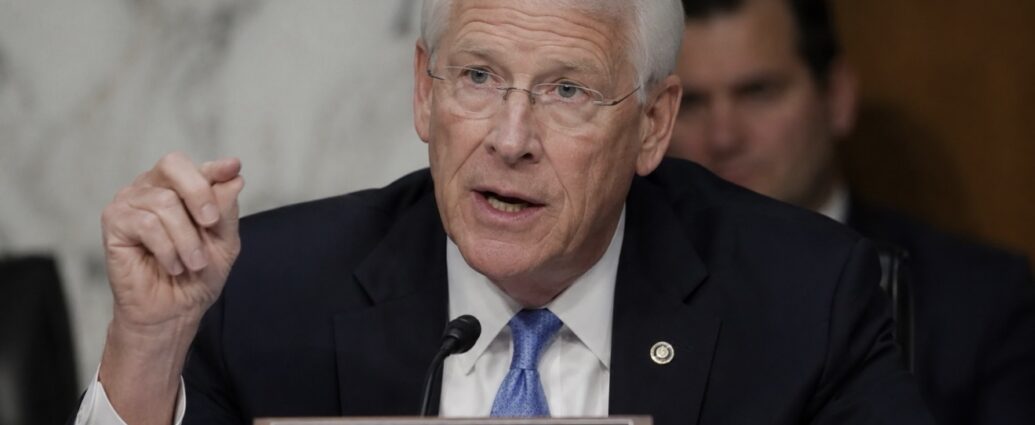
President Trump signed a preliminary peace deal with Iran this week to wind down the war that began on February 28, and it has opened a rare split inside his own party — much of it over money. On Thursday, Senate Armed Services Committee Chairman Roger Wicker of Mississippi, who seldom criticizes the president in public, said he was concerned the agreement “negotiates away the victories… in ways that are completely out of step with the President’s goals.”
Wicker and other hawkish Republicans argue the deal hands Tehran a financial lifeline while doing too little to shut down its nuclear program. Their objections center on three economic pieces: lifting U.S. sanctions, unfreezing Iranian funds, and a proposed $300 billion fund to rebuild Iran’s economy. Wicker said that fund — which the administration says will not come from American taxpayers — would dwarf the relief Iran received under former President Barack Obama’s 2015 nuclear agreement.
Here is why a foreign-policy fight is also a business story.
The agreement is structured as a memorandum of understanding signed by President Trump and Iranian President Masoud Pezeshkian. It halts the fighting and reopens the Strait of Hormuz, the narrow waterway that carries roughly 20% of the world’s oil and gas trade. Negotiators now have 60 days to convert the truce into a final agreement.
During that period, Iran keeps the Strait open and receives sanctions waivers allowing it to resume oil exports. In return, Iran reiterates that it will not pursue a nuclear weapon. Critics argue that is not enough because the agreement does not require Iran to immediately stop uranium enrichment or surrender existing nuclear material stockpiles.
The clearest impact for consumers runs through energy prices.
When Iran largely shut down traffic through the Strait earlier this year, oil prices surged and gasoline prices climbed above $4 per gallon in parts of the United States. As negotiations advanced this week, markets moved in the opposite direction.
West Texas Intermediate crude fell about 4.8%, settling near $80.75 per barrel, while Brent crude dropped roughly 4.7% to around $83 per barrel. Even after the decline, crude prices remain approximately 40% higher than they were in January, highlighting how much of the war premium remains embedded in global energy markets.
President Trump has pointed to those price declines as evidence the agreement is already delivering results. In public statements and social-media posts, he cited lower oil prices and a strong stock market as proof that diplomacy is producing economic benefits.
If Iranian oil fully returns to global markets, additional supply could place further downward pressure on fuel prices. That would benefit consumers, airlines, trucking companies and manufacturers that rely heavily on transportation costs. It could also create challenges for U.S. energy producers, whose profits generally rise when oil prices remain elevated.
Markets, however, remain cautious.
Reopening the Strait legally does not mean commercial shipping immediately returns to normal. Hundreds of vessels were delayed or rerouted during the conflict. Shipping companies, insurers and crews must regain confidence that the route is safe before traffic fully resumes. Any new disruption could quickly reverse recent declines in oil prices.
The proposed $300 billion reconstruction fund remains one of the most controversial pieces of the agreement.
Administration officials say the money would come primarily from Gulf states and other international partners rather than from U.S. taxpayers. The funds would be directed toward rebuilding power plants, transportation networks, industrial facilities and other infrastructure damaged during the conflict.
Supporters argue that economic stability reduces the risk of future conflict and encourages moderation. Critics see the proposal differently.
Wicker has warned that providing such a large pool of capital before obtaining stronger nuclear concessions rewards Tehran prematurely. Other Republican critics have raised similar concerns, arguing that financial incentives should come only after measurable nuclear dismantlement steps have been completed.
The White House has responded aggressively to those attacks.
Vice President JD Vance, who led negotiations on behalf of the administration, insisted that the United States “isn’t giving up a cent of money to Iran” and said any economic benefits are contingent upon Iranian compliance. He described the arrangement as an extension of Trump’s pressure strategy rather than a retreat from it.
Republicans remain divided.
Sen. Lindsey Graham expressed concerns about parts of the agreement but argued that pursuing peace remains preferable to an indefinite conflict. Sen. Bill Cassidy, meanwhile, called the framework one of the most serious foreign-policy mistakes in recent decades.
The debate carries major political implications heading into the November midterm elections.
Republican candidates now face a difficult balancing act. Many voters felt the economic impact of the war through higher gasoline, shipping and consumer prices. Those same voters are now seeing some relief as markets respond positively to the ceasefire.
Whether that relief lasts may determine how the deal is ultimately judged.
Congress is also weighing whether the agreement must undergo formal review under legislation passed after the 2015 Iran nuclear accord. Any congressional challenge could create additional uncertainty during the 60-day negotiation period.
For now, the fighting has paused, oil prices have eased, and the battle has shifted from military conflict to a fight over the terms — and the economics — of peace.
JBizNews Desk | Washington
© JBizNews.com All Rights Reserved. Reproduction or distribution without written permission is prohibited.