Washington — Just four days after signing a peace deal to end his war with Iran, President Donald Trump threatened on Sunday to bomb the country again — a sharp reversal that rattled negotiations meant to secure the agreement and raised fresh concerns in global energy markets. In a post on Truth Social, Trump warned that the United States would strike Iran “very hard again, just like we did last week, only harder” if it does not stop Iran-backed forces in Lebanon from escalating tensions.
The apparent contradiction is central to the story. Last week, Trump declared the conflict over, lifted the U.S. naval blockade, and reopened the Strait of Hormuz to commercial traffic. Yet the memorandum signed Wednesday with Iranian President Masoud Pezeshkian did not resolve the issue of Iran’s regional proxies, and renewed clashes involving the Iran-backed Hezbollah organization in Lebanon are now testing the durability of the agreement.
“Iran must immediately stop their highly paid PROXIES in Lebanon,” Trump wrote.
The interim agreement halted direct hostilities between the United States and Iran, opened a 60-day negotiating window to pursue a final nuclear accord, and restored passage through the Strait of Hormuz, one of the world’s most important energy corridors. Technical negotiations were originally expected to begin Friday but were delayed after Iran objected to escalating violence in Lebanon. The talks began Sunday in Switzerland, the same day Trump issued his warning.
Negotiators from both countries gathered for discussions mediated by Pakistan and Qatar. Vice President JD Vance, attending the talks, said progress had been made and expressed optimism about the situation in Lebanon.
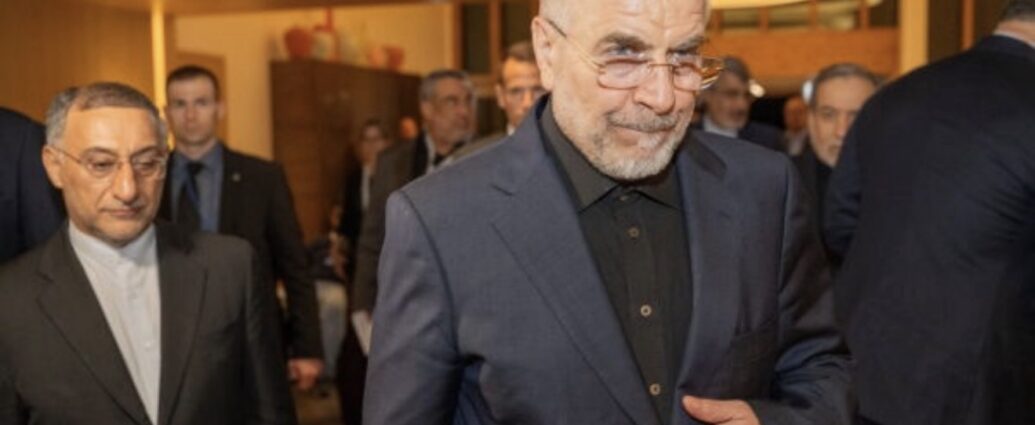
Iran’s delegation includes parliamentary Speaker Mohammad Bagher Qalibaf, Foreign Minister Abbas Araghchi, and senior officials from the country’s central bank and energy sector. The U.S. team includes Jared Kushner and Steve Witkoff. Pakistani Prime Minister Shehbaz Sharif and Army Chief Field Marshal Asim Munir also traveled to Switzerland to support the negotiations.
At the center of the dispute remains the Strait of Hormuz, the narrow waterway connecting the Persian Gulf to international shipping routes.
Iran has signaled that continued access to the strait may depend on developments in Lebanon. According to statements from regional officials, Tehran wants Israel to commit publicly to a comprehensive ceasefire with Hezbollah and halt military operations in Lebanon. Iranian officials have also warned that failure to uphold broader commitments could jeopardize the entire memorandum.
Trump delivered a separate warning during an interview with Fox News, saying Iranian leaders had been told they “won’t have a country” if they attempt to close the strait again.
For global markets, Hormuz remains the critical issue.
Roughly 20% of the world’s oil supply passes through the waterway. During the recent conflict, disruptions pushed crude oil prices above $100 per barrel, fueling inflation concerns worldwide. Following last week’s agreement, oil prices retreated as traders anticipated increased supply and lower geopolitical risk.
That optimism is now being tested.
Any indication that the strait could face renewed restrictions would likely send crude prices higher and increase pressure on gasoline, diesel, aviation fuel, and shipping costs. Energy traders are closely monitoring developments in Switzerland and Lebanon for signs of whether the agreement can survive.
For businesses, the implications extend far beyond the oil industry.
Higher energy costs affect transportation companies, manufacturers, airlines, retailers, and agricultural producers. Shipping rates and insurance costs also tend to rise sharply whenever the Strait of Hormuz faces disruption, creating ripple effects throughout the global economy.
The renewed tensions stem largely from continued fighting between Israel and Hezbollah.
Although both sides agreed to renew a ceasefire on Friday, military activity continued throughout the weekend, including reported Israeli operations in southern Lebanon. Israeli officials have indicated they do not consider themselves bound by provisions of the U.S.-Iran memorandum relating to Lebanon, a position that has angered Tehran and complicated diplomatic efforts.
Iranian officials argue that continued Israeli military actions could themselves undermine the ceasefire and threaten the broader agreement.
The dispute has also exposed divisions within Washington.
Some lawmakers are advocating a more aggressive approach. Senator Lindsey Graham has argued that if diplomacy fails, the United States should consider taking control of the strait to guarantee freedom of navigation and energy flows.
Administration officials have at times appeared divided over how to balance support for Israel, pressure on Hezbollah, and efforts to preserve negotiations with Iran.
For now, oil continues to move through the region, and prices remain below wartime highs. But Trump’s threat highlights how fragile the current arrangement remains.
The coming days of negotiations in Switzerland, combined with developments on the Israel-Lebanon front, are likely to determine whether the recent calm in energy markets holds or whether the world faces another round of geopolitical and economic volatility.
JBizNews Desk | New York
© JBizNews.com All Rights Reserved. Reproduction or distribution without written permission is prohibited.