
Many people find themselves unwilling to attend performances dealing with Shoah themes. For some, it’s too painful and triggering. Others feel saturated and bombarded by content on this topic. But Shards of Laughter, as you might guess from its title, is a different and fresh take on the topic.
Actor Gabi Lev opens the show with the announcement: “I give you permission to laugh.” This assures us from the outset that it is no dishonor to the dead if we crack a smile at absurd words and descriptions, for these accompany all human life, even its darkest episodes.
Shards of Laughter tempers some truly tragic material with genuinely funny moments and surprising twists, such that this intimate show flies by and – though poignant and, at times, sad – does not feel overly grim.
Lev, a Jerusalemite originally from Australia, has decades of theatrical performance under her belt. In 1982, she founded the Theatre Company Jerusalem (joined by three other artists). Their vision was to create works grounded in Jewish texts and in Jerusalem’s cultural landscape, while exploring new forms of theatrical expression. They also present the Annual International Jewish Festival for Contemporary Performance.
This is Lev’s first collaboration with the Theater and Theology troupe and its founder, Yael Valier. The two women share a profound wish to reflect on human experience through Jewish history, tradition, and lived culture. It’s an excellent shidduch (match).
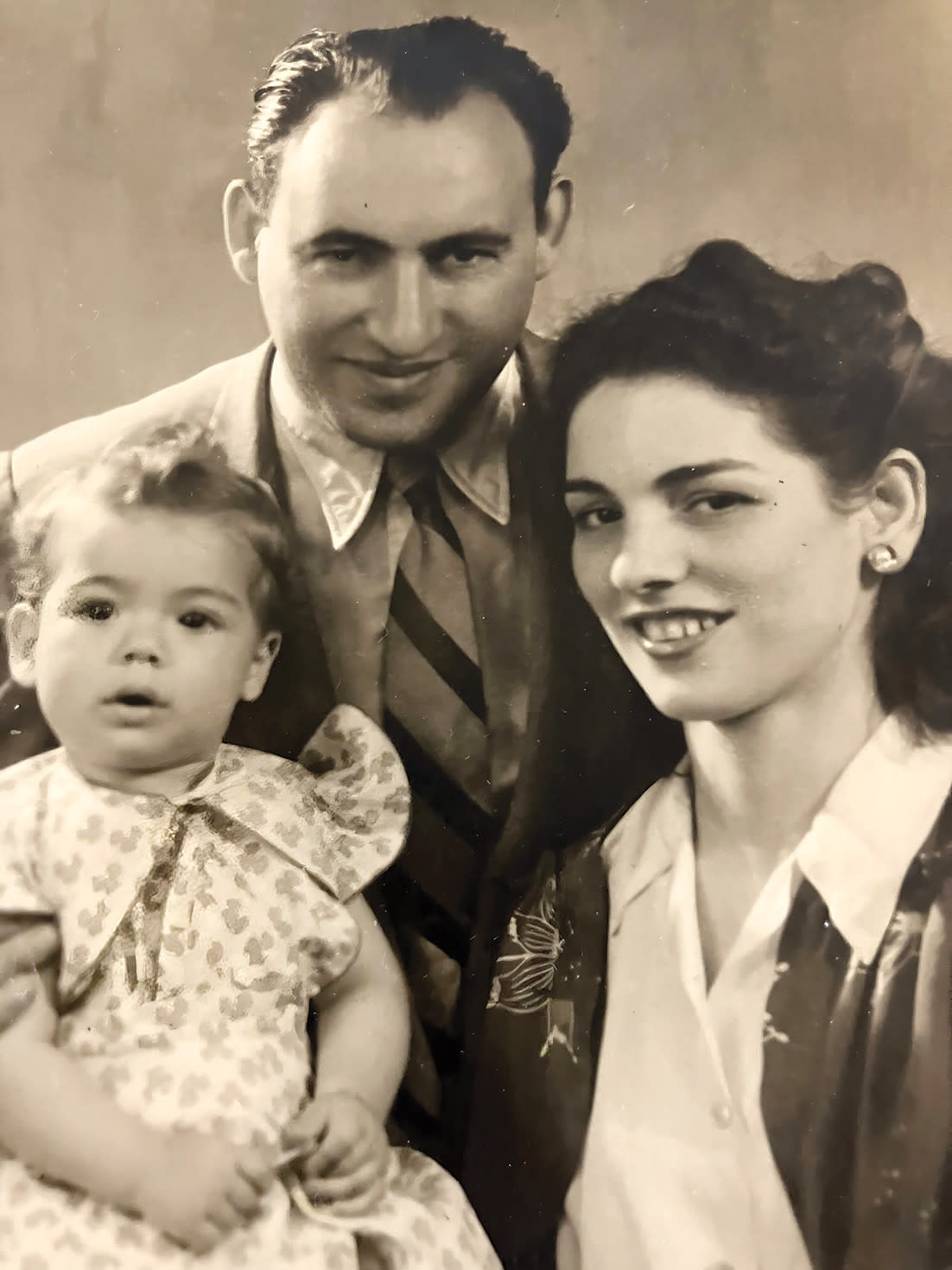
Smaller and more minimalist than Lev’s typically collaborative productions, the show was created following the passing, at age 100, of her mother, Malka, the last survivor in her family. It was also precisely the right time for this play to enter the world, as it might be said to represent the culmination of major strands in Lev’s life. Certainly, with its deeply personal and emotional script, it seems that it could be successfully performed only by a seasoned and accomplished performer.
Watching Lev’s consummate artistry in sharing moving fragments of her family’s Holocaust history and hearing the voices of her dead relatives come vibrantly alive, I wondered how she could pull it off without breaking down each time. Indeed, she had a tissue ready in case of an unexpected tear. We were all with her on her heartfelt journey: the audience remained spellbound to the very end.
The play’s arc takes us from 1924 Munkács, a Czechoslovak town with deep Hungarian roots, through the Holocaust years and to present-day Australia. Lev chooses to jump back and forth in time. We hear about the rich Jewish life between the wars; the incredible story of how Lev’s parents ended up together (“If not for Auschwitz, I wouldn’t be here”), and what happened following the end of World War II.
The Holocaust survivor community in Sydney comes to life before our eyes, full of “objects, food, and people from other places.” We meet her parents, each dealing with the past in a different way, her colorful aunts, and others, all declaring their views in thick European accents. There are some unexpected plot developments, including a touch of the supernatural and the entry of (slight spoiler here) a fortune teller.
Props are minimal: a table, a glass, a small stepladder, and a hat. There is a large video screen, and if I have one comment, it is that I would have liked to see slightly more use of the screen, as it really helped to give us images beyond what Lev herself could conjure up. Balancing this, however, is the fact that I found this veteran actor mesmerizing; and my eyes remained fixed on her expressive face the entire time. I would definitely see this show again.
Finally, I was personally touched when she read the Paul Celan poem “Death Fugue,” with its evocative motif of black milk in the morning. When she reached the line “your golden hair Margarete, your ashen hair Shulamit,” it jolted me back to a reading of that same line in Jerusalem’s Yakar synagogue some 20 or so years ago.
Beyond the power of the image itself, as I write this, I wonder if it struck me particularly because my own aunt Shulamit z”l – my father’s half-sister – died in the Holocaust. May her memory, along with all of those lost so cruelly to us, be for a blessing.
Note: The content of this play aligns with the mourning atmosphere of the Three Weeks. With this, it does contain some recorded music, including lively wedding tunes.