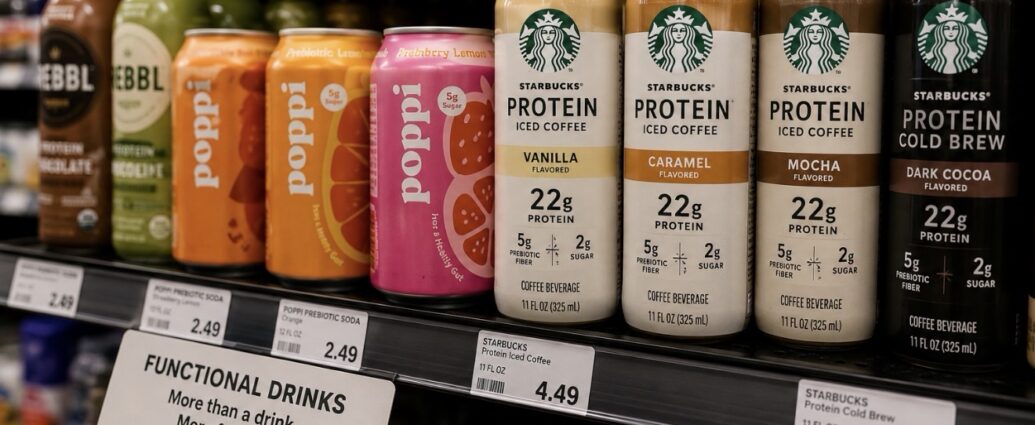
Walk into almost any coffee shop or grocery store today and you’ll see a growing trend: coffee packed with protein, soda promising better gut health, and bottled water infused with electrolytes, vitamins, and other wellness ingredients. Major beverage companies from Starbucks to Coca-Cola are betting consumers will pay more for drinks that offer benefits beyond simple refreshment, helping fuel a global functional beverage market now valued at roughly $166 billion.
Consumer surveys suggest that bet is paying off.
An EY survey of more than 2,500 adults found that roughly 75% of Millennials and 80% of Generation Z consumers regularly purchase functional beverages. More than half said they are willing to spend extra for products that support their health and wellness goals.
Research from Circana found that nearly 64% of consumers sometimes replace a snack with a beverage, rising to 70% among adults ages 25 to 34. The shift reflects growing demand for drinks that provide protein, energy, digestive support, hydration, or nutritional value.
One of the fastest-growing categories is protein coffee.
Often referred to on social media as “proffee,” the trend has rapidly expanded beyond fitness enthusiasts into mainstream retail. Starbucks recently introduced protein coffee beverages across the United States, Canada, and Europe after launching ready-to-drink versions in supermarkets.
Its newest bottled beverages contain 22 grams of complete protein, 5 grams of prebiotic fiber, multiple vitamins and minerals, and only 2 grams of sugar. Industry data show ready-to-drink coffees containing 20 to 25 grams of protein are among the fastest-growing products in the category, while some competing beverages now exceed 40 grams of protein per serving.
Social media has helped accelerate the trend.
According to industry research, 72% of Generation Z consumers turn to social media platforms for food and wellness recommendations. Circana analyst Sally Lyons Wyatt said younger consumers are expected to drive much of the category’s growth as they enter their highest earning years and increasingly seek products that combine convenience with perceived health benefits.
The opportunity has triggered a wave of acquisitions.
French food company Danone recently acquired protein meal-replacement maker Huel in a deal reportedly valued at $1.15 billion. PepsiCo purchased prebiotic soda company Poppi for approximately $2 billion, while Coca-Cola launched its own prebiotic beverage line, Simply Pop.
The boom is also intersecting with the rapid adoption of weight-loss medications such as Ozempic and similar GLP-1 drugs. As millions of consumers eat smaller meals, beverage companies are developing high-protein, lower-sugar drinks designed to deliver nutrition in fewer calories. Danone recently introduced Oikos Fusion, specifically formulated for consumers using GLP-1 medications.
Consumers should expect to pay more for many of these products.
Protein coffees, prebiotic sodas, and functional beverages typically sell at a premium compared with traditional soft drinks and coffee. Nutrition experts also caution that not every health claim is supported by strong scientific evidence, and consumers should evaluate ingredient lists rather than marketing slogans.
Still, industry momentum remains strong.
Analysts project the global functional beverage market could grow from approximately $166 billion today to nearly $372 billion by 2034. Major retailers including Walmart and Target continue expanding shelf space devoted to protein drinks, prebiotic beverages, electrolyte products, and wellness-focused brands.
For beverage companies facing slower growth in traditional soda sales, the message is increasingly clear: consumers—especially younger shoppers—want drinks that promise added value, and many are willing to pay a premium to get it.
JBizNews Consumer Desk
© JBizNews.com All Rights Reserved. Reproduction or distribution without written permission is prohibited.