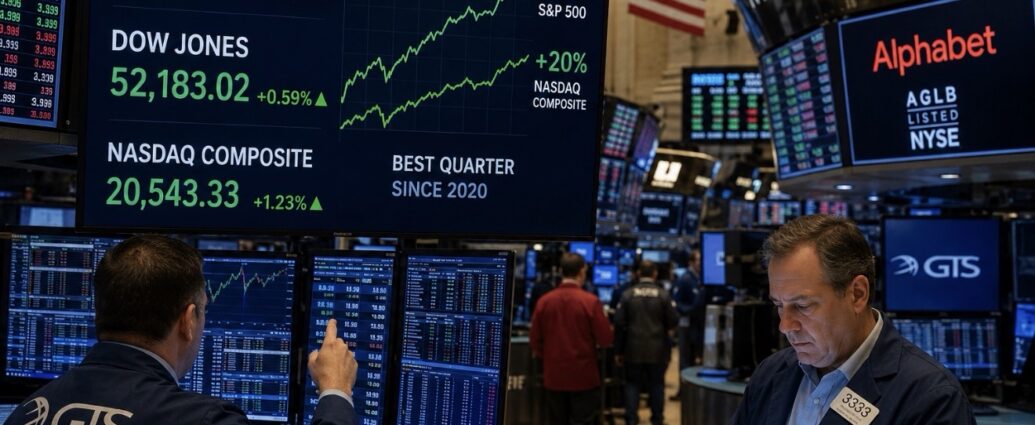
U.S. stocks closed mixed Wednesday, July 1, on the first day of the third quarter, as gains in banks and other value stocks lifted the Dow Jones Industrial Average to another record while a selloff in semiconductor shares pulled the Nasdaq Composite lower. Investors also weighed comments from new Federal Reserve Chair Kevin Warsh, who signaled that the central bank remains focused on reducing inflation rather than cutting interest rates.
The Dow Jones Industrial Average gained about 0.5% to a fresh record high, extending Tuesday’s record close of 52,319.20. The S&P 500 finished little changed as strength in financial stocks offset weakness in technology, while the Nasdaq Composite declined as investors took profits in many of this year’s biggest AI winners. The small-cap Russell 2000 climbed roughly 0.6%, reflecting renewed buying in domestically focused companies. Roughly two-thirds of all U.S. stocks finished higher despite the weakness among major technology names.
Warsh dominated much of the day’s discussion after speaking at the European Central Bank’s annual forum in Sintra, Portugal. In his first major international appearance since replacing Jerome Powell as Fed chair, he emphasized that the central bank remains committed to restoring inflation to its 2% target, stating that anyone expecting the Fed to tolerate higher inflation “would be disappointed.”
The remarks reinforced the Federal Reserve’s independence from political pressure, despite repeated calls from President Donald Trump for lower interest rates. With inflation still running at 4.2% in May, traders have increasingly begun pricing in the possibility that the Fed’s next move could be another rate increase rather than a cut later this year.
Adding to investor caution, payroll processor ADP reported that private employers added just 98,000 jobs during June, a weaker-than-expected reading ahead of Thursday’s closely watched government employment report.
Market movers
Technology stocks led the decline as investors questioned whether the rapid pace of AI-related spending can continue indefinitely. Micron Technology and SanDisk each fell about 8%, while Nvidia lost roughly 3%. AI infrastructure companies experienced even steeper declines, with CoreWeave and Nebius Group posting double-digit losses.
Not every technology company struggled. Meta Platforms surged approximately 8% after unveiling plans to expand into cloud computing by offering businesses access to artificial intelligence models and computing infrastructure. Microsoft, Amazon, and Alphabet finished little changed.
Corporate news also influenced trading throughout the session.
Nike slipped about 2% despite reporting quarterly results that exceeded Wall Street expectations, as executives warned about ongoing weakness in China, where sales declined 12%. Constellation Brands edged higher after posting better-than-expected earnings.
Bloom Energy gained nearly 8% after expanding its partnership with Brookfield to finance power-generation projects serving AI data centers.
Meanwhile, Kroger declined about 2.8% following its announcement that it will acquire grocery chain Giant Eagle for approximately $1.65 billion.
Among Dow components, Microsoft, Chevron, and Apple were among the strongest performers, while Caterpillar, Walmart, and Nvidia weighed on the index.
Analysts continued highlighting opportunities in artificial intelligence despite Wednesday’s pullback. UBS raised its price target on Marvell Technology to $340, citing the company’s leadership in advanced memory technologies used inside AI data centers.
Investors are also preparing for SpaceX to join the Nasdaq-100 Index before trading begins on July 7, forcing index-tracking funds to purchase shares.
Commodities and volatility
Oil prices drifted lower as diplomatic efforts in the Middle East continued. Brent crude traded near $72 per barrel, while West Texas Intermediate fell below $69, extending one of the sharpest quarterly declines since 2020.
Lower energy prices have helped reduce inflation pressures by lowering gasoline and transportation costs for consumers and businesses alike.
Gold remained under pressure as the stronger U.S. dollar and expectations for higher interest rates reduced demand for the precious metal. Market volatility increased modestly as investors balanced concerns over interest rates against elevated technology valuations.
Looking ahead
Attention now turns to Thursday’s U.S. employment report, released one day early because financial markets will be closed Friday for the Independence Day holiday.
Economists expect approximately 110,000 jobs were added during June, with the unemployment rate holding near 4.3%. A stronger-than-expected report would likely reinforce the Federal Reserve’s inflation-focused stance and further reduce expectations for near-term rate cuts.
The first trading day of the third quarter suggested investors are becoming more selective after one of the strongest quarters in years. While technology paused after its extraordinary rally, financials and value-oriented stocks picked up the slack, allowing the Dow to reach another record. Whether that rotation continues may depend on the jobs report, inflation data, and whether the AI-driven rally resumes in the weeks ahead.
JBizNews Desk
© JBizNews.com All Rights Reserved. Reproduction or distribution without written permission is prohibited.