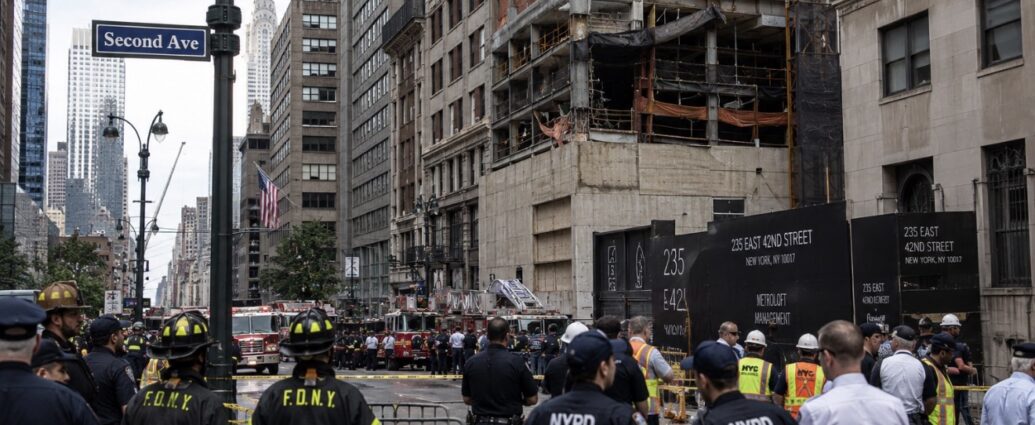
A 37-story Midtown Manhattan tower under construction began buckling Tuesday morning, forcing the evacuation of at least nine surrounding buildings and shutting down a busy stretch of East 42nd Street a block from Grand Central Terminal. The Fire Department of New York said it received a call at 7:57 a.m. on July 7 reporting bricks falling from the 21st floor of the building at 235 East 42nd Street. When crews arrived, they determined that two structural columns had buckled. No injuries have been reported.
At an afternoon news conference, Mayor Zohran Mamdani said the structure remained unstable, warning that one of the columns had continued to move even after city officials reached the scene. “The building remains unstable,” Mamdani said, adding that engineers were assessing the situation “minute by minute.” The New York Police Department closed East 42nd Street between Second and Third Avenues to all foot and vehicle traffic, snarling one of the city’s busiest corridors near the Chrysler Building and the United Nations.
The high-rise is no ordinary construction site. It is the former global headquarters of Pfizer, which occupied the building for decades before selling it, and it is now the centerpiece of one of the largest office-to-residential conversions in New York City history. Construction workers on the 21st floor spotted the columns beginning to give way around 8 a.m. and were safely evacuated, according to police. City structural engineers from the Department of Buildings are investigating a report that a steel beam was compromised, a complaint the site safety manager filed the same morning.
The developer behind the project, Metro Loft Management, said it was working closely with the Department of Buildings to understand the full scope of the problem. “The safety of our workers and the public has always been, and remains, our top priority,” the firm said in a statement. Metro Loft, owned by real estate investors David Werner and Nathan Berman, is converting the aging tower — along with an adjoining building — into a rental complex of roughly 1,500 to 1,600 apartments. The architecture firm Gensler, which is leading the design, has described the building’s mixed 1960s-era structural systems as a uniquely difficult retrofit, with crews racing to pour a new floor every few days to hit a 2026 opening.
The building carries a history of code problems. City records show it has multiple active violations and tens of thousands of dollars in fines, with some complaints dating back years. What caused Tuesday’s failure will not be known until emergency trusses are installed and inspectors can examine the structure, the buildings commissioner said.
Beyond the immediate danger, the incident lands at a sensitive moment for New York’s real estate market. Office-to-residential conversions have been championed by city and state leaders as a rare fix for two problems at once: a glut of outdated, half-empty office towers and a severe shortage of housing that has pushed rents to punishing levels. The 42nd Street project has been held up as the flagship of that movement — billed as the biggest conversion the city has ever attempted, adding more than a dozen new stories atop the original tower.
Tuesday’s scare is likely to sharpen questions about the risks and costs hidden inside those ambitions. Converting a six-decade-old office building into modern apartments means cutting new window openings, removing interior structure and re-engineering floors that were never designed for residential use — delicate, expensive work on bones that are often unpredictable. When it goes smoothly, it turns dead office space into hundreds of homes and construction jobs. When it does not, as the buckling columns on 42nd Street showed, it can halt a neighborhood and put lives at risk.
The property’s ownership reflects how much institutional money rides on these deals. When the building last traded, in 2018, it was purchased for a reported $363.5 million by a group that included Alexandria Real Estate Equities, Deutsche Bank and the State of Wisconsin Investment Board, alongside Werner. Interior demolition began in 2024, with completion targeted for 2027.
For now, the priority is keeping the structure standing and the surrounding blocks clear. A school and a hotel were among the buildings emptied as a precaution, and commuters were urged to avoid the area. City officials said assessments would continue through the evening as engineers worked to stabilize the tower.
This is a developing story.
JBizNews Desk
© JBizNews.com All Rights Reserved. Reproduction or distribution without written permission is prohibited.