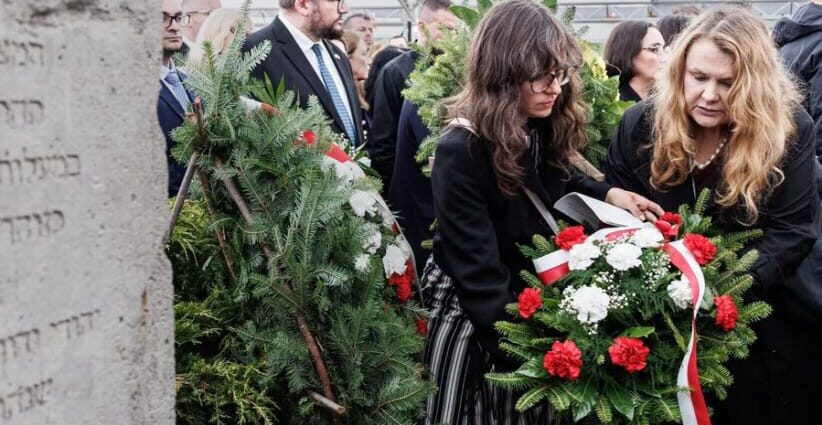
A memorial service commemorating 85 years since the Jedwabne massacre went ahead despite protests by Polish nationalists who called it “Jewish lies.”
The Jedwabne massacre was the killing of hundreds of Jewish residents of the town of Jedwabne in northeastern Poland on 10 July 1941, shortly after Nazi Germany invaded the Soviet-occupied part of Poland during Operation Barbarossa.
Jewish men, women, and children were forced into a barn and burned alive by their Polish neighbors.
Investigations by Poland’s Institute of National Remembrance concluded that at least 340 people were murdered; however, the site has not been fully excavated out of respect for Jewish religious law, and the number could be higher.
On Friday, Jewish citizens of Poland, Polish politicians and foreign ambassadors gathered to pay tribute.
‘Jedwabne massacre is an example of the harm that can result from anti-semitism’
“The history of the crime in Jedwabne is an example of the harm that can result from antisemitism and all forms of hatred, ethnic prejudice and xenophobia, fueled by forces that prey on fear and pursue their own interests at the expense of Poland and the Polish people,” said Poland’s Foreign Ministry.
“The circumstances of this atrocity were examined in an investigation conducted by prosecutors from the Institute of National Remembrance, and its findings remain an important part of our understanding of this tragic chapter in Polish-Jewish history.”
Israel’s Ambassador to Poland, Yaakov Finkelstein, who was present at the memorial, said, “The Jewish residents were driven from their homes, gathered in the town square, humiliated and beaten, and then forced into a barn, which was set on fire. They were killed by their Polish neighbors.”
He said that the anniversary of the Jedwabne crime remains one of the most “painful dates in the shared history of Poles and Jews.”
However, Finkelstein stressed that remembering Jedwabne is not about assigning collective guilt to the entire Polish nation, but is about “confronting history, paying tribute to the victims, and opposing all attempts to distort or deny the historical facts.”
He added that the participation of high-ranking representatives of the Polish authorities in today’s commemoration is an “expression of Poland’s responsible stance and its commitment to historical truth and to honoring the victims with dignity.”
US Ambassador to Poland Tom Rose said that “Jedwabne was the exception, not the rule in occupied Poland”, and praised the “thousands of righteous Poles who gave their lives during the Nazi occupation for helping their Jewish neighbors.”
AJC was present at the memorial and condemned far-right extremism that denies facts
The American Jewish Committee was also present. It condemned the far-right extremists who have sought to deny “these facts.”
“The movement to deny these crimes is yet another example of why Poland must adopt a national strategy to combat antisemitism,” the AJC said.
“Democratic Poland has already done the difficult work of officially recognizing what happened on July 10, 1941. Now, just as the government confronted this painful chapter of its past, it is imperative that it act against those who deny and distort history and spread antisemitism.”
On the same subject, nationalists, led by controversial politician Grzegorz Braun, gathered outside the memorial.
Braun told his audience, “The communists, the Euro-communists, and the ‘Zydokomuna’ are all digging in their heels. They are digging in their heels both over the lie about Jedwabne and over the lie about the Rzeszow, Krakow, and Kielce pogroms of 1945 and 1946. And in Auschwitz, and in other places of memory, and of non-memory.”
“So there are enough Poles and patriots here for us to have hope that, unless a meteor suddenly falls on this very place, some of us have a good, real chance of living to see the moment when the truth comes out.”
Zydokomuna is a loaded, antisemitic term meaning “Jewish communism.” It specifically refers to a conspiracy theory that Jews were collectively responsible for communism.
Braun also uses the phrase “klamstwo jedwabienskie” (“the Jedwabne lie”), which is an expression used by people who deny or dispute the established historical findings about the 1941 Jedwabne massacre. Calling the antisemitic pogroms in Rzeszow, Krakow, and Kielce pogroms “lies” also reflects Braun’s historical denialism.
American Congressman Jared Moskowitz said he was “deeply troubled to see 85 years later the memorial for this atrocity being turned into a site of revisionism that dishonors the victims.”
“At a time when Holocaust denial continues to rise, we cannot let the truth of what happened get buried.”