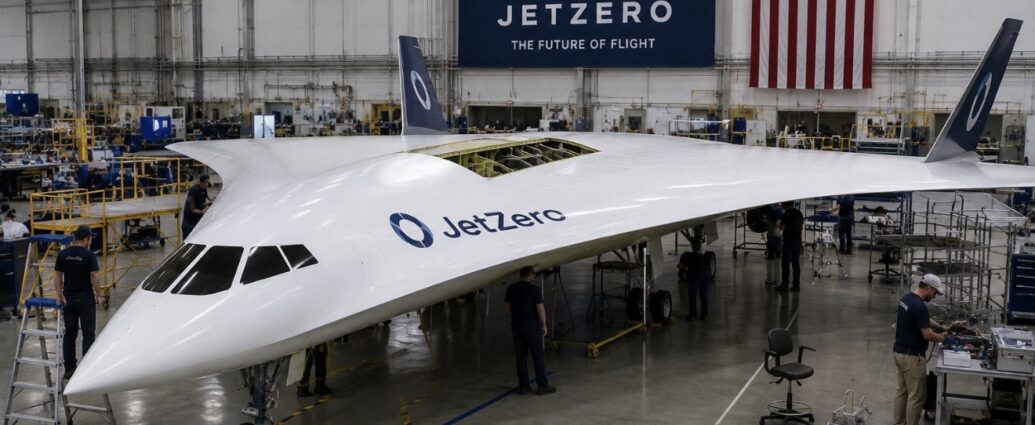
JetZero took a significant step toward becoming the first new American manufacturer of large commercial passenger aircraft in decades after the Export-Import Bank of the United States (EXIM) announced it will explore providing up to $3 billion in financing for the company’s planned manufacturing campus in Greensboro, North Carolina. The announcement, made during the Farnborough International Airshow, signals growing federal support for rebuilding domestic aerospace manufacturing while creating a potential long-term competitor to Boeing.
Just as important, the announcement is not a loan approval.
EXIM issued what is known as a Letter of Interest—a preliminary framework that indicates the bank is willing to continue evaluating the project. Before any financing can be approved, JetZero must still complete financial underwriting, environmental reviews, legal examinations, and receive final approval from EXIM’s board.
That distinction matters because many large industrial projects receive Letters of Interest without ultimately securing financing. While Washington has signaled confidence in the project, no federal funds have yet been committed.
Building one of America’s largest aerospace factories
Construction is already underway.
JetZero broke ground in June on an approximately 8 million-square-foot manufacturing campus spanning about 600 acres in Greensboro. If financing is ultimately approved, the funding would support construction of production facilities, factory systems, manufacturing equipment, and other qualifying infrastructure through EXIM’s Make More in America Initiative, a program designed to encourage companies to manufacture domestically rather than overseas.
The initiative has become increasingly important as the federal government looks to strengthen critical manufacturing sectors and reduce dependence on foreign production.
According to JetZero, the Greensboro campus could create more than 14,500 direct manufacturing jobs while supporting approximately 53,000 additional jobs across suppliers, transportation companies, engineering firms, and related industries nationwide. Those employment figures are company projections and will depend on production reaching planned levels.
A different kind of passenger aircraft
Unlike traditional commercial airplanes, JetZero’s Z4 uses a blended-wing-body design.
Rather than attaching wings to a narrow cylindrical fuselage, the aircraft combines both into one wide lifting structure. The configuration resembles a manta ray and is intended to reduce drag significantly while improving fuel efficiency.
JetZero estimates the aircraft could deliver at least 30% better aerodynamic efficiency than conventional tube-and-wing airliners.
Inside, the company envisions a cabin unlike today’s passenger jets, featuring four aisles, digital exterior displays replacing conventional windows, overhead skylights, and redesigned storage systems intended to improve passenger comfort while increasing operational efficiency.
Assembly of the first demonstrator aircraft is already underway at Northrop Grumman’s Scaled Composites facility in Mojave, California, with the first flight targeted for late 2027.
Major aerospace companies are already involved
JetZero is no longer simply a startup operating on an ambitious idea.
Earlier this year the company raised $175 million in Series B financing led by B Capital, Northrop Grumman, and investment affiliates of United Airlines, RTX, and 3M. Including government grants, incentives, and commercial commitments, JetZero says it has secured more than $1 billion in total funding and financial support.
The U.S. Air Force has also invested in the program, viewing the blended-wing design as a possible future replacement for aging tanker and transport aircraft because of its projected fuel savings.
Several commercial airlines—including United, Alaska Airlines, Delta Air Lines, and Japan Airlines—have expressed interest in helping shape the aircraft’s development, although interest should not be confused with firm purchase orders.
Significant challenges remain
Despite growing momentum, substantial hurdles still separate JetZero from becoming a commercial aircraft manufacturer.
Designing an aircraft is only the beginning. Certifying an entirely new passenger-aircraft configuration with the Federal Aviation Administration represents one of the most demanding regulatory processes in aviation, particularly since no blended-wing passenger aircraft has previously completed FAA certification.
Commercial acceptance also remains uncertain.
Airlines would need to adapt boarding procedures, cabin layouts, maintenance practices, and passenger expectations to accommodate an aircraft that looks—and operates—very differently from today’s fleets.
Why this matters for business
Beyond aerospace, the story reflects a broader shift in U.S. industrial policy.
Historically, EXIM primarily supported export transactions. Increasingly, however, the bank is using programs such as Make More in America to help finance domestic manufacturing projects that might otherwise struggle to attract affordable private capital. Expanded lender guarantees—reaching as much as 90% on certain qualifying projects—could lower borrowing costs for manufacturers considering major U.S. expansion plans.
For suppliers, the implications could be equally significant.
Boeing has long stood as America’s only major producer of large commercial passenger aircraft. Even the emergence of a credible second manufacturer would reshape supplier negotiations, production capacity, engineering demand, and long-term competition throughout the aerospace industry.
What to watch next
The next milestone will not be another aircraft unveiling but a financing decision.
Investors, suppliers, manufacturers, and state officials will be watching to see whether EXIM converts its Letter of Interest into a formal financing commitment after completing its reviews. From there, attention will shift to JetZero’s planned first flight in 2027—a critical test of whether the company can transition from an ambitious concept into a commercially viable American aircraft manufacturer capable of reshaping one of the world’s most competitive industries.
JBizNews Desk | Greensboro, N.C.
© JBizNews.com All Rights Reserved. Reproduction or distribution without written permission is prohibited.