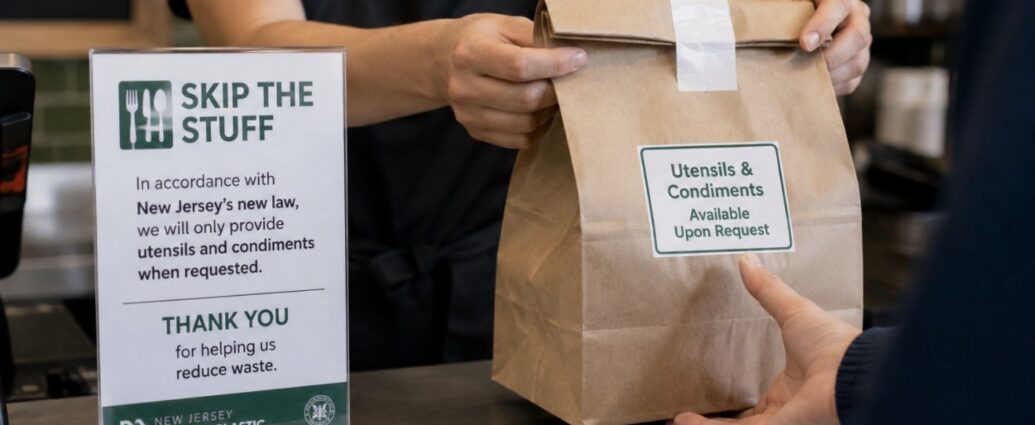
New Jersey restaurants must stop automatically placing disposable utensils, condiment packets and plastic straws into takeout and delivery orders, shifting responsibility to customers to request the items they actually need.
The state’s “Skip the Stuff” law took effect Saturday, August 1, and applies to restaurants, cafés, food trucks and most other food-service businesses. Online ordering systems and delivery platforms must now default to no utensils or condiments, requiring customers to actively select them before completing an order.
For consumers, the immediate change is simple but easy to miss: anyone planning to eat away from home should check the order screen or ask directly for forks, knives, spoons, napkins, sauces and straws. Restaurants may still provide those items, but they can no longer assume every customer wants them.
The rule is intended to eliminate the large number of unused plastic items that leave restaurants only to be thrown away. Many takeout customers eat at home or work, where reusable utensils and condiments are already available, yet disposable packets have historically been added automatically.
Restaurants may also benefit financially by purchasing fewer disposable supplies. The savings on one utensil set or ketchup packet may appear insignificant, but the cost becomes substantial when multiplied across thousands of orders each week.
Digital ordering will make the change most visible. Restaurant websites and delivery apps must present utensils and condiments as an optional selection rather than including them automatically. Consumers who move quickly through checkout may receive their food without anything needed to eat it.
Phone and in-person orders are covered as well. Customers should state what they need when ordering rather than assuming the restaurant will add it later.
Full-service restaurants with seating for at least 10 customers face an additional requirement. Dine-in guests must generally receive washable, reusable utensils rather than disposable plastic cutlery.
The law does not eliminate access to disposable utensils. It changes them from a default part of every order into an item supplied only when requested.
Self-service stations may remain available under certain conditions, allowing customers to take individual items. Bundled packages containing several utensils or condiments may continue temporarily, but the state plans to prohibit those multipurpose packs beginning August 1, 2027.
Several locations are exempt. Public and private K-12 schools, licensed healthcare facilities and state and county correctional facilities are not subject to the new requirements. Food-service businesses located in food courts have until August 1, 2028, to comply.
Prepackaged foods that include utensils during manufacturing and certain sauce containers served with specialty menu items may also fall outside the rule.
Businesses that violate the law initially receive a warning. A second violation can bring a $100 penalty, while later violations within the same year may carry fines of $250. Enforcement is designed to escalate when restaurants repeatedly ignore the requirements rather than immediately punishing an isolated mistake.
More than 60 New Jersey municipalities had already adopted similar policies before the statewide law took effect. Red Bank reported a sharp decline in disposable cutlery distribution after implementing its local program, demonstrating how changing the default can reduce waste without denying customers access to needed items.
The law follows New Jersey’s earlier restrictions on plastic carryout bags, foam food containers and automatically distributed plastic straws. Together, the measures are changing routine transactions at supermarkets, restaurants and other businesses throughout the state.
Consumers ordering for groups should pay particular attention. A single request for utensils may not tell the restaurant how many sets are needed, so customers should specify the number of people who will be eating.
Delivery customers should also inspect app settings before placing repeat orders. A previously saved preference may not carry over after platforms update their systems to comply with the law.
The biggest adjustment may come during the first several weeks, when consumers and restaurant workers are still learning the new process. Forgotten utensils could create inconvenience for travelers, office workers and families eating at parks or other locations without reusable alternatives.
New Jersey is betting that a small change at checkout can reduce a large amount of unnecessary waste. For customers, avoiding frustration now requires one additional step: ask for what is needed before the order leaves the restaurant.
JBizNews Desk | Trenton, New Jersey
© JBizNews.com All Rights Reserved. Reproduction or distribution without written permission is prohibited.