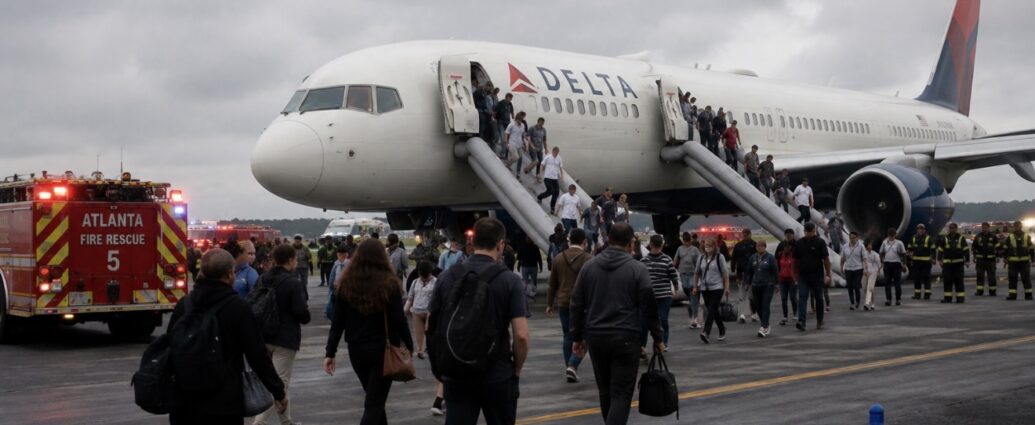
A Delta Air Lines flight bound for Orlando returned to Hartsfield-Jackson Atlanta International Airport minutes after takeoff Saturday morning and was evacuated on a taxiway, sending passengers down emergency slides.
Delta said Flight 2204 departed Atlanta on August 8 carrying 199 passengers and six crew members. The flight crew declared an emergency after fumes were reported in the cockpit and returned to Atlanta as a precaution.
The aircraft took off shortly before 7:30 a.m. and landed safely around 8 a.m., according to the Federal Aviation Administration. The FAA said it will investigate.
What happened after landing made the incident more serious than a routine turnback.
Rather than taxiing to a gate, the crew ordered an evacuation while the Boeing 757 remained on the taxiway. Emergency slides were deployed, first responders surrounded the aircraft and passengers were later bused back to the terminal.
Delta said one passenger and one crew member sought medical attention.
Why the Slide Evacuation Matters
An emergency-slide evacuation carries its own risk of injuries and is generally used when crews determine that getting passengers off the aircraft immediately is safer than keeping them aboard.
Smoke or unexplained fumes in the cockpit can create that calculation because pilots may not immediately know whether the source is electrical, hydraulic, engine-related or something else — or whether conditions could worsen.
Delta said the aircraft is undergoing a maintenance inspection and passengers are being rebooked to Orlando. The airline apologized to customers and said the crew followed established procedures in returning to Atlanta.
The cause of the fumes has not been established.
An Aging but Valuable Aircraft
The aircraft involved was a Boeing 757, a model that remains important to Delta despite its age.
Boeing stopped producing the 757 in 2004, meaning every example still carrying passengers is now more than two decades old.
Delta remains one of the world’s largest operators of the aircraft.
Airlines have kept 757s flying because the jet occupies an unusually useful position in their fleets: it combines narrowbody economics with strong runway performance and enough range for routes that can include transcontinental and some transatlantic service.
Replacing that combination has proven difficult, helping extend the operating lives of aircraft that otherwise might have been retired years ago.
Cockpit and cabin fume events can have numerous causes, including engine oil or hydraulic fluid entering the aircraft’s air supply or electrical components overheating.
There is currently no evidence establishing any of those as the cause of Saturday’s incident.
Delta’s maintenance inspection and the FAA investigation will determine what happened.
The Cost of an Emergency Turnback
The immediate financial impact for Delta is relatively contained.
Nearly 200 passengers must be reaccommodated, the aircraft remains unavailable while maintenance crews inspect it, and the deployed emergency slides must be serviced and repacked before the jet can return to service.
The larger question is what caused the fumes.
A faulty individual component could mean a relatively quick repair. A problem requiring broader inspection of aircraft systems could keep the jet grounded longer.
There is no indication at this point that the incident represents a fleet-wide problem.
For an evacuation involving more than 200 people aboard, two people seeking medical attention is also a relatively limited injury count.
The airplane landed safely. Passengers and crew got off. And investigators now have an intact aircraft to determine what caused the cockpit fumes.
For an aviation emergency, that is the outcome crews train for.
JBizNews Desk | Atlanta, Georgia
© JBizNews.com All Rights Reserved. Reproduction or distribution without written permission is prohibited.