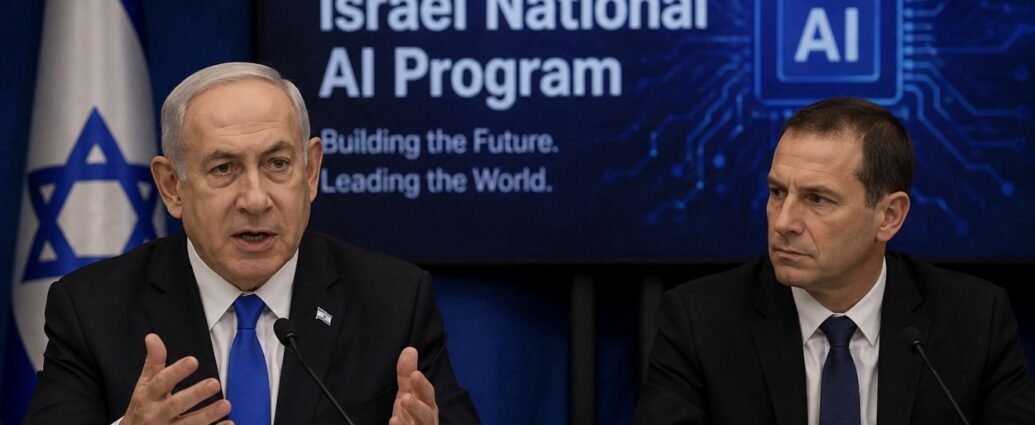
Israel’s government moved Monday from planning to execution on artificial intelligence: Prime Minister Benjamin Netanyahu and Brig. Gen. (res.) Erez Askal, who runs the National Artificial Intelligence Directorate, formally launched the country’s national AI program. In plain terms, the state is now spending public money to buy computing power, train workers, and put AI tools inside government offices, rather than leaving the field to private companies alone.
Netanyahu said the program’s core aims are to make Israel a global AI powerhouse and to spread the economic gains to the broader public, adding that the country sits in a historic but very brief window of opportunity: “The future is not waiting for us; we are creating it.”
Monday’s launch puts machinery behind a cabinet decision taken earlier this summer. On June 16, ministers approved Netanyahu’s National Program to accelerate artificial intelligence, a resolution spanning infrastructure, research and development, human capital, the labor market, public service and international partnerships. That decision also called for a National Artificial Intelligence Institute linking government, academia, industry and investors, plus acceleration hubs meant to turn national problems into working AI products, a security push into cyber and physical AI with defenses against deepfakes, and the rollout of AI tools across government agencies to cut waiting times and paperwork. Netanyahu’s framing then was blunt: he pledged to make the country “a global AI superpower, just as we did with cyber.”
The headline number is hardware. The plan sets a target of 100,000 processing units of sovereign compute, alongside a national quantum computer, AI education and retraining, and the new institute and hubs. Chips at that volume are not a line item — they are a construction program. Outside analysis of the target put the potential cost at $20 billion to $30 billion or more once hardware, data centers, power, cooling, networking and replacement cycles are counted, and GPUs age out fast enough that the bill repeats rather than clears.
For American suppliers, that is the part worth watching. Israel’s existing compute base already runs on U.S. silicon. The country’s first national AI supercomputer was built on an investment topping NIS 500 million, roughly $158 million, including about $50 million in government support, and distributes computing capacity equivalent to 1,000 Nvidia B200 accelerators — 70 percent to commercial technology firms training large models and 30 percent to academic researchers. A jump from one cluster to a six-figure chip fleet means years of orders flowing to chipmakers, data center builders, power and cooling contractors and security integrators, most of them American or American-partnered.
Money is the open question. Askal told a Knesset committee in July that carrying out the national plan would take roughly NIS 5 billion a year, about $1.66 billion, and the Finance Ministry declined to comment when asked about the figure. Israel has been here before. A national AI program launched in 2021 was budgeted at about NIS 5.26 billion over five years; by April 2025 only around NIS 1 billion had actually been spent, with the compute cluster unbuilt and the flagship projects unfunded. The difference this time is where the authority sits: the directorate reports inside the Prime Minister’s Office rather than a line ministry, which puts budget and policy under Netanyahu directly.
The government is already extending the program into adjacent technology. On August 4, the National AI Directorate and the Finance Ministry’s Accountant General issued a tender to build a domestically produced quantum computer, dubbed Project Nexus, with the stated goal of establishing Israeli technological sovereignty and strengthening the local high-tech sector — though the announcement carried no budget or timeline details.
The workforce piece may be the one Israeli households feel first. Estimates cited in Israeli reporting suggest between one million and four million Israelis could need partial or full retraining as AI spreads through the economy, and universities, working with Askal’s office, plan to open a new AI degree track in October 2026 designed to fit the coming job market better than a conventional computer science program. In a labor force of roughly four million, that is not a niche adjustment.
Askal, appointed Israel’s first national AI chief in October 2025, came out of the military’s technology side — a former commander of Unit 9900, the visual intelligence and geospatial unit, and former head of the IDF’s digital transformation directorate. That background points to where Israel expects to compete rather than to spend its way in: security-grade AI, sensor and geospatial work, and defense against synthetic media, areas where the country already has depth and does not need to outbid Washington or Beijing on raw compute.
Whether the launch turns into installed capacity depends on the treasury, not the podium. The 2021 program had the speeches too.
JBizNews Desk | Jerusalem
© JBizNews.com All Rights Reserved. Reproduction or distribution without written permission is prohibited.