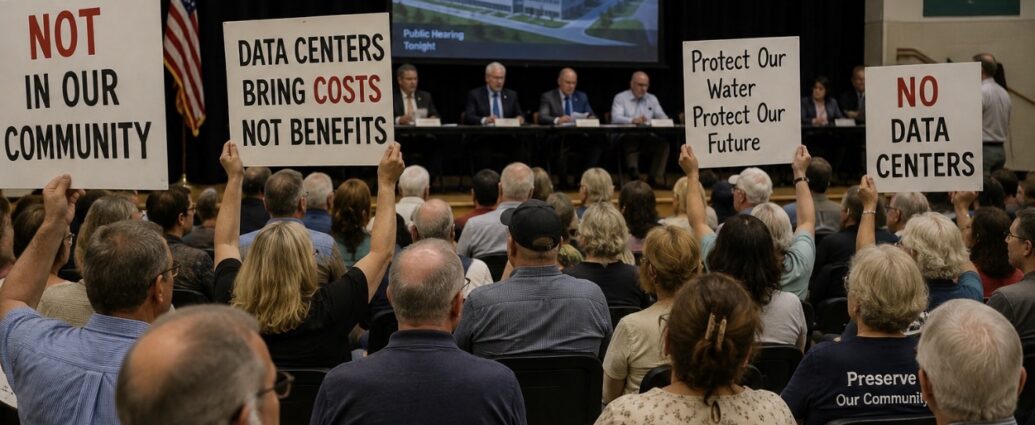
The biggest obstacle facing the companies building artificial intelligence is no longer chips or capital. It is the local zoning board — and in a growing number of places, the answer coming back is no.
Opposition to large AI data centers is rising in Republican and Democratic communities alike, with residents raising electricity bills, water supplies, noise and strain on local infrastructure. Texas, Florida, Pennsylvania, Nebraska and Ohio are all seeing pressure for tighter oversight, project audits, or rules preventing households from absorbing the infrastructure costs these facilities create. With midterm elections approaching, politicians are finding the issue hard to sidestep.
The numbers behind that pressure are substantial. Local opposition blocked or delayed 75 data center projects representing $130 billion in planned construction during the first three months of 2026, according to Data Center Watch — roughly as many projects as were affected across all of 2025. The 2025 total in dollar terms came to $156 billion in delayed or canceled work.
Not a partisan split
The polling is what makes this unusual. A Gallup survey found roughly 70% of Americans oppose construction of an AI data center in their local area — 75% of Democrats and 63% of Republicans. The internal breakdown is stranger still: conservative Republicans oppose local data centers at a higher rate, 53%, than moderate Republicans, at 44%, putting the most conservative voters closer to Democrats than to the center of their own party.
“I’m not sure I’ve ever seen a chart where conservative Republicans are closer to liberal Democrats than liberal and moderate Republicans are,” said Anthony Leiserowitz, director of the Yale Program on Climate Change Communication.
Megan Mullin, faculty director of the UCLA Luskin Center for Innovation, attributes it to something simpler than technology anxiety. “Amid so much partisan division, opposition to data centers seems to be the thing that unites Americans right now,” she said, describing the resistance as rooted in attachment to the places people live.
It is already moving campaigns
In Michigan’s 7th Congressional District, Democrat William Lawrence did not plan to run on data centers, but voters kept raising it. “It wasn’t something that I expected to be part of the campaign last August because data centers weren’t on our radar,” he said. “But there have been four data centers proposed in the district since I declared my candidacy.” He won his primary against two more moderate opponents.
In Wisconsin, calling for a construction moratorium has helped Francesca Hong assemble a broad coalition in the Democratic primary for governor. And two months after OpenAI and Oracle broke ground on a large campus in Saline Township, Michigan, Senate candidate Abdul El-Sayed held a rally in front of the site, calling for no further approvals until federal rules are in place.
It cuts against incumbents of both parties. Maine Governor Janet Mills, a Democrat, vetoed legislation that would have created the first statewide data center moratorium, saying she did not want to shut the industry out entirely. More than 100 moratorium proposals are circulating around the country.
What it costs the builders
The consequences fall on Microsoft, Meta, Amazon, Google, OpenAI and Oracle, whose AI strategies all require extraordinary amounts of physical construction. Developers once treated land, chips and capital as the binding constraints. Community permission is now a fourth. The likely result is slower permitting, higher financing costs, and a strong incentive to build where local officials are openly supportive.
That last point is the practical one for anyone in construction, engineering, utilities or industrial real estate. A project that clears zoning in eight months instead of thirty is worth a premium, and developers are beginning to pay it. Communities that organize a welcome — with clear rules on power costs, tax treatment and water use agreed up front — are moving to the front of the queue.
The complaints cluster around a few concrete items: enormous electricity demand that outruns existing grids and pushes rates up, noise, and public infrastructure rebuilt for the benefit of one very large customer. Non-disclosure agreements around early negotiations have fed the distrust, and residents are skeptical of promised jobs and tax revenue.
There is a structural reason the industry keeps losing these fights. AI has no local constituency. Housing developments have future residents, auto plants have workers, wind farms have environmental groups. A data center employs relatively few people once built, which leaves almost no one in town with a direct stake in seeing it go up.
Whether the coalition holds is a separate question. Researchers note that issues uniting people across party lines tend to fracture once they draw serious political attention, and the midterms will test that. For now, the fastest-growing constraint on the AI buildout is not technical. It is a room full of neighbors with a microphone.
JBizNews Desk | Washington
© JBizNews.com All Rights Reserved. Reproduction or distribution without written permission is prohibited.