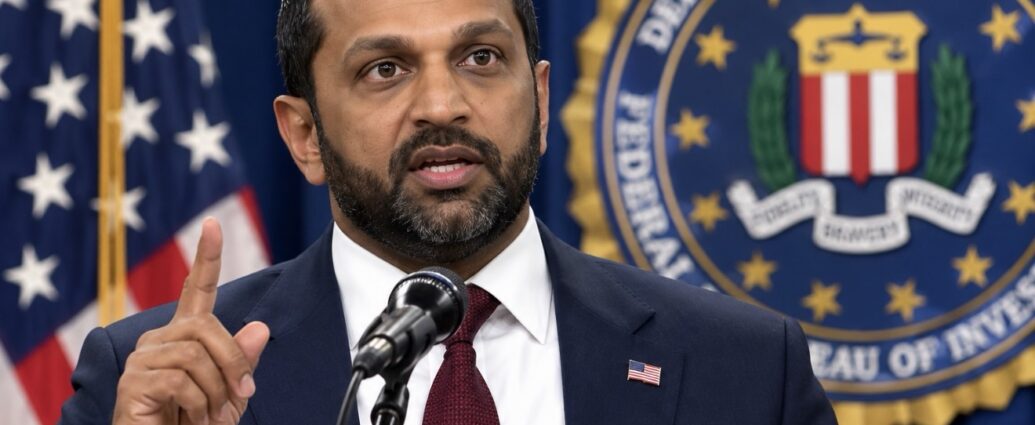
FBI Director Kash Patel said the bureau worked alongside the Department of Homeland Security and the Office of the Director of National Intelligence on the administration’s recent release of intelligence about foreign influence on U.S. elections — but said the FBI played the smaller role.
Speaking in an interview with EpochTV’s “American Thought Leaders” that aired August 8, Patel said the three agencies worked as partners at President Donald Trump’s direction, with DHS and ODNI taking the lead because they had the technical capabilities and mandates more directly tied to overseas threats involving U.S. election infrastructure.
“We shared our information,” Patel said, adding that much of it was later made public through Trump’s July 16 White House address.
The distinction matters because the administration’s election-security push has drawn together intelligence, cybersecurity and law-enforcement agencies at a time when Washington is again debating how much foreign governments know about American voters — and what they could do with that information.
Trump used the July address to announce the release of declassified material that he said showed China had acquired data involving roughly 220 million U.S. voter records. He also questioned the broader security of American election systems and urged Congress to pass the SAVE America Act.
The claim that China targeted U.S. voter information is consistent with earlier intelligence findings that Beijing sought data on American voters, political parties, candidates and public opinion. The larger dispute is over what that activity amounted to.
A declassified 2021 U.S. intelligence assessment concluded that China did not attempt to change vote counts or interfere directly with election infrastructure during the 2020 presidential election. Some intelligence officials assessed that Beijing preferred Trump not win reelection, but the government’s consensus finding was that China focused primarily on intelligence gathering and influence rather than manipulating the voting process itself.
That distinction is significant because much voter-registration information is already commercially or publicly available. Campaigns, political consultants, data brokers and researchers routinely obtain voter files containing names, addresses, party registration and voting-history information where state law permits.
The national-security concern is therefore not simply whether a foreign government possesses voter data. It is what happens when that information is combined with stolen telecommunications records, social-media profiles, hacked government systems or other datasets capable of identifying and targeting individuals more precisely.
Patel has repeatedly identified China as one of the most sophisticated cyber threats facing the United States. During congressional testimony last year, he highlighted Salt Typhoon, the Chinese-linked hacking group blamed for penetrating major U.S. telecommunications networks.
The election-security structure inside the federal government has also changed. Attorney General Pam Bondi dissolved the FBI’s Foreign Influence Task Force in early 2025, while ODNI has undergone significant restructuring and personnel reductions.
That leaves DHS, intelligence agencies, the FBI and state election officials dividing responsibilities across a threat environment that increasingly overlaps with ordinary cybersecurity.
For businesses, the broader lesson extends well beyond elections. Voter offices, municipalities, utilities, hospitals and small public agencies often hold valuable information while operating with far fewer cybersecurity resources than banks or major technology companies.
The data itself may not always be secret. The danger comes from how multiple datasets can be combined, analyzed and weaponized once they fall into the hands of a sophisticated foreign intelligence service.
JBizNews Desk | Washington
© JBizNews.com All Rights Reserved. Reproduction or distribution without written permission is prohibited.