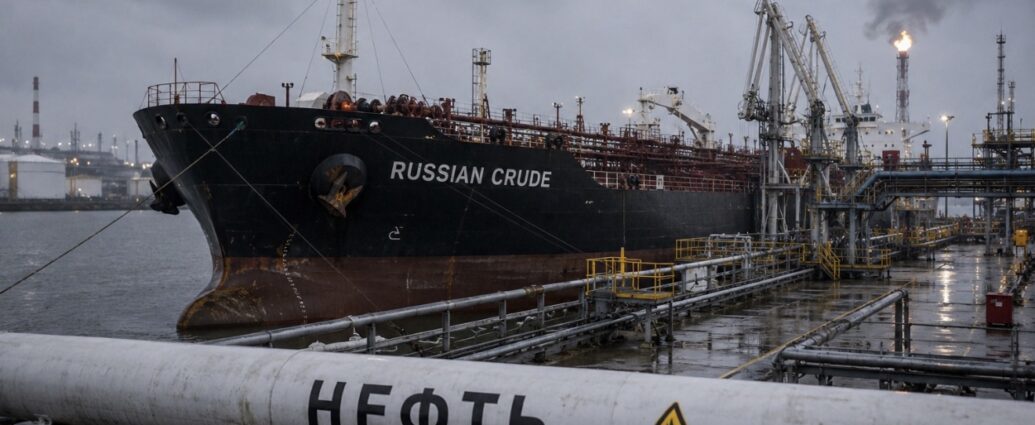
Russia’s seaborne crude shipments have fallen to their weakest level since May, according to tanker-tracking data reported Tuesday — the third straight week of decline and a sharp reversal from the record wartime volumes Moscow was pushing out of its ports just six weeks ago.
The mechanism behind the swing is Ukraine’s drone campaign, and it works in both directions. When Ukrainian drones knock out Russian refineries, Russia cannot process its own crude at home, so it dumps the raw barrels onto tankers and exports them. When the drones hit ports, tankers and export terminals instead, the barrels stop moving altogether. That is the switch that has flipped over the past month.
The numbers behind the drop
The trail is clear in the weekly tanker data. Four-week average seaborne crude shipments hit 4.22 million barrels a day in the period to July 5, the highest since Russia invaded Ukraine in 2022. They held at 4.21 million barrels a day through July 12. By the four weeks to Aug. 2 they had dropped to 3.9 million barrels a day, falling below 4 million for the first time in six weeks and hitting the lowest level since mid-June. This week’s reading takes the decline further, back to territory last seen in the spring.
Ukraine shifted tactics in the second half of July, sending drones after tankers in the Black Sea and Sea of Azov and warehouses in western Russia rather than refineries, then swung back to refinery strikes — hitting Rosneft’s Ryazan plant, Lukoil’s 300,000-barrel-a-day Volgograd facility, a Bashneft complex at Ufa and Rosneft’s Saratov plant. Port activity reflects the security risk: loadings at Novorossiysk have stayed near half their recent peak.
Refining at a 24-year low
The damage to Russia’s downstream industry is severe. Refineries processed an estimated 3.6 million barrels of crude a day in July, the lowest since May 2002 and roughly a third below the seasonal norm, according to EA Analytics data cited by Bloomberg. Between 2020 and 2025, Russian refineries ran 5.3 million to 5.6 million barrels a day at this point in the year.
Refined products are where the loss shows up hardest. Russian oil product export loadings fell 23% in July to 4.7 million tonnes, the lowest on record and less than half the 9.6 million tonnes loaded in July 2025, with the Tuapse terminal — under sustained drone attack since May — loading almost nothing for a second consecutive month.
The barrels that don’t arrive
Shipping crude is not the same as selling it, and Russia has been running into that gap all summer. Cargoes have been taking longer to clear, with tankers of Urals crude anchored off Egypt’s Mediterranean coast and in Indonesia’s Riau archipelago near Singapore, and far-eastern grades idling for weeks near the Pacific port of Kozmino. Those delays pushed the volume of Russian crude sitting on water to about 135 million barrels by mid-July.
Revenue has followed the same path down. The gross weekly value of Russia’s seaborne crude exports fell to a four-week average of $1.68 billion, down $200 million from the prior period, with Baltic Urals at $52.61 a barrel and cargoes delivered to India hitting an eleven-week low of $70.58. Urals averaged $60.22 a barrel in July, down 3% on the month but still well above the $44.10 EU and U.K. price cap that took effect on Feb. 1.
What it means for buyers
The customers are concentrated, which magnifies every disruption. India’s imports of Russian crude hit a record high for a second consecutive month in July, up 2.1% and worth €5.5 billion. Indian refiners have built their margins around discounted Russian barrels; when volumes tighten, they buy replacement cargoes from the Gulf and West Africa at narrower spreads, and that competition for non-Russian barrels is what eventually reaches diesel and jet fuel prices in Western markets.
For American businesses, the transmission runs through freight and fuel rather than through any direct trade. Fewer Russian barrels reaching Asia tightens the global pool, and reduced Russian product exports remove diesel supply from a market that has been thin all year. Diesel is the cost line that moves trucking, rail and construction pricing.
The open question is whether this is a durable decline or a pause. Russia’s export machine has proven resilient at rerouting around damage, and year-to-date flows still run above every annual average since the 2022 invasion.
JBizNews Desk | New York
© JBizNews.com All Rights Reserved. Reproduction or distribution without written permission is prohibited.