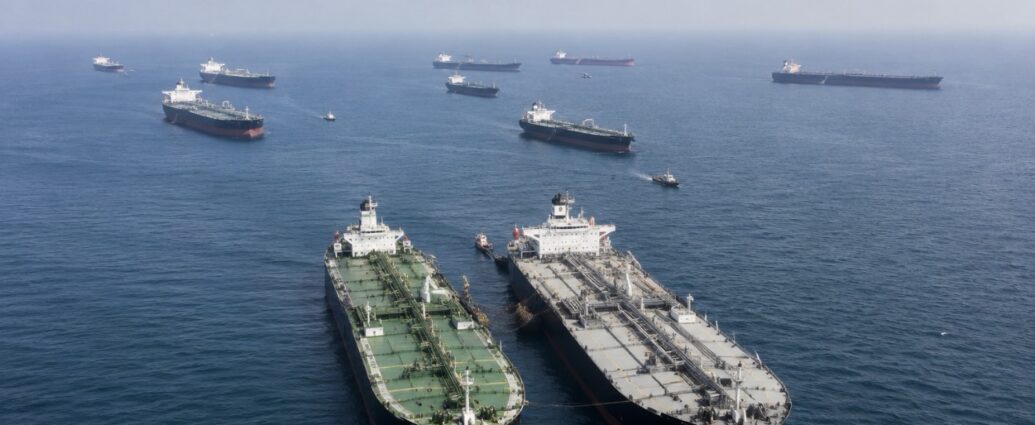
The oil is inside the Persian Gulf, and the Gulf has one way out — a 21-mile-wide strait with Iran on one side of it.
The oil is inside the Persian Gulf. The Gulf is a bathtub with one drain — the Strait of Hormuz. Every barrel loaded at a Saudi, Emirati, Kuwaiti or Qatari terminal has to come out through that drain. The drain is about 21 miles wide at its narrowest, and Iran sits on one side of it.
Since the war began on February 28, Iranian forces have mined the middle lanes that ships used for decades, pushing traffic onto two makeshift routes that hug either the Iranian coast or the Omani coast. Ships that don’t comply with Iranian orders risk being attacked by Revolutionary Guard drones and missiles.
So the problem is simple to state: the oil is on the wrong side of a dangerous doorway, and the ships that normally carry it across oceans are too valuable to send through that doorway.
The solution: two ships, two jobs.
Job one — go in and get it. A medium-sized tanker, typically carrying 750,000 to 1 million barrels, sails into the Gulf, loads at the terminal, and comes back out through the strait. This is the shuttle. It takes the risk.
Job two — cross the ocean. A Very Large Crude Carrier, holding about 2 million barrels, waits in open water outside the strait. It never goes in. This is the ship that will eventually sail to India or China.
Between the two jobs, the oil has to change ships. That handoff is what the satellites are photographing.
Why not just send the big ship in?
Because of how long it would be exposed. A VLCC going in itself would transit the strait, spend a day or more at a berth loading, then transit the strait again — three to five days inside Iran’s reach, through the chokepoint twice. Waiting outside instead means roughly 24 to 40 hours in safer water, and never entering the narrow part at all.
There is also the value at stake. A full VLCC carries well over $150 million of crude on a hull worth more than $100 million. One drone strike on that is a catastrophic loss. The shuttle carries a fraction of it. You send the cheaper ship into the dangerous place.
War-risk insurance reinforces the same logic — underwriters will price a short shuttle run into the Gulf; many will not cover a VLCC going in at all.
Why not have the shuttle keep sailing to Asia?
Because it’s the wrong ship for that trip. Half the cargo means far higher freight cost per barrel, and there aren’t enough of these hulls to run the Asia route. The shuttle is worth more turning around and making another run into the Gulf. It usually takes two or three shuttle loads to fill one VLCC.
How the handoff physically works.
The two ships moor side by side, hulls parallel, kept apart by large inflatable rubber fenders. No divers, nothing in the water. A crewman throws a light line across, which pulls over heavier lines, which pull the mooring ropes. A deck crane lifts the cargo hose string across to the other ship, where crew bolt it to the manifold. The hoses are 8 to 12 inches across, in bolted sections, running perhaps 30 to 100 meters in total. The pumping takes 24 to 40 hours. Then the empty shuttle heads back through the strait to load again, and the loaded VLCC sails on.
Where it happens.
Two sites, identified by 11 people familiar with the operation: off Fujairah in the United Arab Emirates, and off Oman’s port of Sohar. Both sit outside the zone Iran claims to control. On Monday, satellite images showed 12 transfers spread along more than 100 kilometers of Omani and Emirati coastline.
Is that water safe? No — safer.
Fujairah port has been hit by Iranian fire repeatedly during this operation, and an unknown projectile struck a tanker off Oman in mid-June, causing cargo leakage. Explosive naval drones have struck tankers in the region, including one about 44 nautical miles off Oman that killed a crew member. Hitting a ship in Emirati or Omani waters is a bigger political step for Iran than hitting one in the strait — but it is reachable, and the rafted-up pair is at its most vulnerable during those 24 to 40 hours, tied together and unable to move.
Why the transponders go off.
Ships in this system run with transponders off and lights dimmed, staggered about 3 to 4 kilometers apart so a single attack can’t take out several at once. Going dark does not make a tanker invisible — Iran has coastal radar, islands, patrol boats and drones, and a 250-meter ship shows up on all of them. What it does is make the ship anonymous: no name, flag, owner or cargo broadcast. Iran runs a permit system and picks targets; if it can’t identify a vessel in the moment, it can’t sort it. Going dark also breaks the commercial paper trail that insurers and sanctions monitors rely on. This is the technique Iran itself pioneered to sell sanctioned oil, now being used against it.
Who runs it and who’s in it.
Eight sources said the operation is controlled by the U.S. military. Operators must pass a compliance review — full ownership disclosure, tracking history, cargo documentation — submitted to the Navy’s shipping guidance office in Bahrain, and approved ships get assigned transit windows. Support comes through aerial surveillance and monitoring rather than naval escort; a U.S. defense official denied Central Command takes part in any offshore transfer operation. On the outbound side, UAE state oil company ADNOC and the Kuwait Oil Tanker Company have been among the most active; the receiving side is dominated by international operators such as Greece-based Dynacom.
How much it moves.
At least 92 ships have taken part since early May, with 17 pairs transferring at once on June 11, moving perhaps 90 million barrels in total — against a pre-war average of roughly 20 million barrels flowing through the strait every day. It is a trickle, not a restoration.
Oil rose Tuesday on the stalemate, with West Texas Intermediate up 1.4% at $83.27 a barrel and Brent up 1.3% at $88.85.
JBizNews Desk | Dubai
© JBizNews.com All Rights Reserved. Reproduction or distribution without written permission is prohibited.