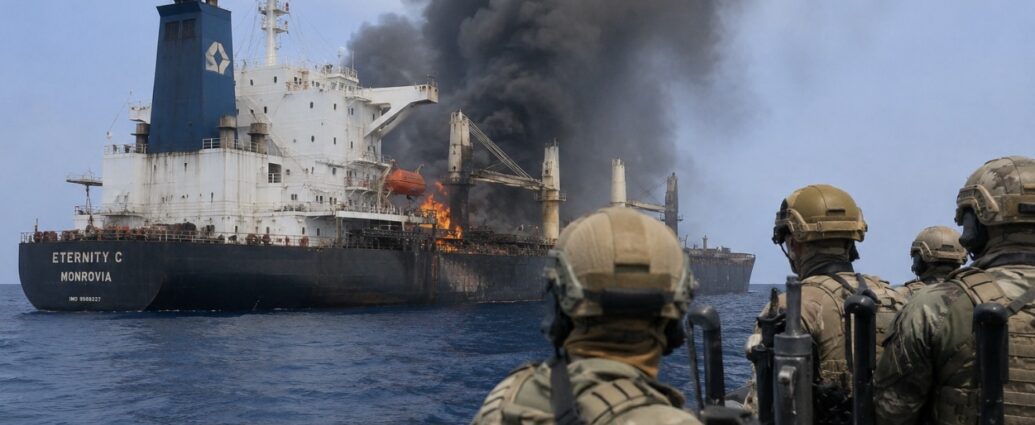
Two attacks on commercial shipping in a single day tightened the squeeze on the world’s two most important maritime chokepoints, with the first crew deaths of the war at one end of the Arabian Peninsula and an American strike on a container ship at the other.
Four crew members were killed when Iran-backed Houthis struck a small cargo ship in the Bab el-Mandeb strait on Tuesday, according to Yemen’s transport ministry. Three Pakistanis and one Indonesian died aboard the Egyptian-owned Tihamah, and the crew lost control of the vessel after the attack. If confirmed, these are the first deaths in a Houthi strike on shipping since the Iran war began Feb. 28. The Houthis have not claimed it.
Three Yemeni coastguard personnel were injured when a drone targeted them during the rescue attempt. UK Maritime Trade Operations, the British navy-affiliated agency, reported the ship was hit by an unknown projectile, and maritime security group Ambrey said it was at anchor northeast of Perim Island at the time, noting the vessel was not Saudi-owned or operated and had left the government-held port of al-Mokha on Saturday. LSEG data lists Egyptian companies as owner and manager; neither responded to requests for comment.
The Houthis declared a maritime embargo against Saudi Arabia in the Red Sea on July 20, citing what they called a Saudi siege. Riyadh denies Yemen is under siege.
Separately, a U.S. blockade enforcement action played out roughly 2,000 miles to the east. The Panama-flagged container ship Vela Nova was struck by a missile off Pakistan as it sailed into the Gulf of Oman, maritime security sources told Reuters, and the Wall Street Journal reported a U.S. helicopter fired a Hellfire missile at the ship’s rudder after it attempted to evade the American blockade on Iran-linked shipping. Vanguard, a UK maritime risk group, put the strike about 71 nautical miles off Pakistan’s coast. U.S. Central Command did not immediately comment.
If confirmed, it would be the 12th vessel attacked by U.S. forces since the blockade was announced in April, and the third since it was reimposed July 14. Charlie Brown of United Against Nuclear Iran, which tracks Iran-related tanker traffic, noted the ship had recently called at Mumbai and Port Klang, Malaysia — ports where Iran-linked vessels have also been spotted — and said the interdiction underscores the scrutiny now applied to Iran-related shipping.
Aiming a missile at a rudder rather than a hull is a disabling shot, meant to strand a vessel for boarding rather than sink it. That distinction matters commercially: it signals the blockade is being enforced as an interdiction regime, which is precisely the risk underwriters now have to price on any voyage with an ambiguous port history.
The traffic numbers show what all of this has done to trade volume. Shipping through Bab el-Mandeb and the Red Sea is down more than 50% from before the 2023-25 wave of Houthi attacks, and has fallen further since last month’s blockade announcement — an average of 32 ships a day passed through the strait last week, according to Kpler, down from 50 before.
The Strait of Hormuz is worse. Just six vessels transited on Monday, against a 10-day average of about 11 and prewar levels of roughly 130 to 140 a day. That is a collapse of better than 95% in the passage that normally carries a fifth of the world’s oil.
The two chokepoints together form the route between Asia and Europe. Ships avoiding Bab el-Mandeb go around the Cape of Good Hope, adding roughly ten days and a corresponding bill in fuel, charter time and crew wages to a Europe-Asia voyage. Cargo that cannot leave the Gulf at all has no detour available.
Oil reflected the pressure Tuesday, with West Texas Intermediate up 1.4% at $83.27 a barrel and Brent up 1.3% at $88.85 after an Iranian official said Hormuz stays closed until Tehran’s conditions are met.
For shipowners and charterers, the immediate consequences are war-risk premiums, crew hazard pay and the growing difficulty of finding operators willing to send ships and seafarers into either strait. Tuesday supplied a reminder of why: on both routes, the danger is now to the people aboard.
JBizNews Desk | Dubai
© JBizNews.com All Rights Reserved. Reproduction or distribution without written permission is prohibited.