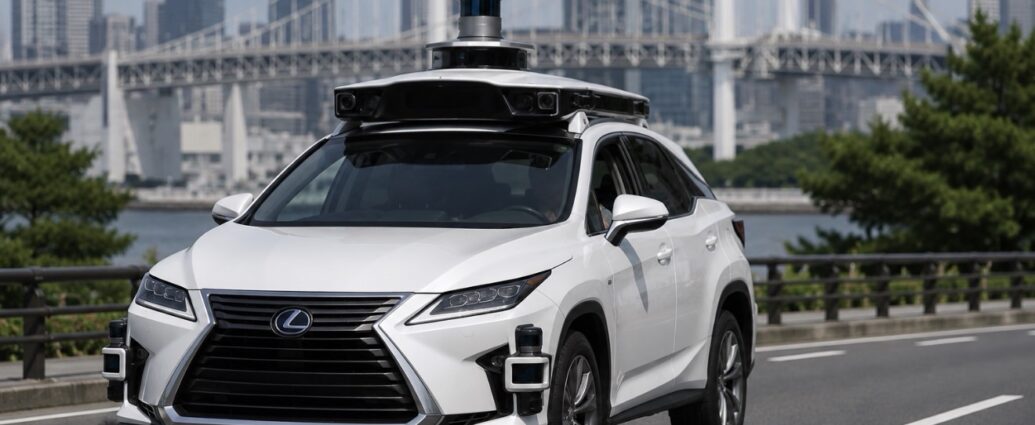
Turing Inc., a five-year-old Tokyo company building software that drives a car by itself, is setting up an office in the United States and telling investors it intends to go public at a valuation of roughly $10 billion. Neither has happened yet. The U.S. office is a plan the company is now acting on, and the listing is a target its founder has held for years — one the company describes internally in yen terms as a ¥1 trillion debut. What is real today is a startup worth a fraction of that number publicly declaring where it expects to end up, and moving staff toward the market where the money and the customers are.
Turing’s technology is simpler to explain than most in the field. Where Waymo and much of the industry stitch together lidar sensors, radar, and centimeter-accurate digital maps, Turing feeds camera images straight into one large neural network that outputs the steering, braking, and acceleration commands. That is the same “end-to-end” bet Tesla made. Strip out the map-building and the sensor stack and the cost per vehicle falls sharply, which is the entire commercial argument: a system cheap enough to sell to automakers for ordinary consumer cars, not just a robotaxi fleet a single company operates itself.
The founders picked the fight openly. Turing was incorporated in August 2021 by Issei Yamamoto, who built the shogi program Ponanza, and Shunsuke Aoki, who holds an autonomous-driving doctorate from Carnegie Mellon. The company’s public slogan is “We Overtake Tesla.” Its proving ground has been a project called Tokyo30, in which a Turing vehicle drove more than 30 minutes through Tokyo traffic without human intervention, an exercise the company has since repeated in denser areas around the country.
American suppliers are already deep in the story, which is part of why a U.S. presence follows logically. In July, Turing closed an extension to its Series A worth ¥12.62 billion — about ¥6.8 billion in equity and a ¥5.8 billion loan from MUFG Bank — with AMD Ventures, Mitsubishi Corp., Super Micro Computer, Tokyo Electron Device, GMO Internet, BIPROGY, and DataDirect Networks taking shares. Combined with the ¥15.27 billion first close in November, the full round came to ¥27.89 billion, or roughly $180 million. That round left the company valued at about ¥96 billion, in the neighborhood of $600 million. Turing has also committed to AMD graphics processors for the compute that trains and runs its driving model, a deliberate cost decision in a business where training bills run to the hundreds of millions, and it has worked with Nvidia on end-to-end development.
The gap between $600 million and $10 billion is the whole question. Turing plans to put its system in consumer vehicles and driverless taxis as early as 2028, with fully autonomous commercial vehicles targeted around 2029. It has roughly 60 to 85 employees, most of them engineers, and no commercial revenue to speak of. A U.S. office gives it three things it cannot get in Tokyo: access to the engineers who have already built these systems at Waymo, Tesla, and Zoox; proximity to AMD, Nvidia, and Super Micro, on whose hardware the entire product depends; and standing with the American investors who will ultimately decide whether a ten-figure listing is credible.
The domestic clock is the pressure. Nissan, British startup Wayve, and Uber are preparing a self-driving taxi pilot in Tokyo before the end of this year. Waymo has been mapping seven central Tokyo wards with human drivers and running validation with taxi operator Nihon Kotsu, working toward a commercial launch that has no confirmed date. Turing’s executives argue the delay costs them little, since automakers refresh models on three- to five-year cycles and a supplier that wins a design slot in 2028 is locked in through the early 2030s.
Japan’s public markets have already given the sector a reality check. Tier IV, the Nagoya University spinout behind the open-source Autoware software, listed on the Tokyo Stock Exchange Growth Market on July 22 in the country’s first autonomous-driving IPO. It priced at the top of its range, ¥1,085, raising about ¥23.2 billion — then opened at ¥1,009, roughly 7 percent below the offer price, for a market value near ¥64 billion. Tier IV booked ¥6.4 billion of revenue and a ¥4.7 billion loss in its last full fiscal year.
That is the number Turing has to argue past. A company with no product on sale is telling the market it will be worth more than fifteen times what Japan’s first listed autonomous-driving firm fetched on its opening day. The U.S. office is the first visible step toward making that case somewhere other than Tokyo.
JBizNews Desk | Tokyo
© JBizNews.com All Rights Reserved. Reproduction or distribution without written permission is prohibited.