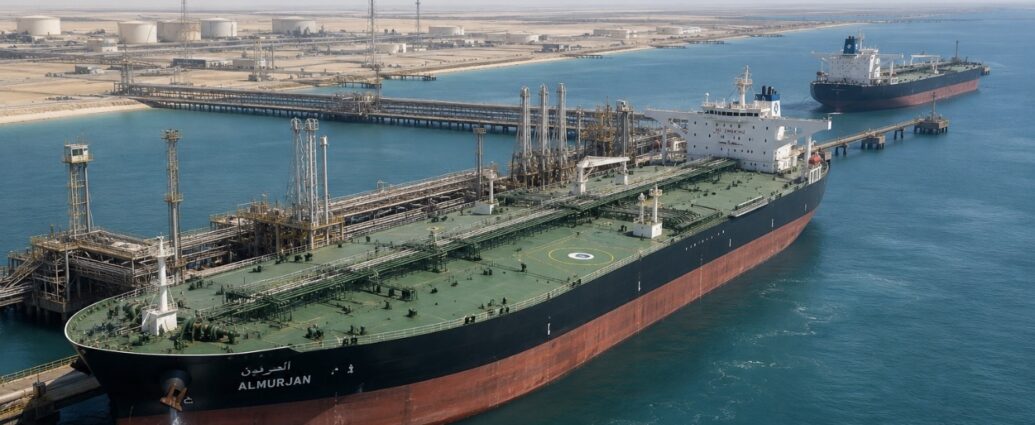
A very large crude carrier capable of loading about 2 million barrels was moored at one of Ju’aymah’s single-point moorings on Tuesday, according to an image from the European Union’s Sentinel 2 satellite. It is the first such sighting at Saudi Arabia’s main Persian Gulf export terminal in almost a month. The last vessel seen there was in mid-July, though the satellite does not pass over every day, so ships may have called without being photographed.
A second tanker appeared in the same images about 20 miles south, at the Ras Tanura sea island. Its dimensions mark it as a Suezmax, good for roughly 1 million barrels — the second ship spotted at that berth this month, after a smaller Aframax a week earlier. Between the two vessels, about 3 million barrels.
The reason this counts as news is that nobody can simply look it up anymore. Since the Iran war began in February, most ships in the region have stopped transmitting automated position signals. Tracking the world’s largest oil exporter now depends on orbital photographs and inference. That is the state of transparency in a market where roughly 1 barrel in every 5 of global supply moves through the Strait of Hormuz.
Saudi Arabia is working two export routes at once and both are under threat. The Persian Gulf side reopened in late June when Aramco resumed loadings at Ras Tanura after a halt of nearly four months, following the March drone attack on the refinery there — a plant that processes more than half a million barrels a day. The Red Sea side, out of Yanbu, became the release valve while Hormuz was effectively shut. Then Houthi forces declared a blockade of Saudi vessels and struck tankers in the Bab el-Mandeb, closing the alternative.
Prices have moved in a range that would once have been a decade’s worth of volatility. Brent hit $115 in late March. It fell to roughly $70 by early July on the interim U.S.-Iran deal. It crossed $100 again in late July after the tanker attacks, a swing of more than 40% in a month. Brent traded near $87.92 on Thursday, down about 1.2% on the day but up roughly 32% from a year ago.
Two forces are pulling against each other. On the supply side, the recovery has been real: shut-in production across the Gulf fell from 11.7 million barrels a day to 9.6 million in about three weeks, and U.S. crude inventories rose 17.4 million barrels last week, the biggest weekly build since early 2023. On the risk side, negotiations over Hormuz remain deadlocked. President Trump said this week that the United States has total control of the strait, while Pakistan’s defense minister described Washington and Tehran as close to some sort of arrangement. Reports place Iran-Oman talks at an advanced stage. Traders are pricing both stories at once.
For American businesses, the exposure is less at the crude level than one step downstream. Refined products — diesel especially — have been rising faster than crude, and diesel is what moves freight. A trucking company, a distributor, a construction firm with equipment in the field pays for the strait through fuel surcharges before it ever shows up as a headline oil price. Refiner margins have been strong precisely because product is tight.
The practical read of Tuesday’s images is modest but real. Two ships loading is not a restored export program; it is evidence that the Gulf route is functioning at some level, on a day when the alternative route is under attack. Ships are still cautious about entering. Inbound ballast traffic — empty tankers heading in to refill — has been thin, and that is the number that actually determines whether exports normalize or bottleneck.
What would change the picture is a Hormuz arrangement that holds long enough for shipowners to believe it. Until then, insurance and charter rates carry a war premium, cargoes route the long way around, and the price of a barrel reflects the odds of a deal as much as the balance of supply.
For anyone budgeting fuel into next year, the planning assumption should be volatility rather than a level. Brent has traded between roughly $70 and $115 inside five months. Companies with the ability to hedge or lock freight rates have a reason to use it; those without should be building a wider band into their numbers than the current spot price suggests.
JBizNews Desk | New York
© JBizNews.com All Rights Reserved. Reproduction or distribution without written permission is prohibited.