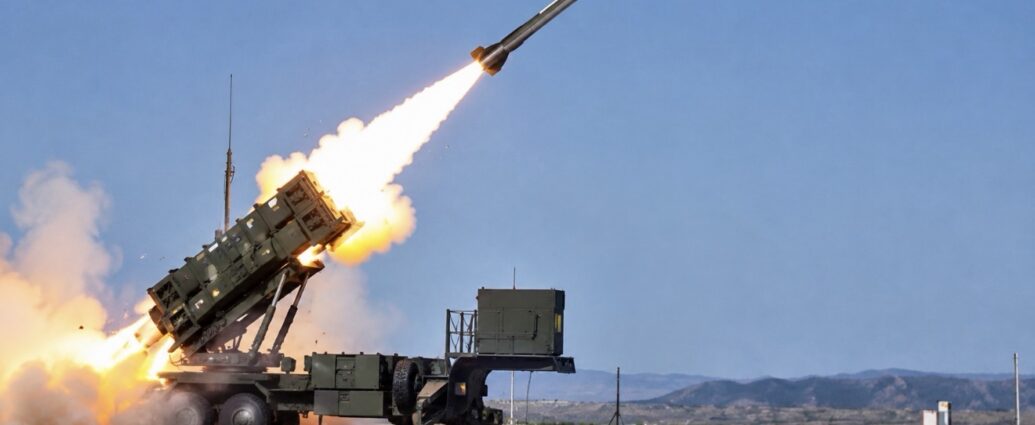
Washington is rapidly expanding production of its most important missile interceptors as wars in Europe and the Middle East expose how quickly even the world’s largest defense industrial base can burn through sophisticated munitions.
The United States is moving aggressively to increase production of Patriot PAC-3 and THAAD missile interceptors, using multiyear contracts and major factory expansions to rebuild inventories and prepare for future conflicts.
The Pentagon’s strategy is a major break from the past.
Instead of relying heavily on year-to-year procurement, the government is now giving manufacturers long-term purchase commitments designed to justify billions of dollars in new factories, tooling, workers and supplier capacity.
Lockheed Martin is at the center of the push.
The company has committed to increasing annual production capacity of PAC-3 Missile Segment Enhancement interceptors from roughly 600 to 2,000 per year.
PAC-3 MSE missiles are among the most advanced interceptors used by the Patriot air-defense system, designed to destroy ballistic missiles and other high-speed threats.
Lockheed delivered a record 620 PAC-3 MSE interceptors in 2025, but current demand from the U.S. military and allied countries is far greater.
Washington has already awarded Lockheed a multiyear PAC-3 contract valued at up to $58.62 billion.
The government is making an equally dramatic push on THAAD.
Production capacity for Terminal High Altitude Area Defense interceptors is planned to rise from 96 missiles annually to 400, more than quadrupling current capacity.
A separate seven-year THAAD procurement agreement is worth up to $35 billion.
THAAD is designed to intercept ballistic missiles at high altitude during the final stage of flight and forms an important layer of U.S. and allied missile defense.
The Pentagon also signed new seven-year agreements with Lockheed Martin and General Dynamics Ordnance and Tactical Systems in late August to accelerate production of key missile components used in both THAAD and PAC-3 systems.
The logic is straightforward.
Missile-defense systems only work if enough interceptors are available.
Modern conflicts have shown that large quantities can be consumed extremely quickly.
The United States has supplied significant air-defense munitions to Ukraine while simultaneously deploying and using missile-defense systems in the Middle East.
The continuing confrontation with Iran has intensified those concerns.
President Trump recently acknowledged that American missile inventories have been under pressure while emphasizing that domestic production is being expanded.
The Pentagon is trying to solve a problem that cannot be fixed overnight.
Highly sophisticated missile interceptors depend on specialized rocket motors, guidance electronics, explosives, seekers and other components produced by a relatively small network of defense suppliers.
Expanding final assembly therefore does little if those suppliers cannot also increase production.
That is why current contracts are extending deep into the supply chain.
Lockheed is spending billions to expand or modernize more than 20 facilities across Arkansas, Alabama, Florida, Massachusetts and Texas.
In Troy, Alabama, the company is building an 87,000-square-foot munitions production center that will support THAAD and potentially the Next Generation Interceptor program.
In Camden, Arkansas, the expansion of PAC-3 production is expected to increase employment from roughly 1,200 workers to about 1,850.
What It Means for You
The business story here is bigger than defense spending.
America is rebuilding an industrial capability that took decades to shrink.
For years, the Pentagon bought sophisticated missiles in relatively limited numbers because the expectation was that future wars would be short and precision weapons would not be consumed at extraordinary rates.
Ukraine and the Middle East have challenged that assumption.
A missile that takes months to manufacture can be fired in seconds.
That creates a completely different economic model for the defense industry.
Long-term Pentagon contracts allow manufacturers to invest in factories and suppliers without worrying that government demand will disappear after one budget cycle.
For defense contractors, that means billions of dollars in predictable revenue.
For manufacturers, machine shops, electronics suppliers and workers across the country, it means one of the largest expansions of the U.S. munitions industrial base in decades.
And for Washington, the calculation is increasingly simple:
The United States cannot deter large-scale wars unless it can manufacture weapons faster than it may eventually need to use them.
That is why production of some of America’s most advanced missile interceptors is now being tripled and quadrupled.
JBizNews Desk | New York
© JBizNews.com All Rights Reserved. Reproduction or distribution without written permission is prohibited.