
The American economy is increasingly rewarding people who own businesses, stocks and other capital rather than those who depend primarily on a paycheck — a decades-long shift that could become even more pronounced as artificial intelligence and automation spread through the workplace.
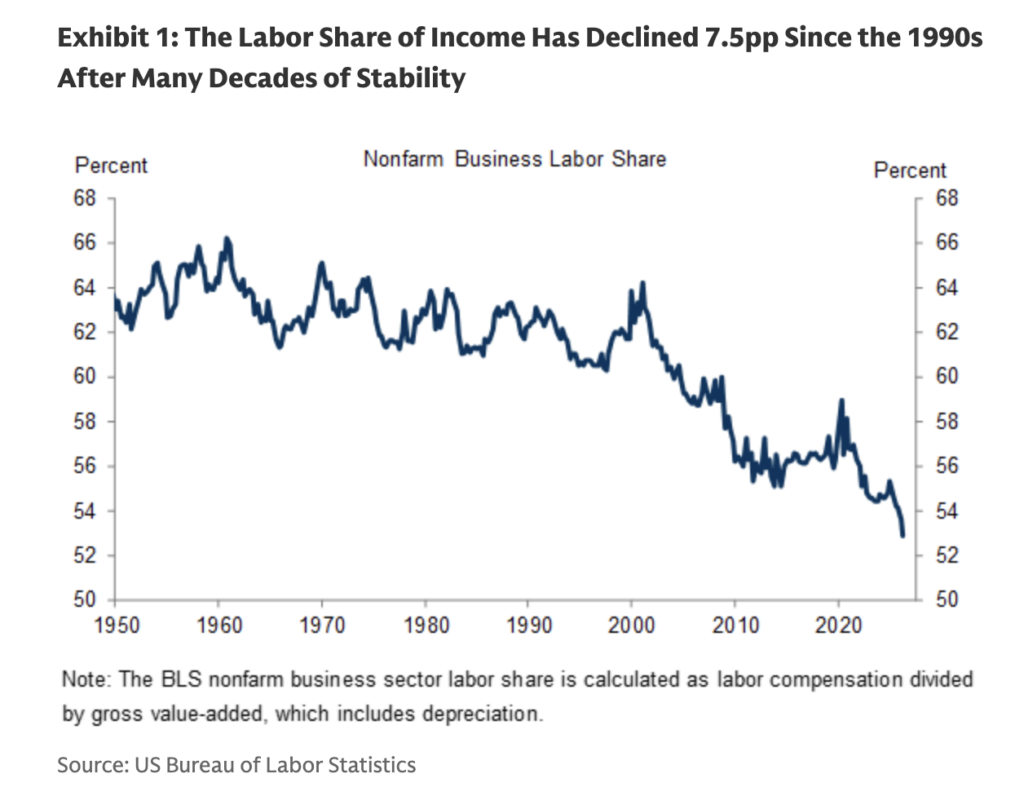
New research from Goldman Sachs examines a striking decline in labor’s share of U.S. business income. The share of nonfarm business output going to workers has fallen roughly 7.5 percentage points since the 1990s, according to Bureau of Labor Statistics data cited in the research.
In the second quarter of 2026, labor’s share fell to approximately 52.8% to 52.9%, the lowest level in government records dating to 1947.
The decline does not mean every dollar disappearing from labor automatically went into shareholders’ pockets. Goldman economist Abhay Duggirala estimates that roughly 40% of the decline can be explained by measurement and accounting effects.
But Goldman concludes the remaining roughly 60% — equivalent to about 4.5 percentage points — represents a genuine structural shift, associated with factors including higher corporate markups, automation and diminished worker bargaining power.
For ordinary Americans, the distinction matters because the financial benefits of stronger corporate profits and rising asset values depend heavily on whether a household owns those assets.
The Economy Is Growing — But Who Owns the Growth?
The simplest way to understand the issue is to look at two ways Americans make money.
One is labor: wages, salaries and other compensation earned by working.
The other is capital: profits, stocks, businesses and other assets capable of increasing in value or generating income.
When more economic income flows toward capital, households with substantial investment portfolios or business ownership are positioned differently from households that rely overwhelmingly on wages.
That divide is particularly important because stock ownership is highly concentrated.
The wealthiest 10% of U.S. households own the overwhelming majority of corporate equities and mutual-fund shares, according to Federal Reserve data cited in reporting on Goldman’s research.
That means a booming stock market can generate enormous wealth without producing the same financial improvement for every household.
Wall Street Is Becoming More Important to Household Wealth
Recent Federal Reserve figures illustrate the scale of the phenomenon.
U.S. household net worth increased by a record $12.8 trillion during the second quarter of 2026, according to Reuters analysis of Fed data.
About $10.7 trillion of that increase came from rising equity values.
Total household net worth reached approximately $196 trillion, with equities accounting for nearly half of household financial assets.
But those gains were far from evenly distributed. The richest 10% of households held more than 87% of equity holdings, Reuters reported.
That creates an increasingly unusual economic picture.
A household with substantial retirement accounts, stocks and business interests can see its wealth rise significantly when markets climb.
A household living primarily on wages may experience the same economic expansion very differently — especially if rent, food, insurance, transportation and other everyday expenses are also increasing.
Why Labor’s Share Has Fallen
Goldman’s research cautions that the headline 7.5-percentage-point decline overstates the amount actually transferred from workers to owners of capital.
The bank identifies several accounting effects.
Changes in the way business income is classified following tax reforms shifted some income previously recorded as wages into business profits.
Another factor is depreciation. Modern businesses rely increasingly on computers, software and other technology that depreciates relatively quickly. Because depreciation is included in the government’s calculation of gross business value added, it can mechanically reduce the measured labor share.
Stock compensation creates another complication.
Workers — particularly highly compensated employees — are increasingly paid partly in company equity. Government statistics may not record that compensation in the same way or at the same time as ordinary wages.
After adjusting for those issues, however, Goldman still finds a substantial genuine decline in labor’s economic share.
Bigger Companies, Higher Profits
One explanation involves what economists sometimes call “superstar firms.”
Highly productive companies can achieve enormous scale, dominate portions of their markets and generate substantial profit margins.
When those businesses capture a larger portion of economic income, more money can flow toward profits and shareholders rather than employee compensation.
The result does not necessarily mean workers’ wages are literally declining. Wages can increase while labor’s share of the overall economic pie decreases if profits and capital income grow even faster.
That distinction helps explain why headline economic statistics and household experiences can sometimes appear disconnected.
AI Could Accelerate the Shift
Artificial intelligence introduces another major variable.
Goldman Sachs Research estimates that 6% to 7% of U.S. workers could be displaced from their current jobs by automation over the next decade, although historical technological changes have also created new occupations and employment opportunities.
Goldman’s labor-share research suggests that if AI continues automating a significant number of tasks, labor’s share of income could decline further.
The key economic question then becomes who captures the productivity gains.
If a company can produce substantially more using AI without proportionally increasing its payroll, the resulting productivity can translate into higher profits.
Workers can benefit if higher productivity eventually produces higher wages, new jobs or lower prices.
Shareholders can benefit more directly if it produces higher corporate earnings and stock valuations.
Goldman has separately argued that technological innovation historically creates new types of employment over time, meaning automation does not automatically translate into permanently fewer jobs across the entire economy.
A Growing Wealth Effect
The divide matters increasingly because consumer spending itself is becoming more closely connected to financial markets.
Reuters analysis found that equities now account for 34% of total U.S. household assets, while real estate’s share has fallen to a record-low 32.4%.
The wealthiest Americans also account for a disproportionate amount of consumption. The top 20% of earners are responsible for roughly 60% of U.S. consumer spending, according to the analysis.
That means Wall Street’s performance increasingly influences not only household wealth but potentially the broader economy.
When wealthy households’ portfolios rise, they may spend more.
But the reverse presents a risk: a major stock-market decline could weaken spending among the households responsible for a large portion of consumption.
What It Means for the Middle Class
For middle-class households, the findings highlight an increasingly important distinction between earning money and owning assets.
A worker can receive regular raises and still fall behind households whose stock portfolios, businesses and other investments are appreciating faster.
Conversely, millions of Americans do participate in capital markets through 401(k)s, IRAs, pensions and other retirement accounts, meaning the line between “worker” and “capital owner” is not absolute.
The difference is the scale of ownership.
A household with a modest retirement account does not experience a stock-market boom in the same way as a household with millions of dollars invested.
That is why a strong stock market can coexist with widespread concern about affordability.
Two Americas Can Experience the Same Economy Differently
The broader picture is not simply one of an economy getting poorer.
U.S. household wealth has reached extraordinary levels, corporate profits remain significant, consumer spending has remained resilient and investment in areas such as artificial intelligence continues at enormous scale. Goldman itself continues to describe the U.S. economy as resilient.
The question raised by the labor-share data is how those gains are distributed.
For households with significant ownership of stocks, businesses and other appreciating assets, economic growth can produce wealth beyond their regular income.
For households whose principal asset is their ability to work, prosperity depends much more directly on wages keeping pace with housing, food, energy, healthcare and other expenses.
As artificial intelligence, automation and capital-intensive investment reshape American business, that distinction may become increasingly important.
The economic divide of the future may therefore be about more than how much Americans earn.
It may increasingly depend on how much of the economy they own.
JBizNews Desk | Trenton, N.J.
© JBizNews.com All Rights Reserved. Reproduction or distribution without written permission is prohibited.




