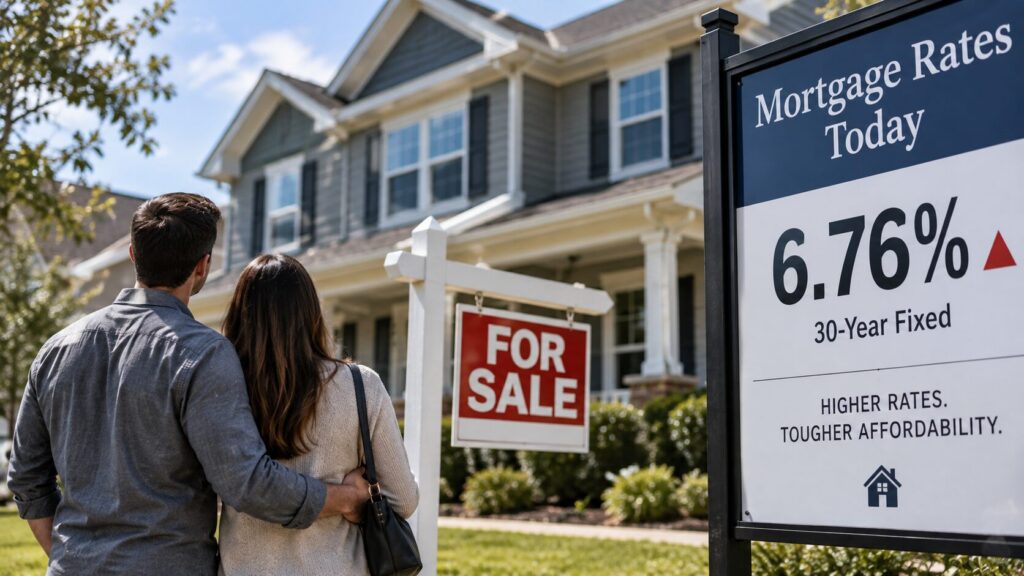
Mortgage rates have moved back toward—and in parts of the market above—7%, forcing prospective buyers to choose between larger monthly payments, smaller homes or delaying a purchase altogether.
Freddie Mac’s most recently published weekly survey put the average 30-year fixed mortgage at 6.76% as of Sept. 10, up from 6.71% one week earlier and the highest level in more than 14 months. Its average 15-year fixed rate stood at 6.09%.
More immediate market measurements were higher Thursday. Bankrate’s national average for a 30-year mortgage reached approximately 7.06%, showing how quickly lender pricing has moved since Freddie Mac collected the applications used in its weekly survey.
The difference between the two figures does not mean one is wrong. Freddie Mac’s survey is based on mortgage applications submitted by lenders and provides a standardized weekly benchmark. Daily market averages use different lenders, assumptions and collection times. An individual borrower’s quote will also depend on credit score, down payment, property type, loan size and whether points are paid upfront.
The affordability effect is substantial. Principal and interest on a $400,000, 30-year mortgage would be approximately $2,398 a month at 6%. At 6.76%, that payment rises to about $2,597—an increase of $199 a month, or nearly $2,400 annually.
At 7.06%, the monthly payment would climb to approximately $2,677, about $279 more than at 6%. Those calculations exclude property taxes, homeowners insurance, mortgage insurance, association fees and other ownership costs.
Higher rates also reduce purchasing power. Because lenders evaluate how much of a borrower’s income is required for monthly debt payments, a higher mortgage rate can lower the loan amount for which the buyer qualifies. A household may need a larger down payment, a less expensive property or additional income to purchase the same home.
Mortgage rates are not directly controlled by the Federal Reserve’s short-term benchmark. They are influenced more heavily by the 10-year Treasury yield and the returns investors demand for buying mortgage-backed securities.
The 10-year Treasury yield recently crossed 5% before easing slightly, reflecting concern about inflation, higher oil prices, federal borrowing and the possibility that interest rates will remain elevated. When investors demand higher yields from government bonds, lenders generally must offer higher mortgage rates to attract buyers for mortgage-backed securities.
The Fed’s quarter-point rate increase this week can still affect the housing market indirectly. A central bank determined to keep monetary policy tight can push investors to expect higher rates for longer, while renewed inflation pressure can lift both Treasury and mortgage yields.
Existing homeowners with fixed-rate mortgages are protected from the increase. Their contractual rates and payments do not change when current market rates rise.
That protection contributes to the housing market’s “lock-in” problem. Nearly half of outstanding mortgages carried rates of 4% or less during the first quarter of 2026, according to National Association of Realtors data cited by The Associated Press. Almost one-fifth were at 3% or below.
Owners with those loans may hesitate to sell because buying another property could require replacing a 3% or 4% mortgage with one near 7%. The result is fewer existing homes for sale, reduced transaction volume for real-estate agents and mortgage lenders, and continued inventory pressure in some markets.
Buyers, meanwhile, are pulling back. Pending home sales rose 0.3% in August but remained 4.7% below their year-earlier level. Contract signings were roughly 30% below their pre-pandemic pace, according to the National Association of Realtors.
Builders may benefit when the shortage of existing listings pushes buyers toward newly constructed homes. Even that market faces limits, however, because developers must contend with higher construction financing costs while buyers struggle to qualify for mortgages.
The next direction for mortgage rates will depend heavily on Treasury yields, inflation and investor demand for mortgage-backed securities. Cooling energy prices or weaker economic data could pull yields lower. Persistent inflation, heavy government borrowing or additional Fed tightening could keep rates near—or above—7%.
For buyers who remain in the market, comparing multiple lenders can be increasingly important. Rates, fees and discount-point options can vary meaningfully, and a lower advertised rate may require thousands of dollars in upfront charges. Buyers should compare the annual percentage rate and total closing costs, not just the headline mortgage rate.
JBizNews Desk | Wall Street
© JBizNews.com. All rights reserved. This article is original reporting by JBizNews Desk. Unauthorized reproduction or redistribution is strictly prohibited.