
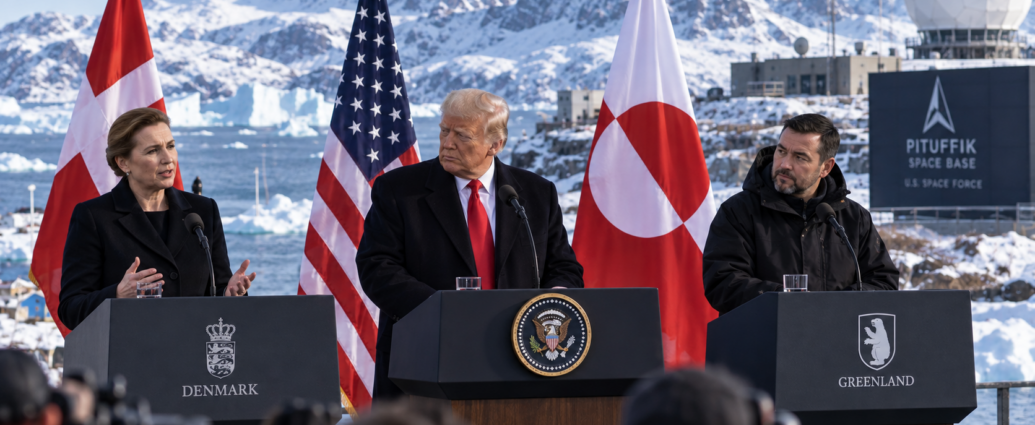
The United States, Denmark and Greenland are preparing to sign a new Arctic security agreement that would expand America’s military role on Greenland without transferring sovereignty over the island, easing a confrontation that earlier this year raised extraordinary questions about the future of NATO.
The agreement marks a dramatic shift from the dispute that erupted after President Donald Trump repeatedly pushed for the United States to acquire Greenland and declined to rule out military force.
Greenland is a self-governing territory within the Kingdom of Denmark, making Trump’s earlier threats particularly significant because Denmark is a NATO ally.
Danish Prime Minister Mette Frederiksen warned in January that an American military attack on another NATO member would undermine the foundations of the alliance.
“If the United States chooses to attack another NATO country militarily, then everything stops,” Frederiksen told Danish broadcaster TV2 at the time, including the security framework NATO has provided since the end of World War II.
The confrontation never reached that point.
Instead, months of negotiations have produced an agreement that appears to give Washington much of the expanded security access it wanted while preserving Danish sovereignty and Greenlanders’ right to determine their own future.
No Transfer of Greenland
That distinction is central to the deal.
The Danish Prime Minister’s Office said the agreement will strengthen security across Greenland, the Arctic and the North Atlantic while recognizing “the sovereignty and territorial integrity of the Kingdom and the Greenlandic people’s right to self-determination.”
Greenland Prime Minister Jens-Frederik Nielsen similarly said the agreement recognizes Greenland’s interests and position in international cooperation.
President Trump has described the arrangement differently, saying it gives the United States permanent control over security in Greenland.
Those descriptions do not necessarily mean the United States is receiving sovereignty over the territory.
Denmark and Greenland have been explicit that the agreement does not transfer ownership of Greenland to Washington.
That gives each side something it had sought throughout the negotiations.
Washington gets a stronger security position in one of the world’s most strategically important Arctic locations.
Denmark retains sovereignty.
Greenland retains its right to self-determination.
And NATO avoids the extraordinary scenario of its most powerful member attempting to seize territory belonging to another member.
Why Greenland Matters to America
The U.S. military already has a major foothold in Greenland.
Pituffik Space Base in northwestern Greenland plays an important role in missile warning, missile defense and space surveillance.
The United States has operated militarily on the island for decades under a defense agreement dating to 1951.
But Greenland’s importance is growing.
Its location between North America and Europe makes the island strategically valuable for detecting missiles approaching the United States across the Arctic and for monitoring increasing military activity in the region.
Russia maintains a substantial Arctic military presence, while Western governments have also expressed concern about China’s long-term strategic ambitions in the region.
The new agreement is intended to prevent adversaries from establishing military footholds in Greenland while allowing the United States to expand its presence.
NATO Welcomes Arctic Cooperation
The agreement arrives as NATO is increasing its own attention to the Arctic and North Atlantic.
NATO’s senior military leadership met in Copenhagen this weekend for the alliance’s annual Military Committee Conference.
Admiral Giuseppe Cavo Dragone, chairman of NATO’s Military Committee, emphasized the alliance’s focus on strengthening collective deterrence and defense amid Russian military activity and other security threats.
NATO said its 32 chiefs of defense discussed readiness, military capabilities, technology and strengthening the alliance’s ability to defend the Euro-Atlantic region.
“NATO remains vigilant. NATO remains ready,” Cavo Dragone said following the meetings.
The Greenland agreement fits into that broader push by strengthening Western military access to a region that is becoming increasingly important to both North American and European security.
A Business Risk Begins to Recede
The significance extends beyond defense.
The earlier Greenland confrontation threatened to spill directly into trade.
Trump had threatened tariffs against European countries opposing his effort to acquire the island, creating another potential source of instability for businesses already navigating changing trade policies.
A serious rupture between Washington and Copenhagen also risked creating broader political uncertainty inside NATO and across the transatlantic relationship.
That matters economically because the United States and European Union maintain one of the world’s largest trade and investment relationships.
Companies make investment, hiring and supply-chain decisions years in advance. The possibility of escalating tariffs or a fundamental breakdown in U.S.-European security relations adds another layer of uncertainty to those calculations.
The Greenland agreement reduces that particular risk, although it does not eliminate the broader trade disputes between Washington and Europe.
Minerals Remain Another Prize
Greenland’s economic importance could also grow.
The island contains deposits of rare earth elements and other critical minerals used in defense systems, electronics, electric vehicles and advanced technologies.
Western governments have been trying to build supply chains outside China, which dominates the processing of many strategically important minerals.
Expanded U.S. security involvement could therefore be followed by greater American and allied interest in Greenland’s mining, infrastructure and energy sectors.
But developing those resources will not be easy.
Greenland has a harsh climate, limited infrastructure and high development costs. Having minerals underground does not automatically make them commercially viable.
Any major expansion of mining would require substantial investment as well as approval under Greenland’s own political and regulatory system.
Agreement Still Isn’t Final
Despite the diplomatic breakthrough, the agreement is not yet legally in force.
The governments of Greenland, Denmark and the United States are expected to sign it during the United Nations General Assembly in New York.
After that, the agreement will take effect only after the necessary national parliamentary procedures are completed, according to the Danish Prime Minister’s Office.
Important details also remain unknown because the complete text has not been publicly released.
Those include the exact scale of additional U.S. military deployments, where new facilities could be located, how investment restrictions will operate and how an expanded American military presence will be financed.
Trump has said the arrangement will come at no cost to the United States, but there is not yet enough publicly available information to determine the eventual expense of additional military infrastructure or personnel.
The agreement therefore does not close every question surrounding Greenland.
What it does appear to accomplish is something that seemed far less certain earlier this year: moving a territorial confrontation between NATO allies back into a negotiated security framework.
For Denmark and Greenland, that means preserving sovereignty and self-determination.
For Washington, it means expanded strategic access to Greenland.
And for NATO, it removes — at least for now — one of the most unusual internal disputes the alliance has faced in decades.
JBizNews Desk | Copenhagen, Denmark
© JBizNews.com All Rights Reserved. Reproduction or distribution without written permission is prohibited.




