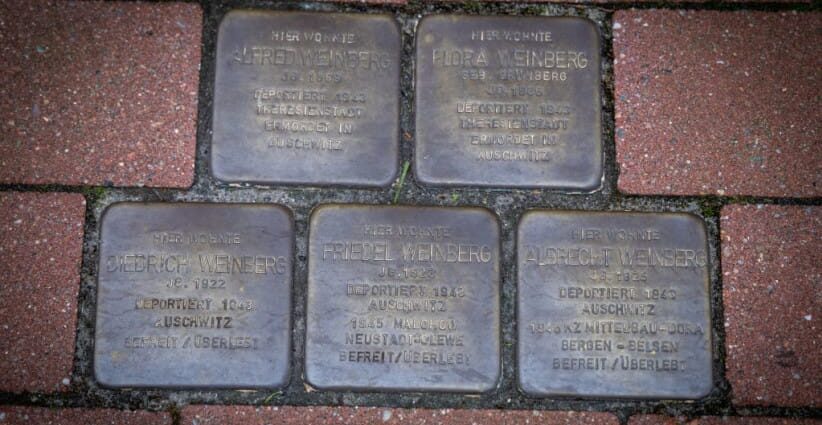
The city council of Heidenau, in the German state of Saxony, voted on Thursday to no longer permit new Stolpersteine memorial stones to be placed on the city’s streets and sidewalks in memory of Jews and other victims of the Nazi regime.
The motion passed in a secret ballot, with 13 council members voting in favor, six opposed, and one abstaining. It was jointly submitted by representatives of the right-wing Christian Democratic Union (CDU) and Alternative for Germany (AfD), together with representatives of the “Oberelbe Alliance for More Democracy.”
German artist Gunter Demnig launched the Stolpersteine, or “stumbling stones,” project in the 1990s, and it has become one of the world’s largest decentralized memorial projects.
The small brass plaques are generally embedded in the pavement outside the former home or last workplace of a person persecuted or murdered by the Nazis. Each bears the individual’s name and details of their fate.
Under the resolution, applications to install new Stolpersteine “in public streets and sidewalks” will now be rejected. Instead, supporters of the measure want memorials to Nazi victims concentrated at a commemorative site in the city’s Northern Cemetery, where people would not walk over the memorial plaques.
Those behind the proposal argued that residents, relatives of victims and various memorial initiatives no longer regard Stolpersteine as an appropriate form of remembrance, in part because passersby step on the names of those who were murdered and persecuted.
City administration recommends rejection of proposal against Holocaust memorials
The city administration recommended that council members reject the proposal, arguing that commemoration should remain “visible and present in public space.”
Five Stolpersteine have already been installed in Heidenau, a town near Dresden. The first was placed outside the town hall in 2021 to remember Paul Gröger, Heidenau’s first mayor.
Gröger was removed from office after the Nazis came to power, arrested in June 1933, and sent to the Hohnstein concentration camp, where he was severely abused. Shortly after his release, on August 27, 1933, he took his own life.
Other stones in the city commemorate members of the Jewish Reiner family and were installed following an initiative by students. Local activists have sought in recent years to expand the project to commemorate additional victims, including Martha and Fritz Goldstein.
They submitted a request to the municipality as early as February 2025, with the organizers offering to finance both the stones and the installation costs.
International Auschwitz Committee denounces motion against Stolpersteine
The decision prompted sharp criticism. The International Auschwitz Committee described it as an attempt to once again push the victims of the Nazis out of the city center and particularly criticized the cooperation between CDU and AfD representatives on the issue.
The March of the Living organization said that the decision served as a “grave warning sign.
“These stones confront passersby with the atrocities committed by the Germans – the Nazis – at the very sites where they occurred; blocking their installation sacrifices historical truth for the sake of political interests.”
They also called the decision “a grave injustice – an act of erasure that compounds the crime of extermination.”
March of the Living urged Heidenau to retract the decision.
Opposition to the use of Stolpersteine, however, is not unique to Heidenau. Munich also does not permit them to be installed on public property, in part because of the position of Charlotte Knobloch, president of the city’s Jewish community, who has argued that it is inappropriate for the names of those murdered by the Nazis to be placed where people walk over them.
Jerusalem Post Staff contributed to this report.