Michael Feuerstein, a Jerusalem psychologist who has done 400 days of reserve duty in Lebanon and Gaza and this week left for another 500 days – this time in Syria – is an unusual and very sensitive person.
Stopping off for a few minutes at the capital’s Malha Mall after the first bout of 100 days in places of destruction and death, he saw Israelis laughing, eating, and buying.
“I returned home, but I had not truly come home,” he told the Magazine in a long interview. “I was plunged into a feeling of strangeness, with a gap between me and other people. I didn’t understand what happened to me. I didn’t understand what people were doing. I felt like an alien from space. I went home, and I cried – even though no combat soldiers I knew had been killed in battle. I couldn’t look my wife in the eyes. I wondered: ‘Am I crazy, am I imagining?’ Men are taught not to show weakness.
“Understanding did not come clearly or all at once. It arrived slowly, in fragments, always accompanied by questions: ‘Did it really happen? Why are you exaggerating? Are you the only one who feels this way?’”
On the battlefield, everything appeared to him to be under control. “We carried out our missions. We maintained our friendships, our smiles, and our humor. But beneath that surface, other experiences continued to emerge: images of destruction and devastation, feelings of terror, annihilation, and loss,” he recalled.
His next birthday will come after the High Holy Days. Being in Syria, it will be “the fourth time in a row that I’ll miss celebrating it at home. I’ll also vote on October 27 from there.”
Asked if he thought about his own possible death in battle, Feuerstein said he did. “We have ammunition, but in war, most of the threats are explosions, artillery. There is nothing that really protects you. We went through minefields. Soldiers understand the statistics. Ninety-nine percent of the time I wasn’t afraid, but I felt a ‘little death’ when I returned.”
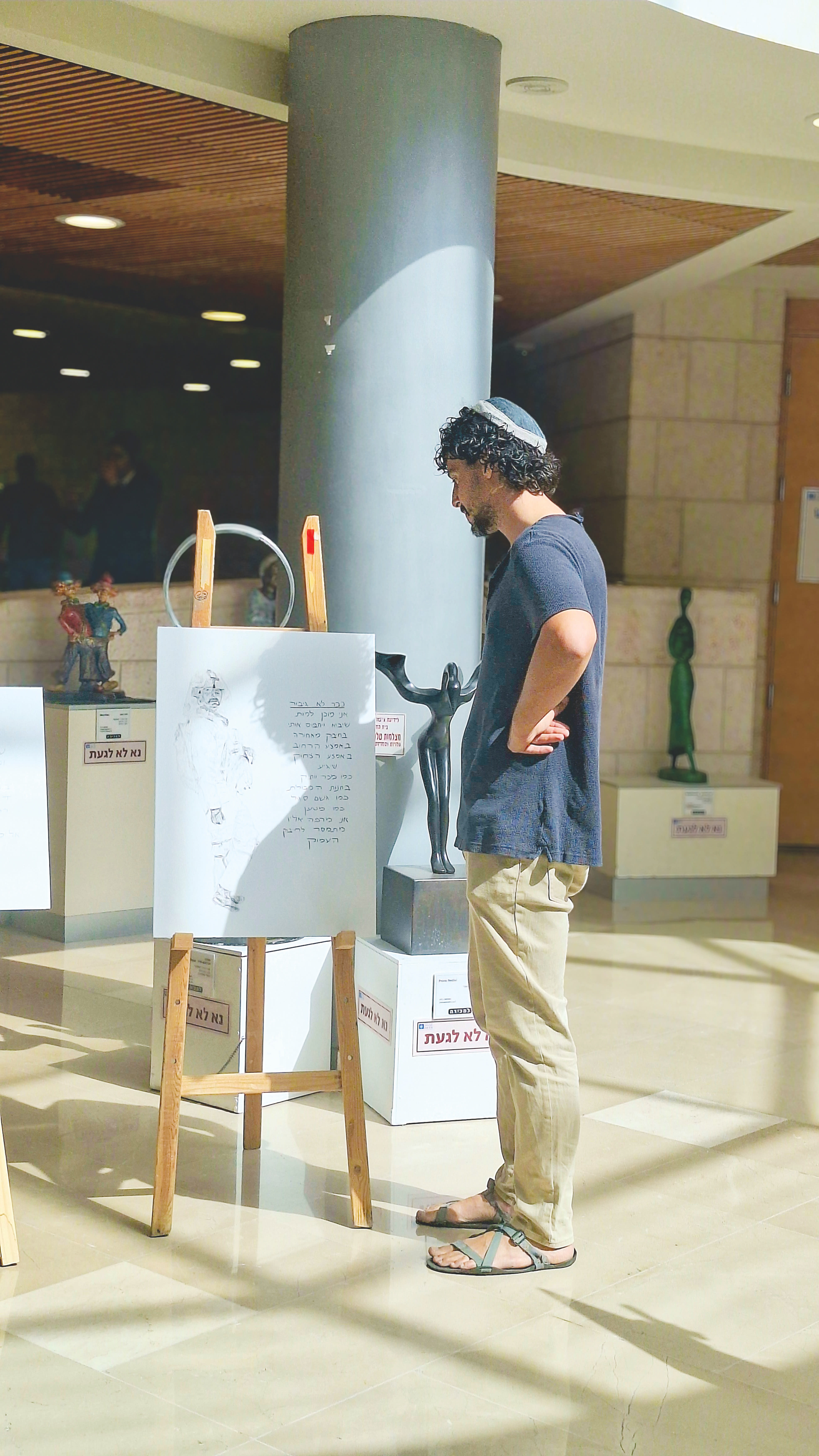
“I really couldn’t explain it in words, so I decided to create an exhibition entitled From the battlefield to home, an intimate journey, comprised of texts, poems, and images. The exhibition gives visual and emotional form to this journey – from war to home, from silence to expression, from fragmentation toward reconstruction, and from pain toward the possibility of healing. The book and the exhibition are dedicated to them – and to all those who have lost what was most precious to them on the battlefields.”
It has already been presented in a variety of medical, academic, therapeutic, and community settings in Israel, including the lobby of the Hadassah-University Medical Center in Ein Kerem and the University of Haifa. On Monday, September 28, at 6:30 p.m., it will be presented in the sukkah booth of the Feuerstein Institute at 17 Diskin Street, Jerusalem.
FEUERSTEIN IS the grandson of the late, world-renowned developmental psychologist and Israel Prize winner Prof. Reuven Feuerstein, who was acclaimed around the world for the clinical methodologies he pioneered – Structural Cognitive Modifiability (SCM) and Mediated Learning Experience (MLE).
In 1965, the senior Feuerstein established a research unit to process data from his historic psychological work with young Holocaust survivors and mass immigrant populations. These techniques continue to be used to treat children with neurodevelopmental conditions such as Down syndrome and autism, as well as adults recovering from traumatic brain injuries and post-traumatic stress disorder (PTSD).
He is the son of Dr. Rabbi Refael (Rafi) Feuerstein, who is today president of Jerusalem’s Feuerstein Institute, where he directs the mission and focus of the organization’s work. Rafi holds degrees in psychology and philosophy from the Hebrew University of Jerusalem and earned his doctorate in psychology from Paris V University. Since 1993, he has been a valuable member of the Feuerstein Institute staff, specializing in cognitive-dynamic assessment.
A psychologist at the Feuerstein Institute while doing his specialist work at Hadassah-University Medical Center in Ein Kerem, Michael is married to Margalit, who works in teaching dance and informal education, and is the father of three children aged nine, six, and 18 months. His sister, Chava Dardik, also works at the institute as an occupational therapist and oversees its five rehabilitation centers around the country, working closely with people dealing with PTSD and the transition back to life after combat.
“These centers, financed by the Defense Ministry and the National Insurance Institute, are caring for 230 men and women. They are mostly young families with small children. Many institutions have sprouted up since October 7, but many still feel it’s hard for them to function,” Dardik explained.
“Our aim is to help them return to normal functioning. It’s not enough to just take young kids to kindergarten. Some complain they don’t interact with them. Our program is multidisciplinary, combining physical and emotional rehabilitation, dealing with trauma. We use the Feuerstein techniques of planning, being organized, and flexible, and not being impulsive. Those who want to study are helped. They are with us for a whole year, two or three times a week for four hours each time. We even use dogs as animal therapy to calm them down.”
Thus, the family legacy and professional history are deeply intertwined across generations, spanning groundbreaking work in cognitive psychology.
“I had a month after returning when I created more and more, but I thought I’d save it in a drawer at home. Later, I sat with my sisters. They were worried about me, that I was different. They came to encourage me. I brought a collection of what I had written and showed it to them. They were shocked – so I realized that publicizing it at an exhibition would help me heal,” Feuerstein recalled.
“I have a young brother in the regular army who is going to Lebanon. My wife has six brothers and brothers-in-law who are also going. As a result of spending the High Holy Days in Syria and continuing through December, it will probably take me about two months to get better. I went to a private psychologist for counseling who himself served in the Second Lebanon War. He understood me, and I felt better.”
Asked whether he mourned not only Israelis who were murdered and killed since Oct. 7, 2023, but also children, women, and men who were not involved in Hamas terror, Feuerstein said: “Yes. It’s all very violent. We did things we had to do. We had to decide in seconds whether to kill a terrorist who endangers you. It’s justified. But you are like a god who decides who will live or die.
“Suddenly, there are no clear borders of what’s right or wrong. Everything is black and white there. You sit in a house in Gaza and know that in a few minutes, I will destroy it. In one, I saw a heart-shaped pillow with a picture of a couple who had lived there. It takes a lot of effort to keep your own heart alive in such situations.”
As a psychologist, he didn’t feel he was supposed to cope better than other soldiers. “I am more sensitive. When we treat patients, we have to be a mirror for their pain. Most people who were there pushed it away.”
Feuerstein and his family are sure that he didn’t and doesn’t suffer from PTSD. “But my experiences have influenced my personality. I changed. At first, I couldn’t go to synagogue minyans, because I needed distance because of my feeling of being alone. I will miss the Shabbat, Rosh Hashanah, Yom Kippur, and Sukkot prayers, but there are not holidays on the battlefield. You don’t feel them, and somebody has to protect Israel even on holy days.”
‘The exhibition helped me to be understood, to tell my story’
ASKED WHAT IMAGE in the exhibition was most meaningful for him, he said: “Drawings, like one in which I lie in sand. They came before words. It was dissociation, like Rabbi Shimon, after Bar Kochba’s revolt, who remained in a cave for a year or two. I am very private and shy. My family wanted to know what happened to me as a result of the battlefield, and since I couldn’t explain it to them, the exhibition helped me to be understood, to tell my story.”
In this sense, “art became a form of archaeology – bringing to the surface experiences that had no name and no recognized place. It was a process of excavating from the depths of the psyche, from the very fabric of the body, words and images that had been buried there, and slowly attempting to reconstruct them on the page.”
The exhibition was born out of a need to give words and images to the experience of war and to the difficult journey home. “Through the creative process, I was able to approach and touch the most delicate materials of the psyche. What my body and mind were telling me was profoundly different from the narrative I had experienced during the events themselves.”
A very powerful image and symbol was the bulldozer, “because in a few hours, in a sea of destruction, we had to clear everything up.” So was the ceramic vest: “It is strong, but underneath there is a storm, so I felt I was dripping into the floor.”
Feuerstein knows that his endless reserve duty hurts his wife and children. “My connection with the kids is less, but if I’m called, I have to go. My soul won’t let me stay.”
His wife contributed poems to the exhibition. “She saw the pain; she paid the price. She has run our home for many months alone, and it hasn’t been easy for her. She asked me not to return to reserve duty. Through the reflection in her eyes, I rediscovered my own face. Her perspective completes the mirror, allowing another dimension of the experience to emerge and helping tell a fuller story – one that is not only about the person who went to war but also about those who waited for him to return.”
Feuerstein has a friend with whom he’s served together in reserve duty, who decided to stop because his family was hurt so much.
‘Why am I on the battlefield and they aren’t?’
When Feuerstein saw haredi young men near him after returning from battle, he felt angry. “It doesn’t do me any good. They won’t pay attention to me. But I see them in the street, and I want to yell at them. Why am I on the battlefield and they aren’t? They say they are responsible for miracles because of their religious studies. Maybe there were miracles, but not because they are in yeshiva.”
Despite all his experiences on the front lines, Feuerstein emerges with optimism and a positive outlook. “When I made room for the pain, allowing myself to touch it and even wallow in it, I discovered its healing power. I discovered how authentic life, hope, and joy are revealed, renewed, and capable of filling the heart. The pain and sorrow enabled me to deconstruct and process the fragments of reality, ultimately building a more complete and complex self.”■
The exhibition of Michael Feuerstein will be on view, free of charge, through Hol Hamoed Succot at the Feuerstein Institute, 47 Narkis Street, in Jerusalem’s Nahlaot neighborhood.