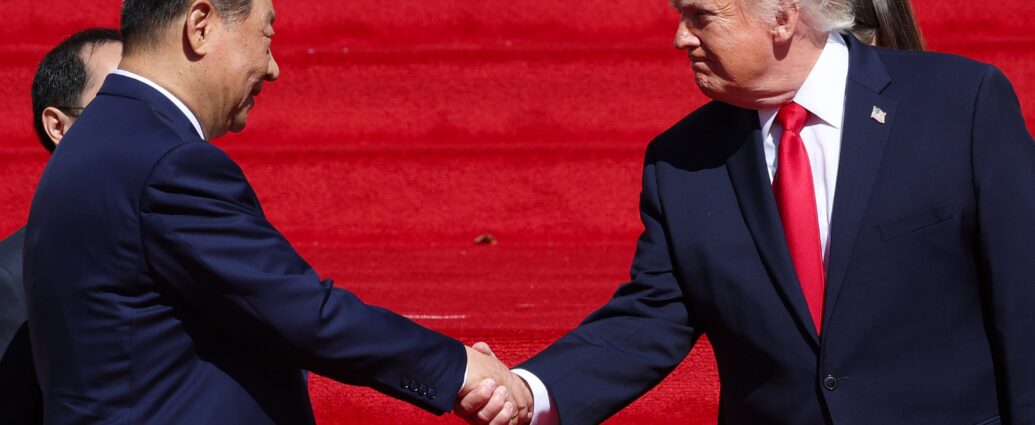
- In today’s CEO Daily: After the Trump-Xi dinner, the tough part begins.
- The big leadership story: OpenAI pauses training for a second time.
- The markets: Mixed globally as oil ticks up.
- Plus: All the news and watercooler chat from Fortune.
Good morning. My Scottish cousin extolled the virtues of his Chinese-made handset while visiting me in New York this weekend, arguing that my Apple iPhone can’t compete when it comes to on-device AI agents and integration. Maybe he’s right. It’s hard for me to know as U.S. carriers don’t sell or support most Chinese brands. U.S. consumers have been shielded from much of the innovation coming out of China. They can’t buy a car made by BYD, the world’s most popular EV maker with its bestselling Seagull starting at around $8,000. They can’t buy Chinese-made humanoid robots and pets or experience the seamless brand integration on a super app like WeChat.
There are many reasons for such product bans, including legitimate concerns about security, intellectual property theft and unfair competition because of state subsidies. But Chinese companies have also moved ahead of American competitors in key areas, making some U.S. CEOs and entrepreneurs now eager to tap their technologies, too. That’s worth keeping in mind when reflecting on the outcome of last week’s China-U.S. summit and apparent warmth between President Donald Trump and Chinese President Xi Jinping. Navigating the relationship between the two countries is complex, regardless of the tariff situation. Here’s why:
A deficit of trust. Concerns about Chinese IP theft are nothing new in Washington, but September brought two major escalations. Earlier this month, the Justice Department finally brought its landmark criminal case against Huawei Technologies to trial in a Brooklyn federal court, alleging the business was built on a two-decade “culture of crime” that stole from companies like T-Mobile, Cisco and Motorola. Also, on Sept. 9, the NSA, FBI, and CISA issued a joint advisory accusing six Chinese AI firms of “industrial-scale” theft of trade secrets from Anthropic, OpenAI, Google, and xAI, among others. That friction runs both ways. I’ve talked to several Chinese leaders who have told me that geopolitical uncertainty has made them less inclined to invest in the U.S. market. (China’s overseas investment was up 11% to $214 billion last year, second to the U.S. as a source of global capital, but direct investment to the U.S. fell 71% to $1.9 billion.)
The AI race. While both countries compete in manufacturing, energy, e-commerce and more, the highest stakes are in the realm of AI. There’s a reason why Nvidia’s Jensen Huang and AMD’s Lisa Su were seated at the head table of Trump’s state dinner for Xi, alongside Tim Cook and Elon Musk. All are impacted by tariffs and export controls. Seated nearby were Sam Altman of OpenAI and Meta’s Mark Zuckerberg, with Anthropic’s Dario Amodei conspicuously absent. Any debate about AI safety should include Chinese companies, especially as players like Alibaba have come out with powerful AI chips. China and the U.S. did agree to set up an AI safety channel, a move reminiscent of the Washington-Moscow hotline deployed during the Cold War to avert nuclear armageddon.
More positive views of China. Americans’ views of China are warming as the world’s view of America is getting colder. Washington’s “dumb trade war” with Canada prompted Prime Minister Mark Carney to get closer to China, letting BYD enter that market. More importantly, Chinese companies are winning business through the value and quality of their products, from entrepreneurs using DeepSeek to the 10 million small business users and wholesale buyers turning to Alibaba.com and its AI-powered Accio Work platform to grow their business. “Our mission is to make it easy to do business anywhere,” Alibaba.com CEO Kuo Zhang told me earlier this month; achieving that means building trust as well as providing “flexible and agile support for their supply chains … tariffs are only one factor to consider.”
Contact CEO Daily via Diane Brady at diane.brady@fortune.com
This story was originally featured on Fortune.com