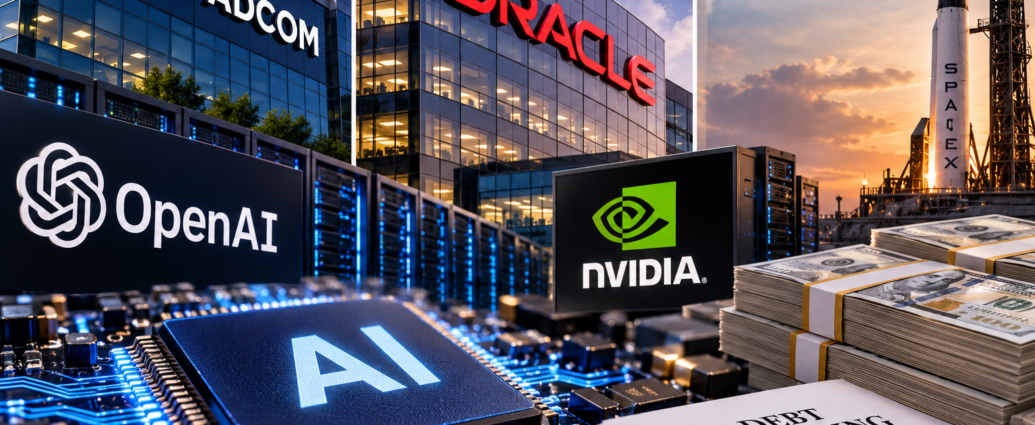
Three of the biggest players in artificial intelligence are lining up tens of billions of dollars in private loans to pay for computer chips, a sign that the AI building boom has grown too expensive for company cash and ordinary bond sales to cover on their own.
Broadcom is working to arrange more than $50 billion in financing for the custom AI chip it is developing with OpenAI. Oracle is in talks with Apollo Global Management and Goldman Sachs to fund a large chip purchase. And SpaceX is seeking about $40 billion to buy chips from Nvidia. The Broadcom and Oracle talks were first reported by the Wall Street Journal on Wednesday, while the SpaceX plan was first reported by the Financial Times. All three deals are at an early stage, and any of them could change in size or fall apart.
In plain terms, these companies want to buy enormous numbers of AI chips now and pay for them over time, much the way a family takes out a mortgage instead of paying cash for a house. The difference is the scale: each deal is worth more than the entire yearly economy of many small countries.
Broadcom’s financing would help pay for the chip it designs with OpenAI, the maker of ChatGPT. Apollo and Blackstone are among the lenders in talks to take part. The money could cover several gigawatts of computing capacity, enough to power some of the largest data centers ever built, and the deal could close as early as the end of this year. OpenAI and Broadcom have already announced plans for a custom chip system totaling 10 gigawatts, to be rolled out from the second half of 2026 through the end of 2029.
Oracle’s deal would work a little differently. Investors would likely fund a separate company that buys the chips, and Oracle would then rent them over time. That setup lets Oracle use the chips without piling more debt onto its own books as it competes with bigger, cash-rich rivals such as Amazon, Microsoft and Google. Oracle has already said it expects to raise $45 billion to $50 billion this year through a mix of debt and stock to build out its cloud business.
SpaceX’s plan calls for about $10 billion in bank loans and $30 billion in investment-grade debt, the kind sold to large institutional investors seeking steady returns. Apollo is expected to lead the deal, and bond giant PIMCO is among the investors looking at it. SpaceX, which absorbed Elon Musk’s AI company xAI earlier this year, runs large AI data centers in Memphis, Tenn., and has said it is working toward $100 billion in yearly recurring revenue by the end of 2026.
The common thread is a shift in who is paying for AI. For the past two years, tech giants mostly used their own profits and sold hundreds of billions of dollars in public bonds to fund data centers. Now the biggest buyers are turning to private lenders, the investment firms that make large loans directly to companies instead of selling bonds on the open market. Firms like Apollo, Blackstone and Goldman Sachs are quickly becoming central players in financing the AI race. Nvidia teamed up with six of these firms in August to create programs aimed at drawing more than $500 billion in outside money into AI infrastructure.
The problem these deals solve is simple. Demand for AI computing is growing faster than companies can build, and the chips are expensive and scarce. Companies that wait to save up cash risk falling behind. Borrowing lets them buy now and pay later out of the revenue the chips are expected to bring in.
The risk is just as simple. If AI revenue grows more slowly than expected, a wider group of lenders will be left holding the bag. And the timing is tough: the interest rate on the 10-year U.S. Treasury hit its highest level since 2002 on Wednesday, which pushes up borrowing costs for everyone, including these companies.
For everyday Americans, the effects are indirect but real. Many pension funds, insurance companies and retirement plans invest with private lenders like Apollo and Blackstone, so their returns are increasingly tied to how the AI boom plays out. And the giant tech stocks at the center of this spending make up a large share of the index funds inside millions of 401(k) accounts.
For now, the message from Wall Street is that the money is there. The question investors will be watching is whether the profits from AI arrive fast enough to pay it back.
JBizNews Desk | Wall Street
© JBizNews.com All Rights Reserved. Reproduction or distribution without written permission is prohibited.