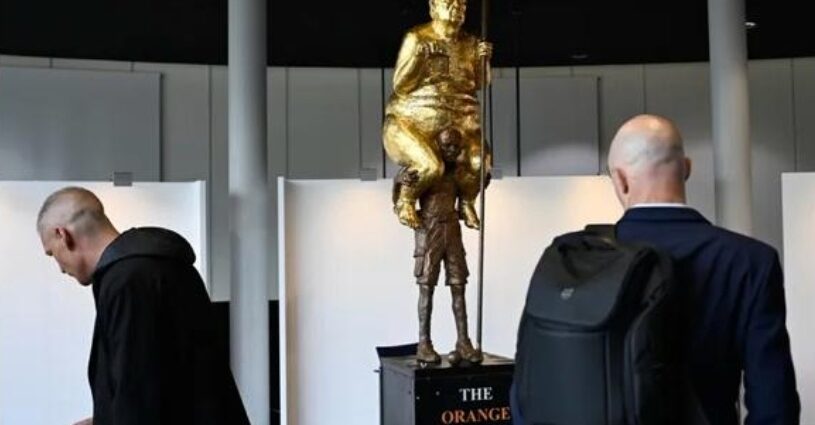
Slovak Prime Minister Robert Fico on Thursday demanded the immediate removal of a sculpture mocking President Donald Trump from the European Parliament’s building in Strasbourg, France. In an emailed statement, Fico said that insulting partners on official premises, at a time that calls for dialogue and respect, shows a failure to understand the moment.
The work is titled “The Orange Plague” and was made by Danish artist Jens Galschiøt. The gold-covered sculpture shows Trump sitting on the shoulders of a smaller man, holding a golf club and a set of scales. Danish lawmaker Per Clausen hosted the exhibit, and it went on display this week in a busy walkway connecting the parliament’s offices. It stands about eight feet tall.
Fico, posting on Facebook on Thursday, called the sculpture a sign of the European Union’s decline. He said he disagrees with many of Trump’s policies but argued that the bloc should not be insulting its international partners. He asked whether parliament officials would allow similar mocking sculptures of French President Emmanuel Macron or German Chancellor Friedrich Merz, and he called on European Parliament President Roberta Metsola to have the statue taken down right away.
The display split lawmakers. Clausen said Trump should be able to take the caricature in stride. Barbara Bonte, a Belgian lawmaker from the Flemish nationalist Vlaams Belang party, called it a disgrace to present a political statement as art. The traveling sculpture was a temporary exhibit and was scheduled to be removed Thursday, the same day Fico made his demand.
The flap lands at a sensitive moment for the money flowing between the United States and Europe. The two sides have the largest trade and investment relationship in the world, and they only recently finished putting a major trade deal into effect after nearly a year of delays.
Here is what that deal does in plain terms. Under the agreement struck in July 2025, the United States charges a tariff of no more than 15% on most goods coming in from Europe, or about $15 on every $100 of European products. In exchange, Europe dropped its tariffs on American industrial goods and opened its market wider to some U.S. farm and seafood products. European governments gave the deal final approval on June 25, 2026, ahead of a July 4 deadline Trump had set.
Getting there was rocky. Trump had threatened to raise tariffs on European cars to 25% from 15% if the bloc kept stalling, and warned of much higher tariffs on European goods if it missed the deadline. The holdup came after tensions over Trump’s threats toward Greenland and a U.S. Supreme Court ruling that struck down many of his tariffs.
The stakes for both sides are large. The United States buys about 1 out of every 5 dollars’ worth of goods Europe sells abroad. Trump has made shrinking America’s goods trade deficit with Europe, which tops $200 billion, a central goal of his tariff policy. For American manufacturers, the deal means their industrial goods now enter Europe without tariffs. For American shoppers and importers, it means a predictable 15% charge on most European products rather than the threat of higher ones.
Some pressure points remain unresolved. U.S. tariffs on European steel and aluminum still stand at 50%, and Europe kept the power to suspend the deal in part or in full if those are not lowered by the end of 2026. The agreement is also set to expire at the end of 2029 unless both sides renew it.
That is the backdrop for Fico’s message. Slovakia’s leader is arguing that Europe’s official institutions should be focused on keeping the relationship with Washington steady, not on putting up displays that provoke the American president. Europe’s own description of the trade deal makes the same basic case, saying it was designed to restore stability and predictability for businesses and citizens on both sides of the Atlantic.
The European Parliament had not publicly responded to Fico’s demand as of Thursday.
JBizNews Desk | Strasbourg, France
© JBizNews.com All Rights Reserved. Reproduction or distribution without written permission is prohibited.