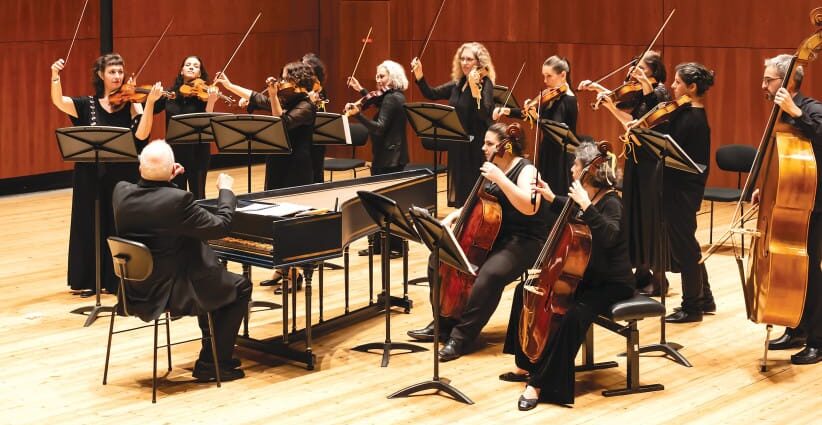
Orit Messer-Yaakobi is not one to moan and groan. Her sunny outlook was patently clear from the first cheery “hello” of our telephone chat ahead of this year’s Witches? Festival, which celebrates female movers and shakers in the classical music world. One can, of course, home in on egregious discrimination, inequality of pay and professional opportunities, and, more tragically, the continuing acts of violence perpetrated against women, but the cellist-conductor was more focused on the positive aspect of the female side of the musical domain across the ages.
The official blurb describes the fifth edition of the festival, which takes place at the YMCA and Hansen House October 16-17, thus: “A musical journey following women who made a difference in the world of music and culture, from medieval times, through ancient eras to 20th-century jazz.” The two-day agenda duly provides plenty of collateral for that gender-oriented claim.
The event was initiated by Jerusalem Baroque Orchestra (JBO) founder-conductor-artistic director David Shemer, with the JBO performing predominantly baroque scores. But the programming purview stretches into more contemporary and other cultural and philosophical spheres too.
Broader road to music appreciation
Messer-Yaakobi features in the curtain-raiser at Hansen House, on cello. The October 16 (11 a.m.) date goes by the evocative and eclectically-leaning name of “Daphnis and the Winds of Love: A Balkan Myth.” An instrumental trio, which also includes recorder player Doret Florentin and guitarist Gideon Bretler, complemented by the Hakdoshot vocal threesome, follows a broad stylistic arc from the realms of Greek mythology through to contemporary material, dipping into French Baroque music and folk melodies en route.
The JBO principal cellist is heavily invested both in the ensemble, of which she is a longtime member, and in the Witches? format. “I am very happy with the festival because it allows us to take an immersive approach to a particular subject,” she notes. “When you have a festival, which lasts just a few days, and you invite other ensembles to take part, that allows us to research and deeply explore a specific topic. We can address it from all sorts of perspectives, and that makes it very interesting and very daring.”
The latter attribute is not a feature one regularly associates with classical music in its wider sense. Artistic and musical directors tend to shy away from more challenging works from contemporary times which incorporate, say, atonal or electronic music. It is very much, particularly in these financially strapped cultural times, about putting bums on seats. That generally leads to programming that treads tried and tested areas, with crowd-pleasers by the likes of Beethoven, Tchaikovsky, Brahms, and Bach.
Messer-Yaakobi says that Witches? has always looked to flex strictly defined genre and stylistic delineations. “The repertoire we perform is not run-of-the-mill stuff. We don’t do the bestsellers – the Magnificat [by Bach] and such like. And we perform in beautiful locations and with very good ensembles.” Seems like a recipe for success, both on the stage and at the box office.
Celebrating female players in classical music domain
The core themes of the whole venture revolve around female composers and performers of classical music across the ages, with each annual agenda based on a more focused feature of that field of endeavor. “We had various themes,” the cellist recalls, “like fate, warrior women, and healing women. Then we had the [post-Oct. 7] war and, you know, things always resonate.”
That brought us neatly around to this year’s thematic linchpin, Echo. Messer-Yaakobi says the programming mindset, for this edition, followed a far more positive planning ethos. “In past years, the festival was generally about women whose voices were suppressed or were pushed aside. Specifically, this year it is about women whose presence and deeds changed the face of music.”
That sounds like a refreshing proactive line to follow. “Each concert takes a different approach – either about women with initiative, women who wrote and performed their music, or patrons or muses, or heroines. It is very fascinating and, I think, very liberating, relieving.”
The accent is very much on upbeat vibes. “This year we are not looking at women who were not heard, so then we’ll have the festival,” the cellist proclaims in a faux weepy voice. Determined philosophy notwithstanding, this is not an under-the-carpet sweeping exercise. “Things are tough enough for women now, [in the classical music arena], and it was much tougher back in the 17th century,” Messer-Yaakobi continues.
Barbara Strozzi is a striking case in point. Not only did she have the “temerity” as a woman to write music, and that despite being the illegitimate child of a servant, her works were duly lauded in 17th-century Venice, with Strozzi performing her own charts as vocalist. Her stellar contributions are noted in the “Virtuosissima cantatrice” concert at the YMCA on October 17 (1:30 p.m.). The Italian show title translates as “the most virtuoso female singer,” which, by all reports, is a fair description of Strozzi’s musical performance abilities. The vocalist spot for the Witches? recital will be taken by soprano Daniela Skorka, supported by violinist Kati Debretzeni, with Shemer on harpsichord.
Strozzi was, it seems, a fearless character who let no social mores or political tenets of the day stand between her and getting the fruits of her artistic labors out there to the public. “She is one of the few female composers who had their scores printed. She operated out of Venice, from a very male-dominated society, and she was very highly regarded,” Messer-Yaakobi advises. “She also ran a very important music salon. But she was exceptional.”
That fits this year’s line of programming thought. “We have presented numerous works by female composers and musicians who were marginalized, but this year that’s not the case. This year the festival is very powerful.”
It is, the cellist simply states, about the music. “There is no intent on righting the situation [vis-à-vis sexual discrimination]. We want to give women their place without the [politically-oriented] crutches. If you look at the concerts, you see that each ensemble, with its program, offers something very interesting. And the gender is of no importance. It is just by chance that the composer is a woman [with regard to the quality of the work in question].”
Messer-Yaakobi proceeds to proffer the evidence for that level playing field strategy in the two-day agenda. “There is the “A Woman’s Song” recital that addresses love, motherhood, and war and peace. That is a triangle that can convey a universal historic passage.” The program comprises texts presented by female characters, at times a mythological or religious figure, or a mother, and other times a basic, clear human call. The voices resonating from the texts are woven into a single storyline that is personal yet universal, historical yet, as we painfully know, more relevant than ever today.
As per Messer-Yaakobi’s claim of eclecticism, the titillatingly titled “High Heels” show, at the YMCA on October 16 (10 p.m.), should have the audience members appreciating the onstage action in a more animated manner. “That is something cute with a very different color,” she chuckles. “They will play swing music from the 1940s and 1950s.” That shuffles the sonic festival pack. “It will bring a different color, and celebrate the music. You don’t always have to play intricate heavy material. You can just enjoy life,” she laughs.
It is also highly likely that the folks who make it over to the YMCA for the outdoor gig, in the YMCA Arcade, should by then be in a suitable frame of mind to make the most of the energized entertainment. “It is scheduled for the end of the first day, when anything goes.” The lineup for the fun run out includes three female vocalists and a piano-led jazz trio.
The women behind the celebrities
The second day opens with a reminder – or eye-opener – of how much poorer the classical music world would be without female contributors, in all walks of musical life.
The 11 a.m. “Vienna-Weimar-Siberia: A Journey with Musical Women” slot, at the YMCA, asks the simple and, no doubt, for some of more conservative, narrow minds, provocative question: What would classical music look like without the women who worked behind the scenes as students, patrons, musicians, and salon hosts? The Israeli Romantic Ensemble foursome, led by Gili Rinot on clarinet, will perform works by the likes of Mozart, Mendelssohn, and Bach. One of the former’s star students was a certain Franziska von Jacquin, one of quite a few female disciples of the feted Austrian composer. It seems he was particularly taken with von Jacquin, both for her talent and her diligence, and composed his Piano Sonata No. 14 and Fantasia in C minor with her in mind.
His early student register included one Thérèse von Trattner who, in fact, kept the then young composer, recently arrived in Vienna from his native Salzburg, financially afloat. She also provided him with accommodation, spread the word about him, and organized subscription concerts of his music in the imperial capital in 1784. The program for those groundbreaking events included Mozart’s Piano Concertos Nos. 14, 15, and 16, and provided him with a firm foothold in the Viennese artistic and hierarchical social domains.
Other women who get a well-deserved salute at the morning concert include German Jewish philanthropist Sara Levy, who was also the great-aunt of Mendelssohn and duly supported his writing efforts, and pioneering female French cellist Lise Cristiani, whose musicianship prompted Mendelssohn to dedicate a slot in his Songs Without Words series to her. “This is a fascinating story of women who changed the history of music,” the festival textual backdrop declares.
There is a nod to biblical climes with “The Golden Apple” concert, with the Nari Ensemble quartet of soprano Liron Givoni accompanied by recorder player Naomi Hasson, cellist Yotam Haran, and harpsichord player Guy Pardo. The Garden of Edenesque storyline subtext features an angel and a man who sets out in search of the woman worthy of receiving a golden apple and bringing the mother of Jesus into the world. En route, they encounter biblical heroines, from Eve to Esther, each of whom is portrayed musically in Baroque works from Bohemia, Italy, England, and Germany. That multilayered sequence creates a compelling musical-theatrical performance in which story and music shed new light on the iconic characters.
Straddling the gender divide
The whole Witches? shebang comes to a climactic end with the closer at the YMCA, at 8:30 p.m. on October 17. The JBO will take the stage with all guns firing for the Cleopatra and Giulio show. Mezzo-soprano Shaked Bar performs the titular royal role, which, considering the fabled Egyptian ruler inspired numerous composers of the Baroque era, is a neat thematic fit. The chap in the concert moniker is better known around the English-speaking world as Julius Caesar, and Bar and the orchestra will perform works by Handel, 18th-century German composer and singer Johann Adolph Hasse, 17th-century Venetian composer Antonio Sartorio, and 18th-century German composer and singer Carl Heinrich Graun. The virtuosic and intimate arias will unpack the romantic relationship between the two fabled protagonists, with Bar navigating her way across demanding bifurcated female-male bridges as she moves between the two characters.
“The grand finale has the whole [JBO] ensemble, as opposed to the other, chamber orchestra-based, concerts,” Messer-Yaakobi notes. The latter approach, she says, adds charm and a welcoming ambiance to the whole program. “When the orchestra organizes a festival, it makes sure to invite outside artists and ensembles. Some of the artists appear with us in the long run but, in fact, these are ensembles that propose programs and the JBO hosts them. That, for me, is wonderful.”
It also offers the paying public a greater breadth of performance styles while keeping the whole Witches? venture fresh and intriguing. “There are all sorts of festivals whereby the host orchestra performs the majority of the concerts,” the principal cellist adds. “With us it is very varied. That is why the festival is so colorful and rich.” That philosophy, she feels, offers across-the-board benefits. “That puts the baroque orchestra in a special place in the [music] scene.”
With its purely sunny affirming take on women’s part in the musical timeline, it is to be hoped that the current Witches? roll out helps to right the male-skewed view of classical music per se, and may even lead to the discovery, by professionals and the public alike, of more hidden, talented and, no doubt, determined female artists.
For tickets and more information:
jbo.co.il/en/festivals/witches-
festival-2026-echo/